If you run a company in India, the CIN number is one identifier you cannot ignore. CIN's full form is Corporate Identification Number, a unique code that acts as your company's official identity. It is allotted by the Registrar of Companies (ROC) at the time of incorporation and remains linked to your company throughout its existence.
You will need it for filings, invoices, and verification checks. Clients, investors, and government bodies use it to confirm that your company is genuine and properly registered. This guide walks you through what a CIN number is, how it is structured, how to find it, and the common errors to avoid when you use it.
What Is the Full Form and Meaning of the CIN Number?
As mentioned earlier, the full form of CIN is Corporate Identification Number. It's a unique 21-character alphanumeric code assigned by the Registrar of Companies (RoC) to every company registered in India. Think of it as your company's fingerprint – distinct and essential for official identification.
Why Knowing Your CIN Number Matters
The importance of the CIN number cannot be overstated. It serves as your company's official identity in all legal and financial documents. Without it, you can't complete essential tasks like filing annual returns or opening business bank accounts. In essence, the CIN number is your company's passport in the corporate world.
Breaking Down the Structure of CIN
The CIN number format consists of 21 characters, each segment providing specific information about your company:
- Listing Status (1st character): 'L' for listed companies, 'U' for unlisted.
- Industry Code (next 5 characters): Represents the company's economic activity.
- State Code (next 2 characters): Depicts the state in which the company is registered.
- Year of Incorporation (next 4 characters): Reflects the year the company was established.
- Ownership Type (next 3 characters): Indicates the type of company, such as 'PLC' for Public Limited Company.
- Registration Number (last 6 characters): A unique number assigned by the RoC.
For example, a CIN like U12345MH2000PLC123456 breaks down as follows:
- U: Unlisted company
- 12345: Industry code
- MH: Maharashtra
- 2000: Year of incorporation
- PLC: Public Limited Company
- 123456: Unique registration number
Example of a CIN Number
A CIN number example makes the structure easier to follow. Take the sample CIN number format U12345MH2020PTC123456 and read it segment by segment. Each part tells you something specific about the company.
Here is how this Corporate Identification Number example breaks down:
|
Segment
|
Value
|
What It Means
|
|
Listing status
|
U
|
Unlisted company
|
|
Industry code
|
12345
|
Economic activity of the company
|
|
State code
|
MH
|
Registered in Maharashtra
|
|
Year of incorporation
|
2020
|
Registered in 2020
|
|
Ownership type
|
PTC
|
Private Limited Company
|
|
Registration number
|
123456
|
Unique number from the ROC
|
Who Is Issued a CIN?
The Corporate Identification Number is assigned to various types of companies registered in India, including:
- Private Limited Companies (PVT)
- Public Limited Companies (PLC)
- One Person Companies (OPC)
- Unlisted Limited Liability (ULLs)
- State Government Companies (SGCs)
Difference Between CIN, DIN & LLPIN
People often mix up CIN with two other identifiers issued under the Ministry of Corporate Affairs (MCA): DIN and LLPIN. Each serves a different purpose. Understanding CIN vs DIN and CIN vs LLPIN helps you quote the right number on the right document.
|
Identifier
|
Full Form
|
Assigned To
|
Format
|
|
CIN
|
Corporate Identification Number
|
Companies registered with the ROC
|
21-character alphanumeric code
|
|
DIN
|
Director Identification Number
|
Individual directors of a company
|
8-digit number
|
|
LLPIN
|
Limited Liability Partnership Identification Number
|
Limited Liability Partnerships
|
7-character alphanumeric code
|
Usage of CIN
Your company's CIN must be mentioned on several official documents, including:
- Invoices and receipts
- Notices and memos
- Letterheads
- Annual reports and audits
- E-forms submitted to the Ministry of Corporate Affairs (MCA)
- The company's official publications
How to Apply for a CIN Number?
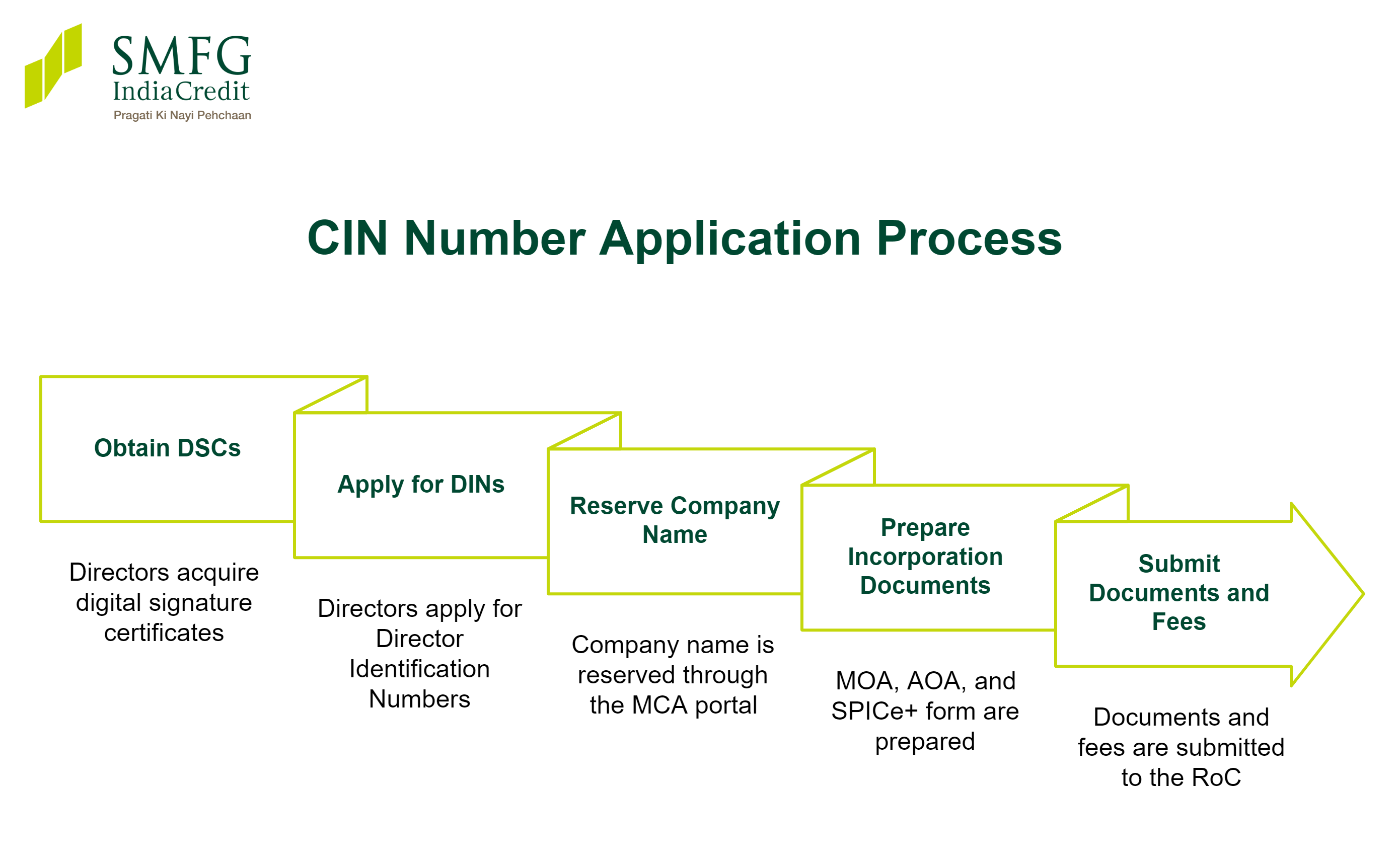
To obtain a CIN, you must register your company under the Companies Act, 2013. The process involves:
- Digital Signature Certificate (DSC): Obtain DSCs for the company's directors.
- Director Identification Number (DIN): Apply for DINs for the directors.
- Name Reservation: Reserve your company's name through the MCA portal.
- Incorporation Documents: Prepare and submit the Memorandum of Association (MOA) and Articles of Association (AOA), along with other required forms like the SPICe+ form.
- Registration: Submit all required documents and fees to the RoC.
Upon successful incorporation, the RoC will issue your company’s CIN, which will be mentioned in the Certificate of Incorporation.
Documents Required for CIN Registration
You do not apply for a CIN directly. It is issued once your company incorporation documents are approved by the ROC. The documents for CIN registration, submitted as part of your ROC registration documents, usually include:
- PAN card of the directors
- Aadhaar card or other identity proof
- Registered office address proof
- Memorandum of Association (MOA)
- Articles of Association (AOA)
- Digital Signature Certificate (DSC)
How to Change a CIN Number?
A company's CIN may change under certain circumstances:
- Change in Listing Status: If a company transitions from unlisted to listed or vice versa.
- Relocation: If the company's registered office moves to a different state.
- Change in Industry: If the company's primary business activity changes.
You cannot manually request a change to your CIN. Instead, the CIN is updated automatically when any of the above changes are recorded through official filings.
The Key Role of the CIN Number
The CIN ensures that each company has a distinct identity, preventing confusion with other entities. This uniqueness is crucial for legal recognition and smooth business transactions. It is also essential for complying with various legal requirements, including filing annual returns and financial statements with the MCA.
How to Find CIN Number
If you're unsure about your company's CIN, locating it is straightforward:
- Visit the MCA Portal: Navigate to the Ministry of Corporate Affairs' official website.
- Access 'Find CIN' Service: Under the 'MCA Services' section, select 'Find CIN'.
- Enter Company Details: Input your company's name, registration number, or former name, and complete the CAPTCHA verification.
- Retrieve CIN Information: The system will display your company's CIN, along with other registration details.
Common Mistakes Related to CIN Number
Under the Companies (Amendment) Act, 2019, failing to print the CIN on required documents can result in a fine of Rs. 1,000 per day of default, up to a maximum of Rs. 1,00,000 (applicable to the entity as well as every officer in default). Staying alert to common CIN mistakes keeps your filings clean. Watch out for these errors:
- Missing CIN on invoices, letterheads, and official notices
- Quoting the wrong CIN number on MCA filings
- Mismatched details between your CIN records and other documents
- Using an outdated CIN after a change in registered office or listing status
- Incorrect filings caused by entering the 21-character code in a hurry
Benefits of Having a CIN Number
The benefits of a CIN number go well beyond ticking a legal box. Here is what a CIN does for your business:
- Legal Recognition: Confirms your company is registered.
- Transparency: Links your filings, finances, and history to one verifiable code.
- Trust: Reassures clients, suppliers, and investors that your business is genuine.
- Easy Verification: Supports quick company verification in India through the MCA portal.
- Smooth Compliance: Helps you file annual returns and statutory forms without delays.
- GST Registration: The CIN is commonly linked with your company's GST registration details, supporting accurate business identification and regulatory compliance across government records.
Wrapping Up
Understanding your Corporate Identification Number (CIN) is essential for legal compliance, transparency, and efficient business operations in India. It's not just a formality but a crucial identifier that plays a significant role in your company's interactions with regulatory bodies, clients, and financial institutions.
As your business grows, managing finances becomes increasingly important. SMFG India Credit offers unsecured business loans tailored to support the unique needs of your business. Apply online today for funds of up to Rs. 1 crore* at attractive business loan interest rates and flexible repayment tenures!
Before applying, review the required business loan documents so that you are well prepared and can complete the application without unnecessary delays.
You can also use our business loan eligibility calculator and EMI calculator to estimate your borrowing capacity and repayment obligations.
Understanding your financial position beforehand helps you make informed decisions to improve your business loan eligibility and increase the chances of approval.
* Please note that this article is for your knowledge only. Loans are disbursed at the sole discretion of SMFG India Credit. Final approval, loan terms, disbursal process, foreclosure charges and foreclosure process will be subject to SMFG India Credit's policy at the time of loan application. If you wish to know more about our products and services, please contact us