Changing consumer preferences have led to a massive increase in online food delivery platforms in India. This surge in demand has significantly contributed to the success rate of cloud kitchens over recent years.
Setting up such an establishment can vary in complexity depending on your approach, but a common requirement is obtaining an FSSAI licence for cloud kitchens in India. This licence is essential for ensuring compliance with food safety regulations in India.
What Are Cloud Kitchens?
Cloud kitchens, also known as ghost kitchens or virtual kitchens, are food establishments that exclusively offer online food delivery and, in some cases, pick-up. Unlike traditional restaurants, they do not offer dine-in options. These kitchens are designed specifically to prepare and deliver food through online platforms. Business owners or operators do not have to invest in visible storefronts or prime locations.
Why Do Cloud Kitchens Need an FSSAI Licence?
An FSSAI licence is mandatory for cloud kitchens because they operate as a Food Business Operator involved in preparing and selling food. Depending on eligibility, businesses must obtain FSSAI registration for cloud kitchens or a cloud kitchen licence in India through FoSCoS registration. This supports food safety compliance and allows the business to display its FSSAI licence number, where necessary.
- Promotes food safety and hygiene standards.
- Improves traceability of food businesses.
- Builds consumer confidence.
- Supports onboarding with online food delivery platforms.
Types of FSSAI Licensing for Cloud Kitchens
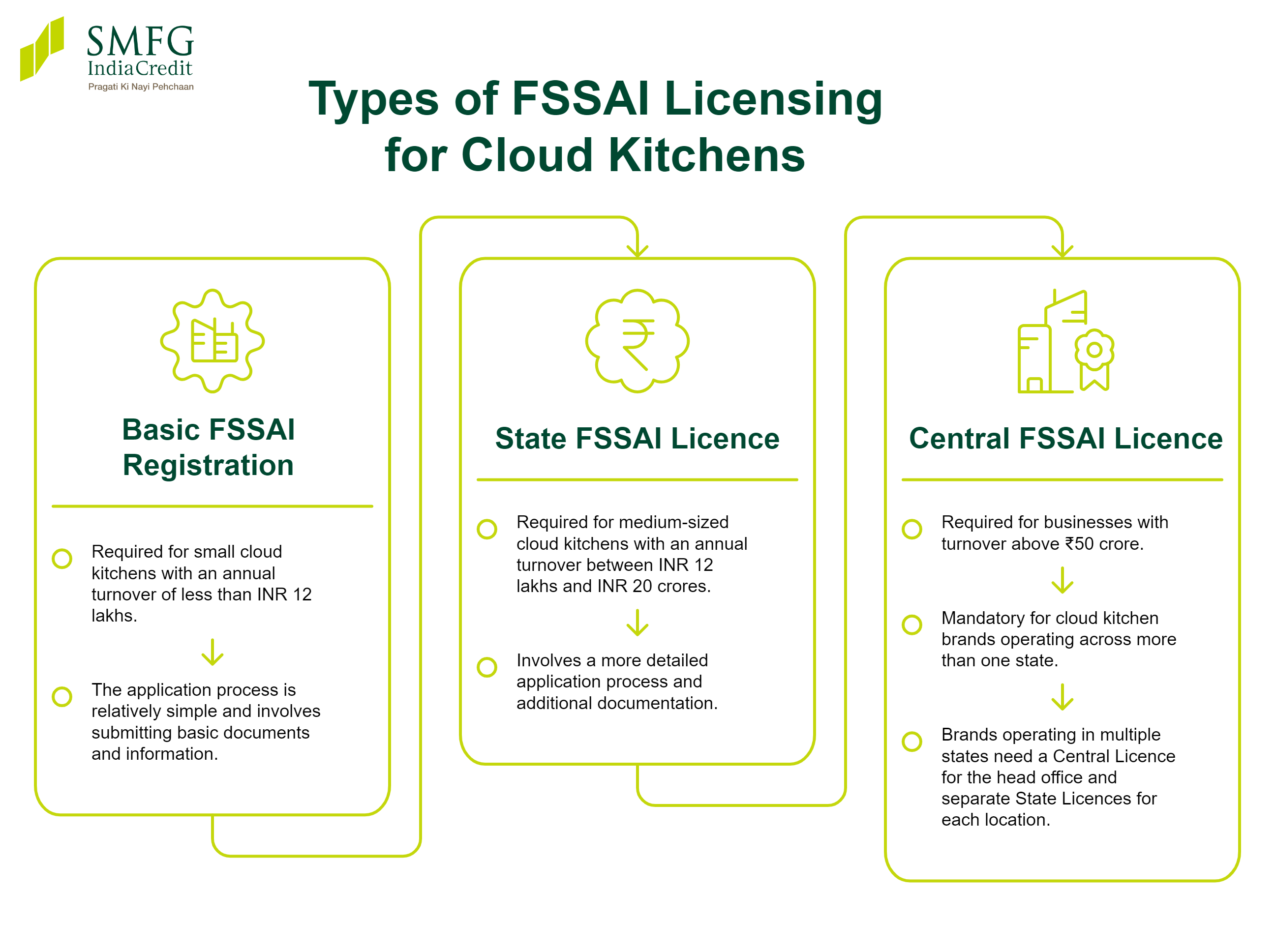
There are three different types of FSSAI licences for cloud kitchens. The type of licence required depends on the size of the cloud kitchen and its annual turnover:
1. Basic FSSAI Registration
This type of cloud kitchen registration is required for small cloud kitchens with an annual turnover of less than INR 12 lakhs. The application process is relatively simple and involves submitting basic documents and information.
2. State FSSAI Licence
This cloud kitchen FSSAI licence is required for medium-sized cloud kitchens with an annual turnover between INR 12 lakhs and INR 20 crores. This licence involves a more detailed application process and additional documentation.
3. Central FSSAI Licence
A Central licence is required for businesses with turnover above ₹50 crore. It is also mandatory for cloud kitchen brands operating across more than one state. A brand operating kitchens in more than one state needs a Central Licence for its head office and a separate State Licence for each kitchen location.
How to Check Which FSSAI Licence Your Cloud Kitchen Needs
The appropriate FSSAI licence for cloud kitchen businesses depends on factors such as turnover, business activities, and operational scale. Before applying for an FSSAI cloud kitchen licence, review your business details carefully to determine the applicable registration or licence category. You can also use the "Eligibility of your food business" feature available on the FoSCoS portal to identify the appropriate option based on your business profile.
Use the following checklist before applying for a cloud kitchen FSSAI licence:
- Estimate your annual turnover.
- Identify the type of food you prepare or process.
- Determine whether your business is involved in food manufacturing or processing activities.
- Check the number of kitchen locations you operate.
- Confirm whether you sell through online food delivery platforms or your own website.
- Consider whether your business operates in one or multiple states.
- Review any e-commerce activities associated with your business.
- Verify the applicable eligibility criteria using the FoSCoS portal before submitting your application.
FSSAI Licence vs FSSAI Registration for Cloud Kitchen
Both FSSAI registration and an FSSAI licence are issued by the Food Safety and Standards Authority of India, but the applicable requirement depends on the size and nature of the food business. While Basic Registration is generally meant for smaller Food Business Operators (FBOs), State and Central Licences apply to businesses with higher turnover or more complex operations. Understanding the difference can help you apply for the correct cloud kitchen licence in India.
|
Parameter
|
Basic Registration
|
State/Central Licence
|
|
Suitable For
|
Small-scale Food Business Operators
|
Medium and large Food Business Operators, depending on turnover and operations
|
|
Annual Turnover
|
Up to the prescribed threshold
|
Above the prescribed threshold
|
|
Application Process
|
Simpler
|
More detailed, with additional documentation
|
|
Documentation
|
Basic business and identity documents
|
Additional business, operational, and compliance documents
|
|
Inspection
|
Generally not required
|
May be required, depending on the licence category and business activities
|
Documents Required for FSSAI Registration of a Cloud Kitchen
The specific documents required for an FSSAI licence can vary depending on the type of licence. The general documents required for an FSSAI licence are as follows:
- Proof of Identity - Identity proof of the owner such as an Aadhaar card, driver's licence, voter ID card, etc.
- Proof of Address - Address proof for the cloud kitchen such as a rental agreement, utility bill, or other property documents.
- Kitchen Layout Plan - A detailed layout plan of the kitchen.
- Food Safety Management Plan - A documented plan outlining food safety measures, including standard operating procedures.
- Water Quality Test Report - A report confirming the quality of the water supplied to the premises.
- NOC Form - A no-objection certificate issued by the municipal corporation.
- Signed Declaration - Also known as Form B, a signed FSSAI declaration form.
- Fire Safety Certificate - A certificate ensuring compliance with fire safety regulations.
- Government Registrations (if applicable) - Any registration certificate such as a GST certificate, Shops and Establishment registration certificate, etc.
- Partnership deed or incorporation certificate (if applicable)
These are the general requirements for registering a cloud kitchen with FSSAI. It is advisable to consult the official FSSAI website or contact relevant authorities for the most current and specific documentation requirements based on the type of licence you need.
Eligibility Conditions for Cloud Kitchens to Acquire an FSSAI Licence
To obtain the FSSAI cloud kitchen licence, it is important to be aware of the eligibility conditions beforehand:
- Infrastructure - Cloud kitchens need to have adequate facilities for food preparation, meeting the guidelines set by FSSAI.
- Sanitation - Proper hygiene and sanitation must be maintained to qualify for the FSSAI cloud kitchen licence.
- Personnel - All personnel involved in food handling should be qualified and maintain proper personal hygiene.
- Food Safety Management System - An appropriate food safety management system that complies with FSSAI regulations should be in place.
- Quality Control - Proper facilities for maintaining food quality and safety should be established.
- Government Registrations - Other relevant government registrations, such as trade licences and GST registration, should be obtained.
- Legal Compliance - All regulations set by the municipal corporation and FSSAI should be followed.
- Document Requirements - All documents required by the FSSAI for cloud kitchen registration must be prepared and available at the time of application.
For the most current and specific eligibility criteria, check the official FSSAI website.
Cloud Kitchen Premises and Layout Requirements
A well-planned kitchen layout helps support food safety, operational efficiency, and compliance with cloud kitchen hygiene rules. Whether operating from a commercial facility or as a home-based food business, the premises should be organised to minimise the possibility of cross-contamination and maintain hygienic food handling practices. As far as possible, different activities should be carried out in separate, designated areas.
- Allocate separate areas for raw material storage, food preparation, cooking, packing, cleaning, and waste disposal.
- Ensure adequate ventilation and lighting throughout the kitchen.
- Use smooth, washable, and easy-to-clean surfaces for floors, walls, and workstations.
- Maintain effective pest control measures and proper drainage systems.
- Provide a safe and adequate water supply for food preparation and cleaning.
- Store ingredients and prepared food at appropriate temperatures, where applicable.
- Ensure staff follow good personal hygiene practices, including proper handwashing and the use of clean protective clothing where required.
Water Quality Test Report for Cloud Kitchens
A water quality test report may be required when applying for a food licence for cloud kitchen businesses, depending on the licence category, the nature of the food operations, and the requirements of the licensing authority. Water used for food preparation, cooking, cleaning, or as an ingredient should be potable and suitable for its intended use. Where required, the report should be obtained from an approved or recognised laboratory. Periodic water testing also helps demonstrate continued hygiene compliance and may support the renewal or inspection process for an FSSAI licence for cloud kitchen businesses.
Fire Safety, Trade Licence and Local Municipal Permissions
An FSSAI licence is only one part of the regulatory requirements for operating a cloud kitchen. Depending on the location, business structure, and premises, additional approvals may also be required. Businesses should verify the applicable requirements with the relevant state or local authority before commencing operations, particularly when applying for a cloud kitchen trade licence or a home-based cloud kitchen licence.
|
Requirement
|
Purpose
|
|
Fire Safety Certificate/No Objection Certificate (NOC)
|
Demonstrates compliance with applicable fire safety requirements, where required.
|
|
Shop & Establishment Registration
|
Registers the business under the applicable state legislation, where required.
|
|
Trade Licence/Health Trade Licence
|
Permits the operation of the food business under local municipal regulations, where applicable.
|
|
GST Registration
|
Required if the business meets the prescribed eligibility criteria under GST laws.
|
|
Pollution and Waste Management Compliance
|
Ensures proper disposal of waste and adherence to applicable environmental regulations.
|
|
Municipal or Local Body Permissions
|
Additional approvals that may be required depending on the city, state, and type of premises.
|
GST Registration for Cloud Kitchens
A cloud kitchen GST registration may be required depending on factors such as annual turnover, the nature of supplies, inter-state transactions, online food delivery platform arrangements, and other applicable GST provisions. Where applicable, the GST registration certificate may also form part of the supporting documents submitted when applying for an FSSAI licence for cloud kitchen businesses.
As GST requirements vary based on individual business circumstances, it is advisable to consult a qualified tax professional or refer to the latest government guidelines to determine your registration and compliance obligations.
How to Apply for an FSSAI Licence for a Cloud Kitchen Online
If you are wondering how to get an FSSAI licence for cloud kitchen businesses, the application can be completed through the FoSCoS portal. Before starting your FSSAI licence online application, ensure you have identified the correct licence category and gathered all the required documents.
- Visit the FoSCoS portal and select "New Licence/Registration".
- Choose the state or Union Territory where the cloud kitchen operates.
- Select the appropriate Food Business Operator category for your business, such as food service or the applicable cloud kitchen-related category.
- Complete Form A (Basic Registration) or Form B (State/Central Licence), as applicable.
- Upload the required supporting documents.
- Pay the applicable FSSAI licence fee for a cloud kitchen online.
- Submit the application and note the reference number.
- Use the "Track Application" module on FoSCoS to monitor the application status.
- Respond to any clarification requests or inspection requirements, if applicable.
- Once approved, download your FSSAI licence or registration certificate from the portal.
How to Track FSSAI Application Status on FoSCoS
After submitting your application, save the reference number, as it is required to track the progress of your request on the FoSCoS portal. You can use the "Track Application" m odule to view the latest status and respond promptly if any additional information or documents are requested. Regularly checking the application status can help avoid unnecessary delays in the licensing process.
The application may display one of the following statuses:
- Submitted – Your application has been successfully submitted.
- Pending Scrutiny – The licensing authority is reviewing the application.
- Document Clarification – Additional information or documents have been requested.
- Inspection – A site inspection has been scheduled or is in progress, where applicable.
- Approved – The application has been approved.
- Rejected – The application has not been approved, along with the reason for rejection.
- Certificate Issued – Your FSSAI registration or licence certificate is available for download from the FoSCoS portal.
FSSAI Licence Fees for Cloud Kitchen
The FSSAI licence for cloud kitchen fees depend on the type of registration or licence applicable to the business. While the figures below reflect the standard government fee structure historically followed by FSSAI, the applicable fee, validity period, and payment requirements may change in line with the latest regulations. Therefore, the final FSSAI licence for cloud kitchen cost should always be verified on the FoSCoS portal at the time of application.
|
Licence Type
|
Typical Government Fee
|
Suitable For
|
Note
|
|
Basic Registration
|
Rs. 100 per year*
|
Small food businesses meeting the applicable eligibility criteria
|
Verify the latest fee and validity on FoSCoS.
|
|
State Licence
|
Rs. 2,000-Rs. 5,000 per year*
|
Medium-sized food businesses, depending on turnover and operations
|
Fee varies based on the business category and licence type.
|
|
Central Licence
|
Rs. 7,500 per year*
|
Large food businesses and businesses requiring a Central Licence
|
Check the applicable fee and current validity before making payment.
|
*Government fees are subject to revision. Always confirm the applicable fee and licence validity on the FoSCoS portal before submitting your application.
FSSAI Licence Validity, Renewal, and Perpetual Validity
FSSAI licences and registrations issued on or after 1 April 2026 have perpetual validity. This means they remain valid unless suspended, cancelled, or surrendered, and Food Business Operators are not required to complete periodic renewals. However, perpetual validity does not remove ongoing responsibilities related to food safety, hygiene, testing, inspections, fee payments, modifications, or other statutory requirements applicable to the business.
Although periodic FSSAI licence renewal is no longer required, Food Business Operators must continue to pay the applicable annual licence or registration fee. Failure to pay the prescribed fee may result in the licence or registration being deemed suspended, during which the food business cannot continue its operations.
If a food business permanently ceases operations, the FBO is required to notify the licensing authority in writing within the prescribed timeline and surrender the licence or registration. Any fee already paid is generally non-refundable upon surrender.
Note: Businesses should check their FoSCoS account to confirm how the revised rules apply to an existing or pending licence.
Modification of FSSAI Licence for Cloud Kitchen
If there are significant changes to your business after obtaining an FSSAI licence for cloud kitchen operations, you should update the licence details through the FoSCoS portal using the modification feature. Keeping your licence information current helps ensure that your business records accurately reflect your operations and remain compliant with applicable FSSAI requirements.
Common situations where a licence modification may be required include:
- Change in the business address or operating premises
- Addition of new food categories or expansion of the menu
- Change in the legal entity or ownership structure
- Addition of new kitchen units or production facilities
- Update of registered mobile number, email address, or other contact details
- Revision of turnover resulting in a change in licence category
- Expansion to multiple locations or changes in food delivery aggregator operations
Food Aggregator Listing Requirements for Cloud Kitchens
Before listing your cloud kitchen on food delivery platforms or marketplaces, ensure you have the required business and compliance documents ready. While the exact requirements may vary across platforms, the food aggregator FSSAI requirement generally includes a valid FSSAI licence or registration number, along with other information needed to verify your business. FSSAI has also issued compliance-related announcements through FoSCoS for e-commerce Food Business Operators participating in the ONDC ecosystem.
Before applying, keep the following ready:
- Valid FSSAI licence or registration certificate number
- GST registration details, where applicable
- Updated menu and product information
- Bank account details for settlements
- Identity and address proof of the owner or authorised signatory
- Photographs of the kitchen, outlet, and food packaging
- Required declarations and compliance documents specified by the aggregator
Penalties for Running a Cloud Kitchen Without an FSSAI Licence
Operating a cloud kitchen without the required FSSAI registration or licence can lead to regulatory action and business disruptions. Depending on the nature of the non-compliance, authorities may impose penalties under the Food Safety and Standards Act, conduct inspections, or direct the suspension of operations until the necessary approvals are obtained. In addition to regulatory consequences, food delivery platforms may refuse to onboard or delist businesses that fail to meet mandatory compliance requirements.
A lack of valid licensing can also affect customer trust, increase the likelihood of complaints, and negatively impact your brand's reputation. Obtaining the appropriate FSSAI registration or licence before commencing operations and ensuring it remains up to date can help minimise these risks.
Business Loan for Cloud Kitchen Expansion
As your cloud kitchen grows, additional funding may be required to expand operations or improve efficiency. An enterprise or MSME may consider a business loan to finance kitchen equipment upgrades, working capital, packaging, rent or security deposits, licence-related expenses, aggregator onboarding, marketing activities, and delivery operations, depending on its business requirements.
Before applying, review the lender's business loan eligibility criteria carefully. Many lenders generally require businesses to have been operational for at least three years. If your cloud kitchen does not yet meet this requirement, you may explore a personal loan option, subject to eligibility and your financing requirements.
Preparing the required business loan documents in advance can help support a smoother application process. Commonly requested documents include PAN and KYC proofs, business registration proof, CA-audited financial statements, bank statements, and other documents specified by the lender.
Checklist Before Starting a Cloud Kitchen in India
Use the following checklist before launching your cloud kitchen to help ensure operational readiness and regulatory compliance. Confirm the applicable FSSAI licence for the cloud kitchen category before beginning the application process.
- Prepare a detailed business plan and budget.
- Finalise your menu and pricing strategy.
- Identify your target delivery area.
- Select a suitable kitchen location.
- Determine the appropriate FSSAI registration or licence category.
- Complete FoSCoS registration or licence application.
- Obtain GST registration and other local licences, where applicable.
- Arrange fire safety approvals, if required.
- Plan compliant food packaging and labelling.
- Complete onboarding with online food delivery platforms.
- Establish food safety and hygiene SOPs.
- Maintain supplier records and invoices.
- Set up payment collection systems.
- Create a marketing plan and allocate sufficient working capital.
Conclusion
Obtaining an FSSAI licence is essential for legally operating a cloud kitchen in India. For a smooth certification process, make sure you understand the different types and requirements of licences before applying.
Running and scaling a cloud kitchen requires substantial capital, especially with expenses such as FSSAI licence costs. To support your capital needs and ambitious expansion goals, SMFG India Credit offers collateral-free business loans of up to Rs. 1 Crore*. Eligible enterprises can enjoy affordable business loan interest rates and flexible repayment options.
Use our business loan eligibility calculator to estimate how much you may qualify for and apply online today!