Waiting for a tax refund can be frustrating, especially when there is an ITR refund delay despite filing your ITR on time. In some cases, taxpayers may find their income tax refund not credited even after the return has been processed. Issues such as verification pending, bank account validation errors, data mismatches, or refund failures at the CPC (Centralised Processing Centre) can contribute to an ITR processed but refund not received situation.
This article explains the common reasons for income tax refund delays, how to check the status on the e-Filing portal, and the steps you can take to resolve the issue.
Key Takeaways on ITR Refund Delay
An showing a pending or delayed refund does not always indicate a problem with your return. Before taking further action, keep the following points in mind:
- Complete e-verification after filing your return.
- Ensure your pre-validated bank account is active and correctly linked.
- Verify that your PAN details are accurate and linked wherever required.
- Incorrect bank details may result in a refund failure.
- An existing outstanding demand may be adjusted against your refund, if applicable.
- If the refund fails, you can submit a refund reissue request through the e-Filing portal after resolving the issue.
Reviewing these common income tax refund delay reasons can help you identify and address the cause of the delay more quickly.
What Is an Income Tax Refund?
An income tax refund meaning refers to the amount returned by the Income Tax Department when the total tax paid during a financial year exceeds your actual tax liability. If the taxes deducted or paid through TDS, TCS, advance tax, or self-assessment tax are higher than the final amount payable, you may become eligible for a refund amount. For those wondering exactly what the ITR refund is, the excess amount is generally credited to your validated bank account after your return is processed and the necessary checks are completed.
When Is an ITR Refund Issued?
The income tax refund timeline begins after you complete ITR filing, but the refund is not issued immediately. Before the refund is released, the return must be successfully e-verified, undergo ITR refund processing, and be validated by the CPC. The refund is then approved through a refund order and credited after successful bank account validation. Although processing times vary, the following stages are generally involved:
- File your ITR
- Complete e-verification
- Wait for processing by the CPC
- Ensure your bank account is validated
- Refund is issued after the refund order is generated and the required checks are completed
Common Income Tax Refund Delay Reasons
Several factors can contribute to the reasons for ITR refund delay, even when the return has been filed on time. If you are wondering why your ITR refund is delayed, review the following common causes:
- ITR verification has not been completed
- The return is still under processing
- Incorrect bank details have been provided
- Bank validation or pre-validation of the bank account is pending
- PAN mismatch with the bank account or tax records
- Mismatch between the information in Form 26AS, AIS, and the ITR
- Adjustment of an existing outstanding demand against the refund
- The return has been marked as a defective return requiring corrective action
- The return has been selected for manual review
- The refund could not be credited due to a refund failure
Reason-Wise ITR Refund Delay
This table summarises some of the common income tax refund not credited reasons and the corresponding actions that taxpayers can consider.
|
Reason
|
What It Means
|
What Taxpayer Should Do
|
|
Return Not E-Verified
|
The return cannot proceed for processing until e-verification is completed.
|
Complete e-verification through the e-Filing portal.
|
|
Bank Account Not Validated
|
Bank validation is pending, so the refund cannot be credited.
|
Pre-validate the bank account on the e-Filing portal.
|
|
Refund Failure
|
The refund could not be credited because of incorrect or inactive bank details.
|
Correct the bank details and submit a refund reissue request.
|
|
Mismatch in Tax Details
|
The information in the ITR does not match tax records.
|
Review the records and file a revised return, if applicable.
|
|
Outstanding Tax Demand
|
The refund may have been adjusted against pending tax dues.
|
Check the demand details on the e-Filing portal and respond, if required.
|
|
Processing or Other Issues
|
The return may still be under processing or require further review.
|
Raise a grievance if the delay continues beyond a reasonable period, and no update is available.
|
How to Check ITR Refund Status Online
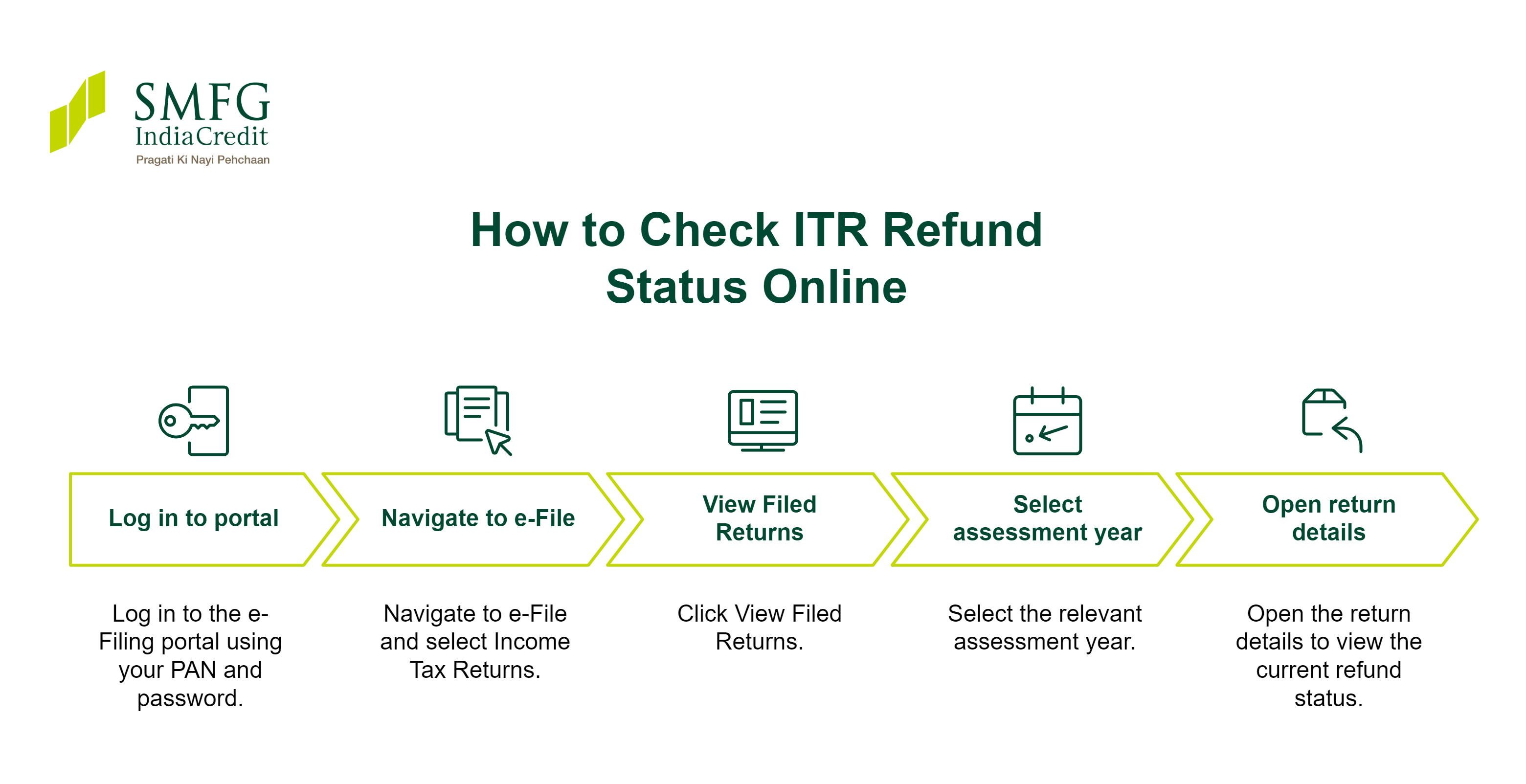
You can check the ITR refund status through the Income Tax Department's e-Filing portal after your return has been filed. The portal allows you to track your income tax refund status for a particular assessment year and identify the current stage of processing. To view your ITR refund status online, follow these steps:
- Log in to the e-Filing portal using your PAN and password.
- Navigate to e-File and select Income Tax Returns.
- Click View Filed Returns.
- Select the relevant assessment year.
- Open the return details to view the current refund status.
Taxpayers can also use the refund status services made available by the Income Tax Department, wherever applicable, to track the progress of their refund.
Step-by-Step Process to Check Refund Status
- Visit the Income Tax e-Filing portal and log in using your PAN and password.
- Navigate to e-File and select View Filed Returns.
- Choose the relevant assessment year from the list of filed returns.
- Open the return details to review the ITR-V, if required, and the return processing information.
- How to check ITR refund status: View the refund status check online section to see the latest update.
- Review the status message carefully and note any refund failure reason or other action required before taking the appropriate next step.
Receiving your tax refund on time can support short-term financial planning by improving cash flow and helping you manage upcoming expenses. It may also be useful when planning for financial products such as a personal loan.
Maintaining accurate tax and income records, along with meeting the lender's eligibility criteria, can strengthen your loan application. A strong overall financial profile may also improve your chances of qualifying for a favourable personal loan interest rate.
Refund Reissue Status: How to Track It
If you have submitted a refund reissue request, you can monitor its progress through the Income Tax e-Filing portal. Tracking your income tax refund reissue status helps you confirm whether the request has been received, processed, or requires any further action. Follow these steps to track refund reissue request details:
- Log in to the e-Filing portal.
- Navigate to Services and select Refund Reissue.
- Open View Refund Reissue Request.
- Locate your request status and review the latest update.
- Keep a record of the transaction ID generated for the request.
- Check your registered email and mobile for any email confirmation or mobile confirmation sent by the Income Tax Department regarding the request.
Saving the transaction ID and related confirmations can make it easier to follow up if the refund is delayed further.
ITR Refund Delay: Top Reasons
Bank Account Issues That Cause Refund Delay
A bank account issue is one of the most common income tax refund delay causes. If your refund is not credited to your bank account, it may be due to incorrect bank validation or account details. Common reasons for an income tax refund bank account issue include:
- Pre-validated bank account refund requirement not met
- Incorrect account number or IFSC
- PAN not linked to the bank account
- Dormant or closed account
- Name mismatch or details requiring re-validation
Refund Failed Due to Wrong Bank Account: What to Do
A refund failed due to a wrong bank account can occur if the wrong account number, IFSC, or a closed account or dormant account is linked for the refund credit. If your ITR refund has not been received because of the wrong bank details, follow these steps:
- Add the correct validated bank account on the e-Filing portal.
- Complete bank account validation and nominate it for a refund credit.
- Submit a refund reissue request after the refund failure is reflected on the portal.
Refund Adjusted Against Outstanding Demand
Your income tax refund adjusted amount may be reduced or fully set off if there is an outstanding demand in income tax relating to an earlier assessment year. This refund adjusted against the demand process is carried out in accordance with Section 245, after the prescribed procedure is followed. If this happens, you should:
- Check the tax demand details and the relevant intimation available on the e-Filing portal.
- Verify whether the demand relates to your tax records and is correct.
- Submit a response to the demand through the e-Filing portal if you disagree with the demand or require a review.
Reviewing the intimation carefully can help you determine whether any further action is required.
ITR Refund Delay Due to Return Not E-Verified
An ITR not e-verified refund delay can occur because the Income Tax Department generally begins processing a return only after income tax refund e-verification is completed. To e-verify ITR refund processing, you can use any of the approved methods:
- Aadhaar OTP
- Net banking
- EVC (Electronic Verification Code)
- DSC (Digital Signature Certificate), where applicable
- Submission of the signed ITR-V, where permitted
Completing the verification within the prescribed timeline can help avoid unnecessary delays in refund processing.
ITR Refund Delay Due to Mismatch in AIS/Form 26AS
An AIS mismatch refund delay or a Form 26AS mismatch refund delay may occur if the tax details reported in your return do not match the records available with the Income Tax Department. Common reasons include:
- TDS mismatch in ITR refund due to incorrect reporting by the employer or another deductor.
- Differences between the AIS, Form 26AS, and the income reported in the ITR.
- Incorrect or omitted income details.
Review these records carefully and, if required, file a revised return or request the deductor to rectify the reported information.
ITR Refund Delay Due to Defective Return or Notice
A defective return refund delay, or an ITR notice refund delay, may occur if your return is treated as defective under Section 139(9) or if an income tax refund pending notice requires clarification. In such cases:
- Review the notice on the compliance portal.
- Submit the required taxpayer response within the prescribed timeline.
- File a revised return, if applicable.
Once the compliance requirements are fulfilled, refund processing can generally resume.
How to Resolve the Delay
If your ITR refund is not received despite completing the filing process, start by identifying the exact reason for the delay instead of submitting multiple requests. Check the return and refund status on the e-Filing portal, confirm that your return has been e-verified, and ensure your bank account is pre-validated with accurate details.
Review any notices, outstanding tax demands, or mismatches in AIS and Form 26AS, and respond promptly if corrective action is required. If the refund has failed, update the relevant bank details and submit a refund reissue request through the portal.
Performing an ITR refund delay status check regularly can help you track progress and identify pending actions. If the delay continues after all requirements have been fulfilled, consider raising a grievance through the e-Filing portal. Also, remember that filing an income tax return late may affect the overall processing timeline, depending on the circumstances of your return.
How Long Does an ITR Refund Usually Take?
The ITR refund time can vary from one taxpayer to another and depends on several factors, including the processing time of the return, successful e-verification, bank validation, and the workload at the CPC for the relevant assessment year. If you are wondering how many days it takes for an ITR refund, there is no fixed timeline applicable to every case.
However, refunds are generally processed faster when the return is error-free, the bank account is validated, and all verification requirements have been completed before the refund credit is initiated.
How to Raise a Grievance for ITR Refund Delay
If your refund remains pending after checking its status and submitting a refund reissue request, where applicable, you can raise an income tax refund grievance through the e-Filing portal. To submit an ITR refund complaint or a refund delay grievance:
- Log in to the e-Filing portal.
- Navigate to the grievance or service request section.
- Select the appropriate refund-related complaint category.
- Describe the issue and upload supporting details, if required.
- Submit the request and note the ticket number for future tracking through taxpayer support.
Details to Keep Ready Before Raising a Grievance
When raising a refund grievance, keeping the required information ready can help speed up the process. The following income tax refund complaint details are commonly required:
- PAN
- Relevant assessment year
- Acknowledgement number of the filed return
- Expected refund amount
- Bank validation status
- Intimation number, if available
- Screenshot of the refund status or status message
- Transaction ID of the refund reissue request, if applicable
Having these ITR refund grievance details readily available can help the Income Tax Department review your grievance more efficiently.
Conclusion
An ITR refund delay is often caused by pending processing, verification, bank account validation issues, data mismatches, or a refund failure. If your ITR is processed but the refund is not credited, review the refund status on the e-Filing portal, ensure your bank account details are accurate, and check for any communication from the CPC. If required, submit a refund reissue request or raise a grievance to help resolve the issue. Taking these steps promptly can help every taxpayer minimise further delays and receive the refund without unnecessary complications.
Maintaining timely tax compliance and organised financial records can also support future borrowing requirements. If you are planning to borrow, SMFG India Credit offers unsecured financing of up to Rs. 10 Lakhs* at with straightforward personal loan eligibility and competitive interest rates starting from 12.5%* per annum.
Before applying, use the personal loan EMI calculator to estimate your monthly repayments and plan your budget accordingly.
You can also use the personal loan eligibility calculator to estimate your borrowing potential before starting your application.
* Please note that this article is for your knowledge only. Loans are disbursed at the sole discretion of SMFG India Credit. Final approval, loan terms, disbursal process, foreclosure charges and foreclosure process will be subject to SMFG India Credit's policy at the time of loan application. If you wish to know more about our products and services, please contact us