The nature of business meaning refers to the type of economic activity a business undertakes, including how it conducts its operations, the products or services it offers, and the value it delivers to customers. Understanding a company's business nature helps entrepreneurs, lenders, customers, and regulators identify its business purpose and the industry in which it operates.
This article explains the nature of business definition, its major types, practical examples, and where it is commonly used in business documents, loan applications, and official forms.
What Is Nature of Business?
The nature of business definition refers to the overall character and primary business activity of an organisation. Simply put, the meaning of the nature of business describes what a venture does, the offerings it provides, the industry in which it operates, the target customers it serves, its legal structure, and its operating model.
Clearly defining the nature of a business helps stakeholders understand its operations and is commonly required for registrations, financial reporting, and business loans or compliance-related documentation.
Importance of the Nature of Business
Understanding the nature of a business helps stakeholders evaluate how a company operates, who it serves, and how it creates value. It also provides clarity for planning, compliance, financing, and day-to-day decision-making. Some of its key benefits include:
- Helps define the business model and core activities
- Identifies the sector in which the business operates
- Clarifies the target market and customer needs
- Supports business registration, licensing, and regulatory compliance
- Assists lenders and investors in evaluating the business
- Guides marketing, operational planning, and future growth strategies
How Does the Nature of Business Work?
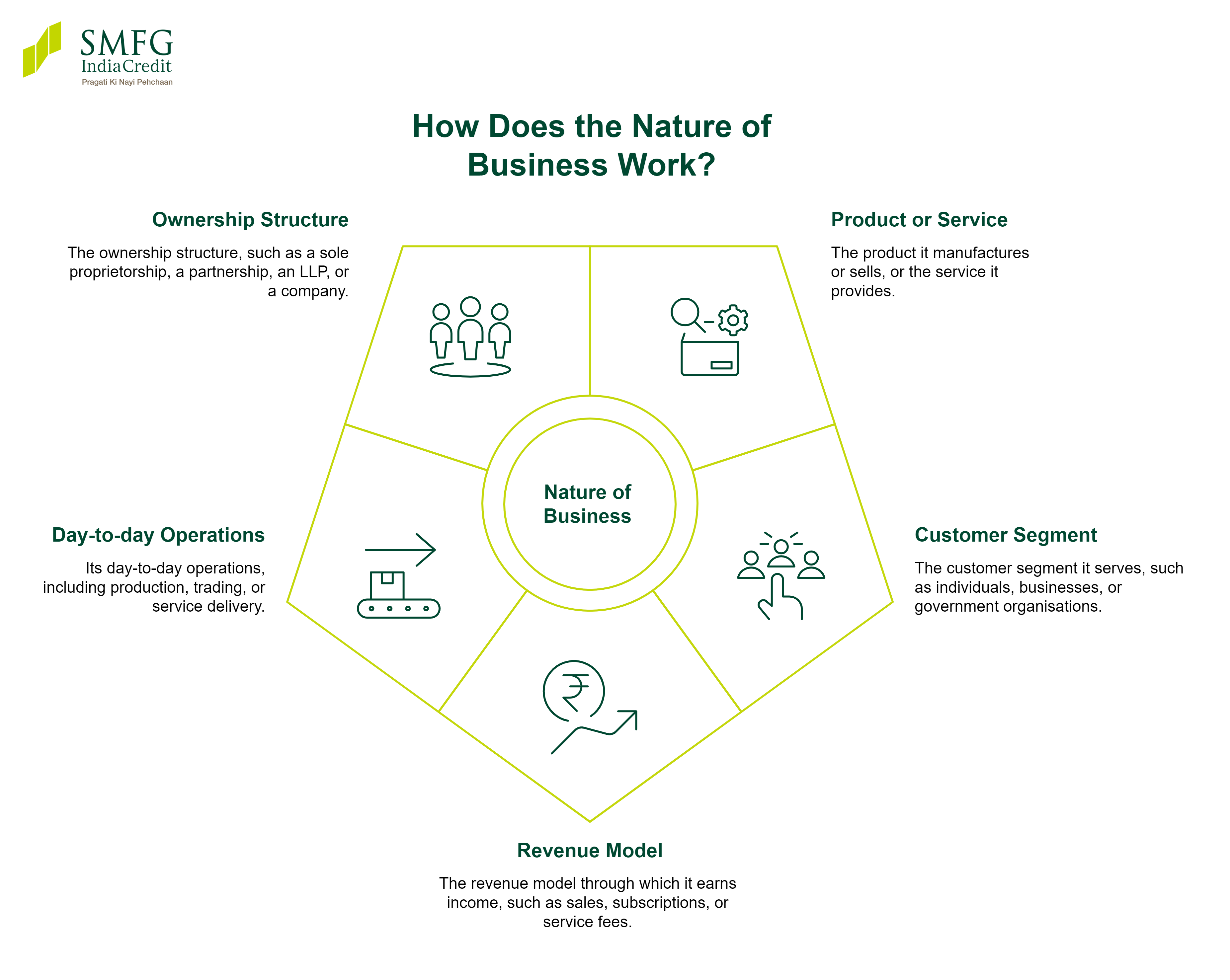
The business nature classification helps identify how a company operates and generates value. The nature of business process is based on several key aspects that define the enterprise and distinguish it from others. These include:
- The product it manufactures or sells, or the service it provides.
- The customer segment it serves, such as individuals, businesses, or government organisations.
- The revenue model through which it earns income, such as sales, subscriptions, or service fees.
- Its day-to-day operations, including production, trading, or service delivery.
- The ownership structure, such as a sole proprietorship, a partnership, an LLP, or a company.
Together, these factors provide a clear picture of the business and help lenders, regulators, investors, and customers understand its activities and operating approach.
Types of Nature of Business
The types of nature of business are generally classified according to the primary activity a business undertakes. Understanding the different nature of business types helps businesses describe their operations accurately for registrations, taxation, financing, and compliance purposes. Some of the common categories include:
- Service business
- Manufacturing business
- Retail business
- E-commerce business
- Agriculture business
- Financial business
- Professional business
- Construction business
- Hybrid business
Service Business
A service nature of business focuses on delivering value through expertise rather than physical products. Examples include consultancy, marketing agency, IT services, salons, repair services, educational institutions, and other professional services, where strong customer service plays an important role in building long-term relationships.
Manufacturing Business
The manufacturing nature of business involves converting raw materials into finished goods through a structured production process using machinery and skilled labour. The manufacturing business meaning includes enterprises such as textile units, furniture manufacturers, food processing companies, and electronics producers that operate from a factory and manage an extensive supply chain.
Trading Business
The trading nature of business covers purchasing goods from a supplier, wholesaler, or distributor and selling them without manufacturing or significantly altering them. The trading business meaning centres on trade, efficient inventory management, and the resale of products to retailers, businesses, or end consumers.
Retail/Merchandising Business
The retail nature of business pertains to purchasing products, maintaining inventory, and selling them directly to the end customer through a retail store. The merchandising business's meaning focuses on earning a sales margin on each sale, with transactions typically completed through a point of sale system.
E-commerce Business
The e-commerce nature of business enables companies to sell products or services through a website, app, or online marketplace. This online business nature relies on digital payments, efficient logistics, and order fulfilment to deliver a convenient shopping experience for customers.
Agriculture/Farming Business
The agricultural nature of business covers economic activities related to cultivating crops and raising livestock. The farming business nature includes dairy, poultry, fisheries, and agri-processing, with businesses supplying agricultural produce and related products to consumers, retailers, or processing industries.
Professional/Consultancy Business
A professional nature of business is built around specialised knowledge and skills rather than the sale of physical products. The consultancy business nature covers work carried out by a consultant, chartered accountant, lawyer, architect, financial adviser, or doctor, who provides professional services, advisory, and expertise to a client in return for fees.
Financial Business
The financial nature of business covers organisations engaged in lending, insurance, investment, brokerage, and other financial services. The finance business nature focuses on managing money and financial transactions, with many activities subject to regulatory compliance requirements depending on the services offered.
Construction/Real Estate Business
The construction nature of business includes activities related to building, infrastructure development, and property projects. The real estate business nature includes work undertaken by a contractor, builder, or developer, including the construction, sale, leasing, or management of property and large-scale infrastructure projects.
Hybrid Business
A hybrid nature of business combines two or more business activities within a single business model. For example, a company may handle manufacturing, generate product sales through e-commerce, and also offer after-sales service, reflecting a multiple nature of business approach.
Healthcare
The healthcare nature of business focuses on providing medical care, diagnosis, treatment, and preventive health services. It includes hospitals, clinics, diagnostic centres, pharmacies, and healthcare providers that deliver patient care while complying with applicable medical and regulatory standards.
Transportation
The transportation nature of business centres on moving people or goods from one location to another. Businesses in this category include logistics companies, freight operators, courier services, passenger transport providers, and fleet operators that support efficient supply chains and mobility.
Wholesale
The wholesale nature of business involves purchasing goods in bulk from manufacturers or suppliers and selling them to retailers or other businesses. Wholesalers manage inventory, distribution, and bulk transactions, earning revenue through trade margins rather than direct sales to end consumers.
What Are the Benefits of Business Nature?
Understanding the nature of a business helps entrepreneurs, lenders, investors, customers, and regulators clearly identify what a business does and how it operates. It also supports better planning, compliance, financing, and long-term growth. Some of the key benefits include:
- Clear Business Identity: Defines the products or services offered and the primary business activity.
- Better Strategic Planning: Supports informed decisions on expansion, investments, and operations.
- Improved Customer Understanding: Helps businesses identify and serve the right target audience.
- Simplified Regulatory Compliance: Assists with registrations, licences, taxation, and other legal requirements.
- Easier Access to Finance: Enables lenders to assess business activities and recommend suitable financing solutions, such as an MSME/SME loan.
- Effective Marketing: Helps businesses position their offerings and communicate their value proposition clearly.
- Operational Efficiency: Guides resource allocation and day-to-day business management.
- Supports Business Growth: Provides a strong foundation for diversification, expansion, and long-term planning.
Nature of Business Examples
Understanding the nature of business examples can make it easier to complete registration forms, small business loan applications, and other official documents accurately. The business nature examples below show how different enterprises are typically classified.
This nature of business list is illustrative, and the exact description may vary depending on the business's primary activity.
|
Business
|
Nature of Business
|
|
Restaurant
|
Food service and hospitality
|
|
School
|
Education services
|
|
Textile unit
|
Manufacturing
|
|
Grocery store
|
Retail/Merchandising
|
|
Digital agency
|
Service/Professional services
|
|
Manufacturer
|
Manufacturing
|
|
Trader
|
Trading
|
|
Hospital
|
Healthcare services
|
|
Logistics company
|
Transportation and logistics
|
|
E-commerce retailer
|
Online retail/E-commerce
|
Nature of Business in Business Loan Applications
The nature of business for loan assessment helps a lender understand how a business operates and evaluate its ability to repay a business loan. When reviewing the nature of business in a loan application, lenders typically consider several factors, including:
- The business's risk profile based on its industry and operations
- The stability and consistency of cash flow
- Annual turnover and overall financial performance
- The business's repayment capacity
- Industry type and market conditions
- Business vintage and operational track record
Tip: Before applying, ensure that your business activities are accurately described and keep all business loan documents required ready. Providing complete and consistent information can help make the evaluation process smoother.
Common Mistakes While Mentioning the Nature of Business
Accurately describing your business is important when completing registrations, financial applications, and compliance-related forms. The following nature of business mistakes can lead to delays, clarification requests, or inconsistencies during verification:
- Using vague descriptions instead of clearly stating the business activity
- Selecting the wrong nature of the business category
- Confusing the industry with the actual business activity
- Not updating the business description after expanding or changing operations
- Using a personal current account for business transactions where a business account is more appropriate
- Providing inconsistent descriptions across business forms, KYC, GST registration, and other documentation
- Sharing inaccurate information with a lender during loan applications
Review your business description carefully before submitting any application to ensure it accurately reflects your current operations and remains consistent across all official records.
Conclusion
The nature of a business defines its primary activities, the products or services it offers, and the way it operates. Clearly identifying it helps with regulatory compliance, business planning, financial management, and loan applications while ensuring consistency across official documents.
If you are planning to expand or strengthen your operations, SMFG India Credit offers unsecured business loans of up to Rs. 1 crore* to meet diverse funding requirements.
Review the eligibility criteria and apply online to benefit from competitive business loan interest rates.
You can also estimate how much you may be able to borrow using our business loan eligibility calculator.
* Please note that this article is for your knowledge only. Loans are disbursed at the sole discretion of SMFG India Credit. Final approval, loan terms, disbursal process, foreclosure charges and foreclosure process will be subject to SMFG India Credit's policy at the time of loan application. If you wish to know more about our products and services, please contact us