Businesses across sectors may need vehicles for goods transport, logistics, deliveries, or moving customers and employees. A commercial vehicle loan can help fund these purchases without requiring the business to pay the entire cost upfront. Depending on the requirement, vehicle finance for business may be used to purchase a truck, van, bus, or passenger vehicle. The amount financed and repayment terms can vary based on the lender's terms, applicant eligibility, and other factors. This article explains how commercial vehicle finance works, its key features and benefits, and other important aspects to consider before applying.
What Is a Commercial Vehicle Loan?
The commercial vehicle loan meaning refers to financing taken specifically to purchase vehicles intended for commercial activities rather than personal travel. Depending on the type of operation, businesses may consider a truck loan for moving goods, a bus loan for carrying passengers, or a taxi loan for providing paid travel services.
Financing may also cover vans, tippers, and other types of transport vehicles used for deliveries, construction, logistics, or similar activities. The purchased vehicle is therefore primarily meant for business use and supports the borrower's day-to-day commercial operations.
How Do Commercial Vehicle Loans Work?
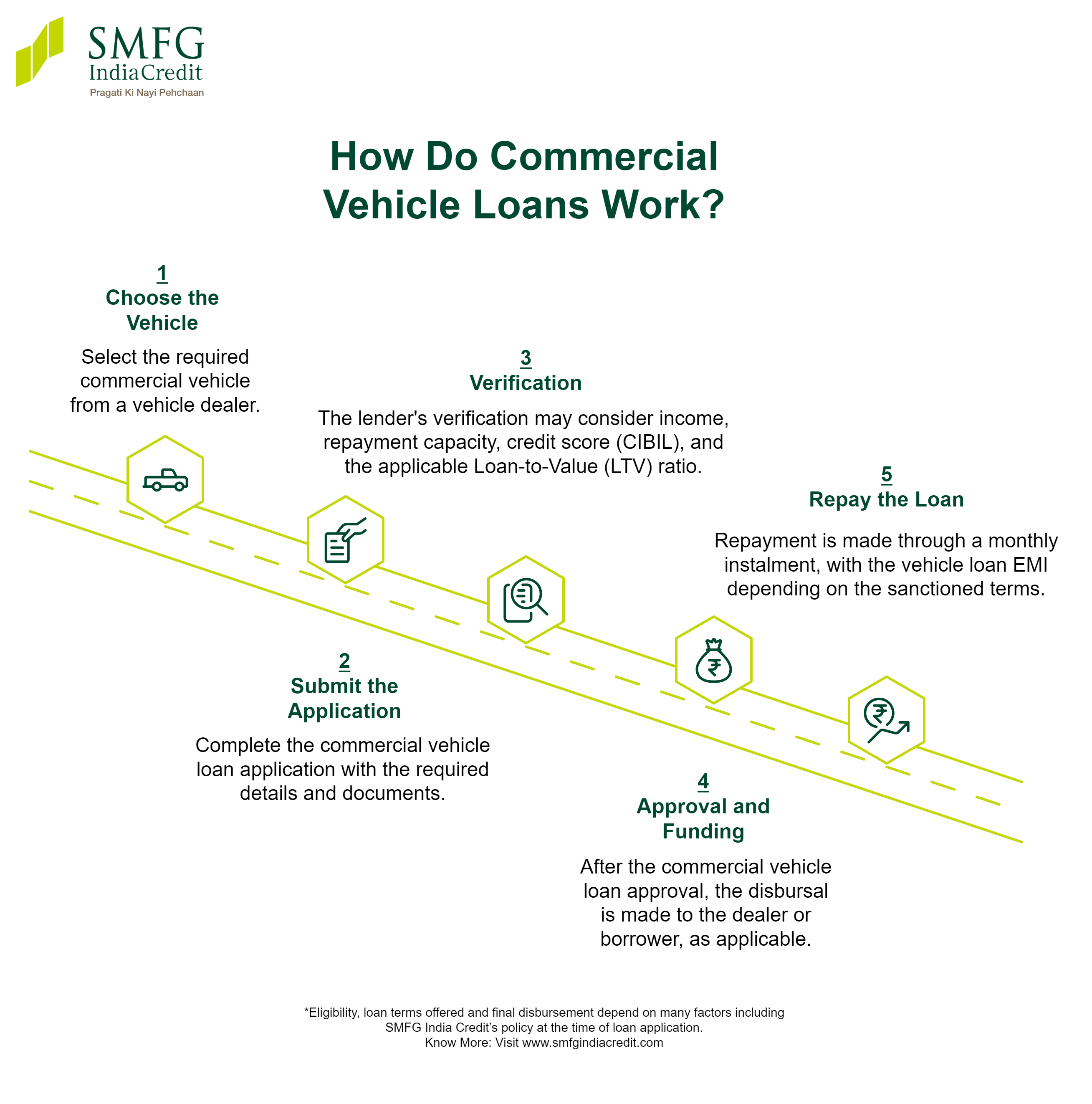
Understanding how commercial vehicle loans work is easier when the borrowing journey is broken down into the primary stages.
The commercial vehicle loan process typically begins with choosing a suitable vehicle and continues until the borrowed amount is repaid.
- Choose the Vehicle: Select the required commercial vehicle from a vehicle dealer.
- Submit the Application: Complete the commercial vehicle loan application with the required details and documents.
- Verification: The lender's verification may consider income, repayment capacity, credit score (CIBIL), and the applicable Loan-to-Value (LTV) ratio.
- Approval and Funding: After the commercial vehicle loan approval, the disbursal is made to the dealer or borrower, as applicable.
- Repay the Loan: Repayment is made through a monthly instalment, with the vehicle loan EMI depending on the sanctioned terms.
Types of Commercial Vehicles Covered Under the Loan
The types of commercial vehicle loans available can differ according to the vehicle category and its intended commercial purpose. Common commercial vehicle financing options may cover:
- Goods Vehicles: A commercial truck loan may finance a goods carrier, tipper, trailer, mini truck, Heavy Commercial Vehicle (HCV), or Light Commercial Vehicle (LCV).
- Passenger Vehicles: A bus loan or taxi loan can fund a bus, van, three-wheeler, or another passenger vehicle used commercially.
- Other Commercial Vehicles: A loan for commercial vehicles may also cover commercially operated tractors and certain special-purpose vehicles.
Depending on the lender and vehicle, borrowers may be able to choose between a new commercial vehicle loan and a used commercial vehicle loan.
Documents Required for a Commercial Vehicle Loan
The commercial vehicle loan documents required usually include the applicant's identity, address, income, business, and vehicle details. Depending on the applicant profile and lender requirements, these may include:
|
Document Type
|
Documents
|
|
Identity, Address, and Age Proof
|
PAN card, Aadhaar, passport, driving licence, voter ID, or other accepted proofs
|
|
Financial Documents
|
Recent bank statements, Income Tax Returns, profit and loss statements, and balance sheets
|
|
Business Documents
|
Business ownership or constitution proof and Goods and Services Tax (GST) details, where applicable
|
|
Vehicle Documents
|
Vehicle details, valuation report, Registration Certificate (RC), and motor insurance documents
|
|
Other Documents
|
Photographs, application form, fleet details, trade references, and repayment track record, where applicable
|
The above list is indicative. Additional documents may be requested depending on the lender terms, applicant profile, and vehicle type.
Who Can Apply for a Commercial Vehicle Loan?
A business vehicle loan may be available to different types of borrowers who need a vehicle for commercial activities. Commercial vehicle loan eligibility can vary by lender, but applicants commonly include:
- An individual borrower purchasing a vehicle for commercial purposes
- A self-employed applicant using the vehicle to support business operations
- A transport operator providing goods or passenger transportation services
- A fleet owner looking to add vehicles or replace existing ones
- An MSME engaged in logistics, distribution, transport, or other eligible activities
- A proprietorship or partnership firm
- A private limited company or other eligible business entity
- Logistics businesses requiring vehicles for regular operations
The lender typically verifies the applicant’s profile, business requirements, repayment capacity, and other applicable criteria before approving the loan.
Tips to Improve Commercial Vehicle Loan Approval Chances
A well-prepared application can make it easier for the lender to assess your borrowing profile. While approval is subject to several factors, the following commercial vehicle loan tips may help you improve loan approval chances:
- Maintain a healthy credit score, as it can indicate responsible borrowing and repayment behaviour.
- Keep your latest bank statement and other relevant financial records ready for assessment.
- Request a loan amount that is appropriate for the vehicle cost, your business needs, and your financial position.
- Consider making a higher down payment, if financially feasible, to reduce the amount you need to borrow.
- Provide accurate information and submit complete documents to help avoid unnecessary delays during verification.
- Select a suitable tenure that keeps instalments manageable based on your commercial vehicle loan repayment capacity.
Following these steps can help present a clearer financial profile and support a smoother application assessment.
Factors to Consider Before Choosing a Commercial Vehicle Loan
Before selecting commercial vehicle finance, compare the terms carefully to understand how the loan may affect your business cash flow over the repayment period. Some important factors to consider include:
- Compare the commercial vehicle loan interest rate offered by different lenders, along with the applicable fees and charges.
- Check how much of the vehicle's cost can be financed and how much you may need to pay upfront.
- Review the available repayment tenures and choose one that suits your expected cash flow.
- Calculate the Equated Monthly Instalment (EMI) to determine whether the monthly repayment is manageable for your business.
- Read the loan terms for prepayment, foreclosure, late payment, and other applicable charges.
- Consider the lender's or the Non-Banking Financial Company's (NBFC) application process, customer support, and expected processing time before making a decision.
Conclusion
A commercial vehicle loan can help enterprises purchase a business vehicle without having to pay its entire cost upfront, making it easier to preserve funds for other operational needs. Before choosing commercial vehicle finance, it is important to review your eligibility, keep the required documents ready, check whether the EMI fits your budget, and understand the lender terms that may affect loan repayment.
If you are looking to apply for a commercial vehicle loan, SMFG India Credit offers financing solutions for eligible applicants. Apply online today or contact us for more information.