An equitable mortgage is a property-backed loan arrangement where the borrower deposits original title deeds with the lender as security without formally transferring legal ownership. This equitable mortgage meaning is fundamental to understanding how borrowers in India can access funds quickly against property.
Unlike a registered mortgage, an equitable mortgage skips sub-registrar registration, making it faster, more private, and more cost-effective. For anyone navigating property finance or Loans Against Property in India, understanding how an equitable mortgage works is essential.
What Is an Equitable Mortgage?
To define an equitable mortgage in India simply: it is a loan secured by depositing title deeds with a lending institution, without executing a formal registered deed. The equitable mortgage meaning under the Transfer of Property Act, 1882, covers mortgages created in notified towns by mere deposit of title documents.
Essentially, a borrower hands over original property documents to a lender, who holds them as collateral until the loan is fully repaid.
An equitable mortgage example: a business owner in Mumbai deposits title deeds of a commercial property with a financial institution to secure a Loan Against Property. No sub-registrar visit is required. The deposit itself creates the security interest under Indian law.
Key Features and Aspects of Equitable Mortgage
The key features of equitable mortgage include:
- No Registration Required: This is the core equitable mortgage aspect. Unlike a registered mortgage, no formal registration with the sub-registrar is needed, reducing costs and time.
- Deposit of Title Deeds: The borrower hands over the original title documents. This property deed mortgage creates the lender's security interest.
- Borrower Retains Ownership: Legal title stays with the borrower throughout the loan term.
- Privacy: Equitable mortgage features include confidentiality, i.e. it is not recorded in public registers.
- Lower Costs: Stamp duty and registration charges can be significantly lower compared to a registered mortgage.
- Lender Rights: The lender holds the title deeds and can seek a court order to sell the property if the borrower defaults.
Importance of Equitable Mortgages in Real Estate
The importance of equitable mortgages in real estate lies in their ability to offer an accessible and quick way to secure loans using property as collateral. This method of equitable charge enables property owners to get the necessary funds while retaining ownership, making it a preferred option in many real estate dealings.
How to Create an Equitable Mortgage?
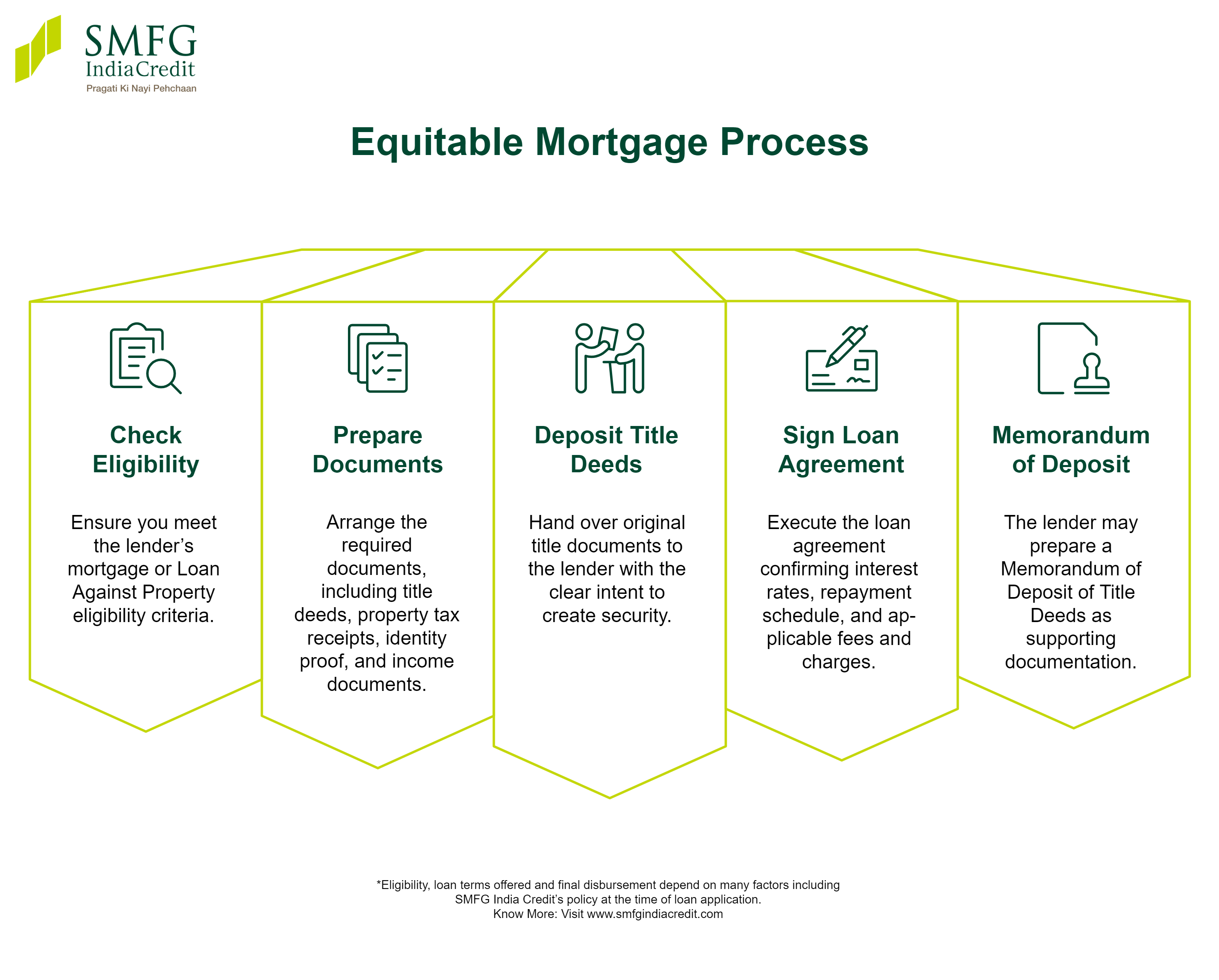
Here’s how a typical equitable mortgage process in India works:
- Check Eligibility: Ensure you meet the lender’s mortgage or Loan Against Property eligibility criteria based on income, property type, creditworthiness, and other underwriting factors.
- Prepare Documents: Arrange the required Loan Against Property documents, including original title deeds, property tax receipts, identity proof, and income documents.
- Deposit Title Deeds: Hand over original title documents to the lender with the clear intent to create security.
- Sign the Loan Agreement: Execute the loan agreement confirming interest rates, repayment schedule, and applicable fees and charges.
- Memorandum of Deposit: Depending on state regulations and lender policy, the lender may prepare a Memorandum of Deposit of Title Deeds as supporting documentation.
How Does an Equitable Mortgage Work?
Equitable mortgages usually involve the borrower depositing the title deed or ownership documents with the lender. The lender then provides the loan based on the agreed terms, such as the Loan Against Property interest rates and repayment schedules. During the loan term, the borrower retains ownership of the property, while the lender holds the title deeds as security. If the borrower repays the loan as agreed, the title deeds are returned, and the mortgage is discharged. However, if the borrower defaults, the lender can seek a court order to sell the property and recover the loan amount. This process offers a flexible and efficient way for borrowers to access funds. Unlike registered mortgages, it does not make the debt publicly known.
While equitable mortgages can be beneficial in terms of quick processing, privacy, and the ability to retain property rights or ownership, it is crucial to understand the repayment terms and the legal consequences involved.
Pros and Cons of Equitable Mortgages
Pros:
- Creating an equitable mortgage is generally a quicker process than a formal mortgage.
- Borrowers retain their property rights and ownership while still securing a property loan.
- The terms of an equitable mortgage, such as interest rates and repayment schedules, can be adjusted to suit the needs of both the borrower and the lender.
- Equitable mortgages can offer greater privacy since they are not registered publicly.
Cons:
- By not being registered in public records, equitable mortgages may provide less legal protection compared to registered mortgages.
- If the borrower defaults, the lender can still foreclose on the property. Further, the process can be more time-consuming and complex compared to registered mortgages.
Key Differences Between Equitable Mortgage and Registered Mortgage
The registered mortgage and equitable mortgage differences are given in the table below:
|
Feature
|
Equitable Mortgage
|
Registered Mortgage
|
|
Registration
|
Not required; title deeds deposited
|
Mandatory with the sub-registrar
|
|
Speed
|
Quicker, minimal paperwork
|
Slower; formal legal process
|
|
Public Record
|
Private; not publicly recorded
|
Visible in public records
|
|
Legal Protection
|
Lower; court order needed to enforce
|
Stronger enforceability
|
|
Cost
|
Lower; minimal stamp duty as per state laws
|
Higher; stamp duty applicable
|
These distinctions also clarify the broader comparison of an equitable mortgage vs a registered mortgage in property-backed lending.
Similarities Between Equitable Mortgage and Registered Mortgage
The key similarities in mortgages – equitable and registered – are that both serve the same fundamental purpose: creating a security interest for the lender against the borrower's property.
Another important addition to equitable and registered mortgage similarities is that both support a Loan Against Property structure and require property valuation, title verification, and borrower eligibility checks.
Both require the borrower to meet the agreed repayment terms, as non-repayment may lead to enforcement of the security interest. A Micro Loan Against Property uses similar collateral principles.
Both types are governed by the Transfer of Property Act and Indian law, and both create binding legal obligations on borrower and lender alike.
Judicial Rights Associated With Movable and Immovable Property
Judicial rights associated with movable and immovable property differ based on legal classification. Immovable property (lands or buildings) rights include ownership, transfer, exclusive possession, use, development, and legal protection against infringements under Indian law and Contract Law.
Movable property (vehicles or furniture) has simpler ownership transfer procedures and can also serve as collateral.
Both categories share rights such as seeking legal remedies, enforcing contracts, addressing inheritance issues and potentially dealing with an equitable lien. The latter is less common for movable property due to its generally lower value.
Conclusion
An equitable mortgage offers property owners a practical, cost-efficient way to access funds by depositing title deeds as security. Understanding what an equitable mortgage is helps borrowers make informed and confident financial decisions.
If you are looking for mortgage loan options, SMFG India Credit offers Loans Against Property up to 70%* of the property’s market value, depending on your eligibility. Use our Loan Against Property EMI calculator to estimate your monthly obligations and apply online today! Contact us or visit your nearest branch to know more.