A margin call in a Loan Against Securities may arise when the market value of the pledged securities falls, resulting in the outstanding loan amount exceeding the margin limit maintained under the lender's terms. In such situations, the lender may ask the borrower to restore the required margin by providing additional collateral or repaying part of the loan. Since the value of securities can fluctuate over time, it is important to understand how a LAS margin call works.
This article explains the meaning of a margin call in LAS and how the process works, along with practical examples.
What Is a Margin Call in Loan Against Securities?
In a Loan Against Securities (LAS), a margin call is a request from the lender asking the borrower to restore the required LTV ratio when the collateral value of the pledged securities, such as shares, mutual funds, or other eligible securities, falls below the prescribed level.
Essentially, the margin call meaning in a Loan Against Securities is that the outstanding loan has become higher than the permitted borrowing level relative to the current value of the pledged assets. Following a Loan Against Securities margin call, the borrower is generally required to provide additional eligible securities, repay part of the loan, or take another action specified by the lender to restore the required margin.
Why Margin Matters in Loan Against Securities
The margin in a Loan Against Securities helps ensure that the value of the pledged assets remains sufficient in relation to the outstanding loan, even if market prices fluctuate. Since the value of securities can rise or fall over time, the lender/NBFC maintains a safety margin to support the approved LTV throughout the loan tenure. Meeting the LAS margin requirement helps keep the loan within the permitted borrowing limit.
- Helps account for market volatility affecting the value of pledged securities.
- Provides a buffer between the loan amount and the value of the pledged collateral.
- Supports continued compliance with the required margin throughout the loan tenure.
- May require the borrower to restore the margin if the value of the pledged assets declines.
How Does the Margin Call Process Work?
The Loan Against Securities margin call process generally involves the lender regularly monitoring the value of the pledged assets. If the collateral value falls and the permitted borrowing level is exceeded, a margin call may be triggered.
As part of the LAS margin call process, the borrower is notified and asked to restore the required margin within the specified timeframe. This is typically done by making a partial repayment or pledging additional securities. Once the required action is completed, the lender reassesses the account. If the shortfall is not addressed within the stipulated period, the lender may proceed with a pledged securities sale, as permitted under the loan terms.
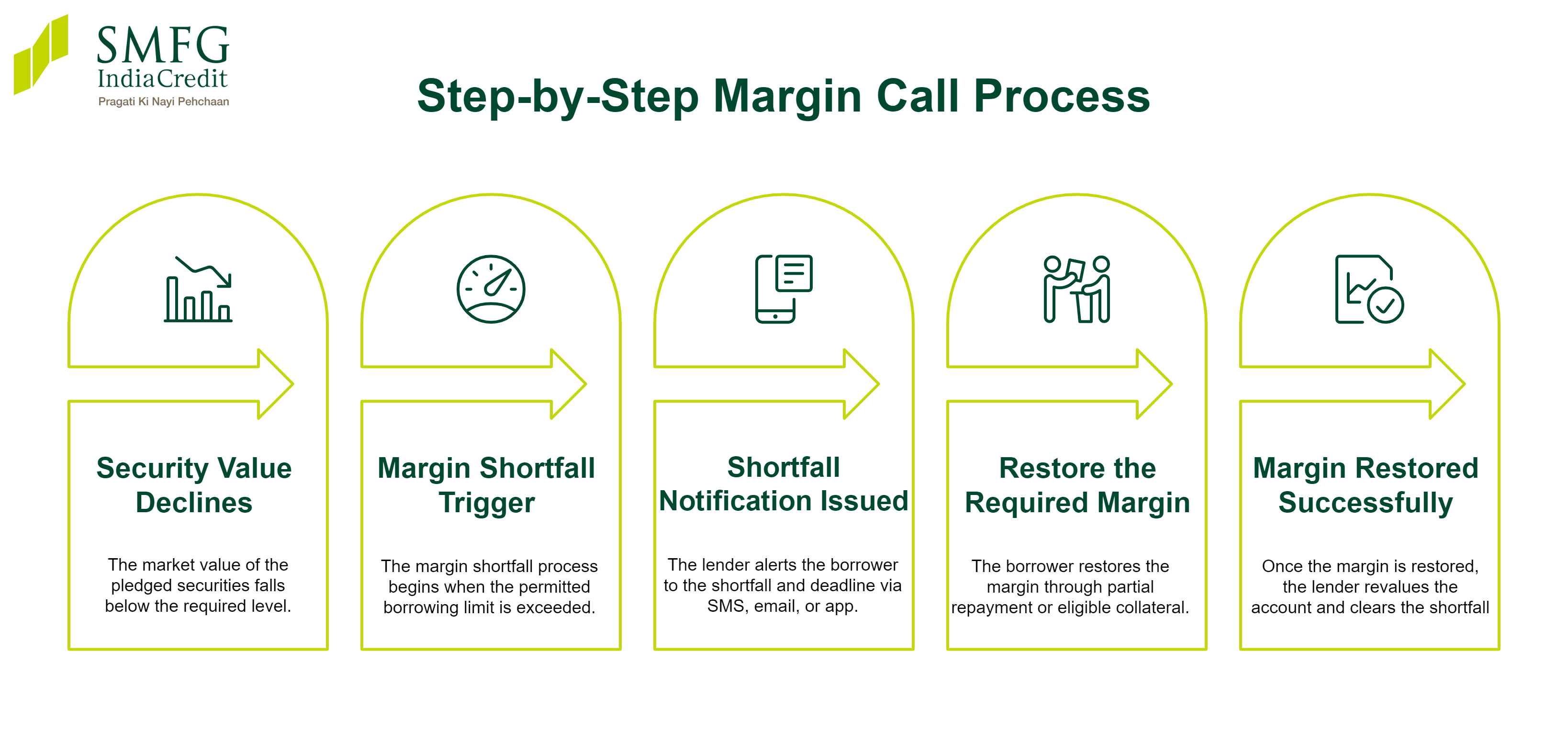
Step-by-Step Margin Call Process
- The market value of the pledged securities falls below the required level.
- The margin shortfall process begins when the permitted borrowing limit is exceeded.
- The lender sends an SMS alert, email alert, or app notification informing the borrower of the shortfall amount and the timeline for compliance.
- The borrower restores the required margin by making a partial repayment or providing additional eligible collateral.
- The lender revalues the account and, once the required margin is restored, the shortfall is removed.
These LAS margin call steps help ensure the loan continues to meet the agreed terms.
What Happens If You Ignore a Margin Call?
If you ignore margin call notifications, the lender may take action in accordance with the loan agreement to restore the required margin. The exact margin call consequences depend on the lender's policies and the terms of the loan, making it important to respond within the specified timeline.
- The lender may levy applicable charges, where provided under the loan terms.
- Your available drawing power may be reduced until the required margin is restored.
- Further withdrawals from the loan account may be restricted.
- A forced sale of pledged securities may be initiated if the shortfall remains unresolved.
- Payment delays or non-compliance may be reported in accordance with the loan terms.
- Selling investments during unfavourable market conditions may result in an investment loss.
Forced Sale of Pledged Securities
A forced sale of pledged securities may occur if the borrower does not restore the required margin within the timeline specified in the loan agreement. In such cases, the lender sells pledged shares or other eligible securities to recover the outstanding dues, depending on the terms of the Loan Against Shares or the applicable LAS facility. Since the sale may take place at the prevailing market price, the proceeds may differ from the value the borrower expected. Understanding the lender's LAS liquidation process can help borrowers respond promptly if a margin call is issued.
Margin Call Example in Loan Against Securities
The following Loan Against Securities margin call example shows how a call may arise when the value of the pledged investments declines. Suppose a borrower avails of a Loan Against Mutual Funds by pledging investments worth Rs. 12,00,000. With an allowed LTV of 50%, the loan outstanding is Rs. 6,00,000. If the market value falls to Rs. 9,00,000, the permitted loan reduces to Rs. 4,50,000, creating a shortfall of Rs. 1,50,000. The borrower must either repay Rs. 1,50,000 or provide additional collateral to restore the required margin.
Margin Call Calculation Summary
|
Particulars
|
Before Market Fall
|
After Market Fall
|
|
Collateral Value (Rs.)
|
12,00,000
|
9,00,000
|
|
Allowed Loan at 50% LTV (Rs.)
|
6,00,000
|
4,50,000
|
|
LAS Shortfall Calculation (Rs.)
|
Nil
|
1,50,000
|
|
Repayment Required (Rs.)
|
Nil
|
1,50,000
|
Margin Call Considerations for Shares, Mutual Funds, and Bonds
The likelihood of a margin call can vary depending on the type of security pledged, as different asset classes experience different levels of price movement. Understanding these differences can help borrowers manage their Loan Against Securities more effectively. While all eligible securities are subject to changes in value, the extent of volatility and fluctuations in the NAV or market price may influence how often the required margin needs to be maintained.
|
Security Type
|
Typical Price Movement
|
Margin Call Considerations
|
|
Shares
|
Generally higher
|
Individual share prices may fluctuate significantly, which can affect the value of pledged securities.
|
|
Equity Mutual Funds
|
Moderate to high
|
The NAV changes with market performance, so the pledged value may rise or fall over time.
|
|
Debt Mutual Funds
|
Generally lower
|
Debt funds are typically less volatile than equity funds, although their value can still fluctuate.
|
|
Bonds
|
Generally lower
|
Bonds may experience relatively smaller price movements, but changes in interest rates and market conditions can still affect their value.
|
Understanding these margin call considerations for shares and mutual funds and broader LAS collateral value movements can help borrowers monitor their pledged investments and respond promptly if the lender requires the margin to be restored.
Loan Against Securities Margin Call vs Stock Trading Margin Call
Although both involve a margin call, they apply in different situations. A LAS margin call vs trading margin call comparison shows that a Loan Against Securities is a loan secured against pledged securities, whereas a trading margin call relates to leveraged market positions maintained through a broker. In Loan Against Securities vs margin trading, the former is intended for borrowing against existing investments, while the latter supports the purchase or sale of securities using leverage. Understanding this margin call difference can help borrowers and investors avoid confusion.
Differences at a Glance: LAS Margin Call vs Trading Margin Call
|
Parameter
|
LAS Margin Call
|
Trading Margin Call
|
|
Purpose
|
Loan secured against investments
|
Leverage for trading
|
|
Provider
|
Financial institutions or NBFCs
|
Broker
|
|
Security
|
Pledged shares or other eligible collateral
|
Trading position funded through margin
|
|
Trigger
|
Fall in collateral value
|
Decline in the value of a leveraged trading position
|
|
Required Action
|
Repay part of the loan or pledge additional collateral
|
Deposit additional funds or securities to maintain margin
|
This comparison between LAS vs margin trading highlights that, despite the similar terminology, the two operate differently and serve distinct purposes.
Conclusion
A margin call in a Loan Against Securities is a standard mechanism used by a lender to ensure the value of the pledged assets remains aligned with the approved LTV. The margin call meaning is simply a request for the borrower to restore the required margin if the value of the pledged securities changes. To help avoid margin calls in LAS situations, borrowers should maintain a comfortable borrowing buffer, monitor the value of their collateral, and respond promptly to lender notifications with timely repayment or additional eligible securities, where required.
If you are looking to unlock the value of your investments without selling them, SMFG India Credit offers Loan Against Securities against eligible shares, mutual funds, bonds, and ETFs.
Eligible applicants can avail of a competitive Loan Against Securities interest rate starting from 9.5%* per annum.
Review the Loan Against Securities eligibility and documents required before applying online to ensure you have the necessary information and paperwork ready.
* Please note that this article is for your knowledge only. Loans are disbursed at the sole discretion of SMFG India Credit. Final approval, loan terms, disbursal process, foreclosure charges and foreclosure process will be subject to SMFG India Credit's policy at the time of loan application. If you wish to know more about our products and services, please contact us