A solvency certificate is an official document that proves your financial credibility. Whether you're applying for a visa, participating in government tenders, or seeking large contracts, this certificate plays a crucial role in showing that you have the financial strength to meet obligations.
Understanding the solvency certificate meaning is important, as it's more than just a financial statement. It reassures authorities, institutions, or partners that you are financially stable and trustworthy. To apply, you’ll typically need to fill out a solvency certificate form and submit it along with the necessary documents.
If you're unfamiliar with what the document looks like, many government sites or financial institutions offer a solvency certificate sample to guide applicants. In this article, we’ll cover what a solvency certificate is, its purpose, how to apply, and what to expect during the process.
Meaning of a Solvency Certificate
A solvency certificate is an official document that certifies the financial soundness of an individual or business. It confirms that the entity has sufficient financial resources to meet its debts and obligations. Solvency certificates are typically issued by banks or financial institutions after thoroughly assessing the entity's assets, liabilities, and financial standing.
In simpler terms, it’s a statement of financial health that demonstrates your ability to meet current and future liabilities. This certificate is often required when engaging in high-value transactions, bidding for government contracts, or making large financial commitments.
Understanding the Solvency Certificate
Now that you understand the meaning of the bank solvency certificate, let’s understand these certificates in more detail:
- Issuance: Banks, financial institutions, or state revenue departments issue solvency certificates based on the applicant's financial standing.
- Documents Required: To apply for a solvency certificate, you will generally need to provide various documents, including account statements, investment details, property certificates, and liability declarations. The exact requirements can vary depending on the issuing authority.
- Application Process: The certificate can be applied for online via state portals or offline at revenue offices. In some regions, Common Service Centers (CSC) or e-District Kiosks also offer an alternative method for applying.
- Tracking and Downloading: Applications can be tracked online, and certificates can be downloaded from state websites or platforms like DigiLocker.
A solvency certificate typically remains valid for one year. After this period, it must be renewed. The renewal process generally involves resubmitting financial documents and undergoing a re-evaluation by the issuing authority.
Why Is a Solvency Certificate Required?
A solvency certificate is an important document used in various important scenarios. For instance, it is often needed when applying for government or private tenders to show that you have the financial strength to fulfil the contract. In business contract negotiations, the certificate helps by proving your financial reliability to potential partners, which builds trust.
For visa applications, whether for work or study, a solvency certificate confirms that you have enough money to support yourself while abroad.
In legal contexts, such as resolving financial disputes, the certificate may be necessary to prove the applicant's financial stability.
Additionally, when applying for loans, lenders may ask for a solvency certificate to check your financial health and creditworthiness.
Overall, a solvency certificate is useful in various contexts, including tenders, business deals, visas, legal matters, and financial transactions, helping to show that you are financially secure and capable of meeting your obligations.
Format of a Solvency Certificate
A solvency certificate follows a standard format, which may vary slightly depending on the issuing authority. It typically includes the applicant’s name or the business name, the certified solvency amount, and a declaration from the issuing authority confirming the applicant’s financial strength. The certificate is usually backed by a bank attestation, verifying the ability of the individual or entity to cover the mentioned solvency value. This format ensures uniformity while providing clear and verifiable proof of financial credibility for legal, financial, or contractual purposes.
Issuance of a Solvency Certificate
Solvency certificates are typically issued by state revenue departments and authorised financial institutions upon request. The issuance is based on a thorough review of the applicant’s financial documents, including bank account history, property records, and net worth statements. In many cases, a report from a Chartered Accountant helps strengthen the request.
Eligibility Criteria for a Solvency Certificate in India
To obtain this certificate in India, applicants must generally meet the following eligibility criteria:
- Applicant must be an Indian citizen.
- Valid identity and address proof are required.
- Income proof, such as salary slips or ITR, must be submitted.
- Applicants should provide details of assets, investments, or property.
- Recent bank statements should reflect financial stability.
- There should be no major unpaid dues or serious legal disputes.
- The application must be submitted to the authorised local Revenue or Tehsildar Office.
Documents Required for Applying for a Solvency Certificate
To apply for a solvency certificate, several documents must be submitted for financial verification. These include a filled request form, property-related documents like encumbrance and mortgage certificates, a self-declaration, passport-sized photographs, and proof of property valuation.
Additionally, supporting financial documents such as bank statements, gold valuation statements, share investments, insurance policies, and net worth certificates issued by a Chartered Accountant are often required. These documents help the issuing authority assess the applicant's financial stability and ensure that the solvency claim is valid and well-supported. The exact document requirements may vary depending on the issuing authority.
How to Obtain a Solvency Certificate
Obtaining a solvency certificate can be done online or offline. Online, applicants need to visit the relevant official state portal, register using a mobile number, fill in the required details, upload documents, and make a payment. Offline, one can collect and submit the application form at the local Revenue or Municipal Office.
Alternatively, Common Service Centres (CSCs) or e-District Kiosks offer assistance for application submissions. Each method requires accurate documentation and verification. Once processed, the certificate is issued either digitally or as a physical copy.
Who Will Issue the Solvency Certificate?
Solvency certificates are issued by financial institutions, state revenue departments, and authorised banks. Banks can issue certificates to their account holders based on their transaction history, account balance, and property documents. Revenue departments issue them after verifying ownership and financial records. Chartered Accountants can also assist by providing a net worth certificate, which is often required during the process.
However, the final issuance is typically authorised by banks or government offices after thorough due diligence. Only reliable, trustworthy applicants are granted this certificate.
How to Apply for a Solvency Certificate?
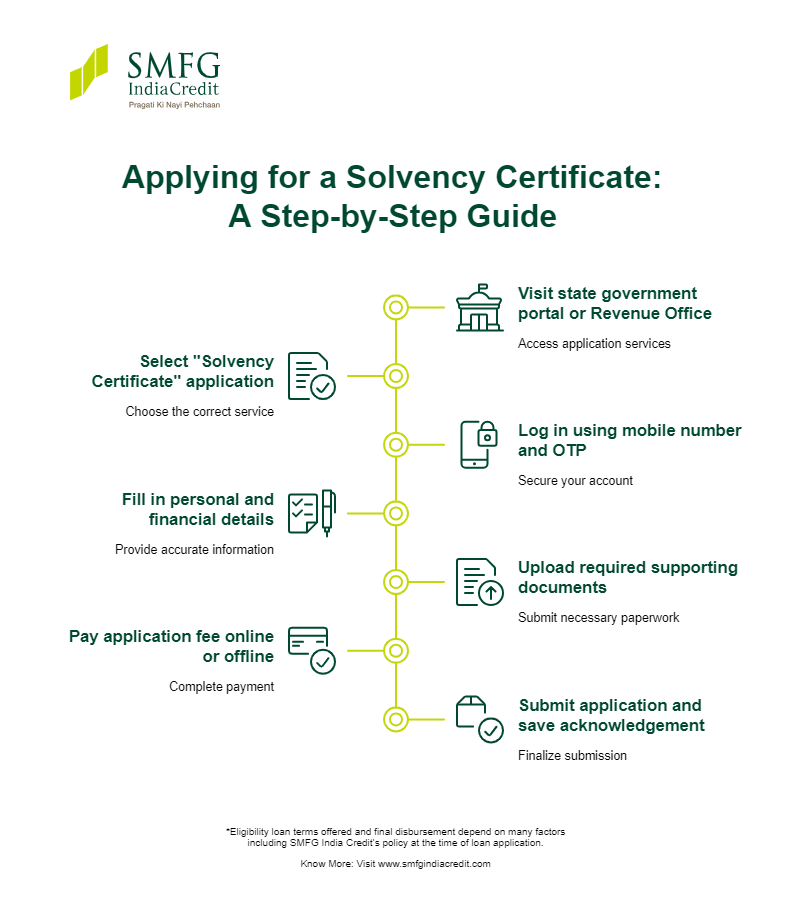
The process for submitting an application for a solvency certificate generally involves the following steps:
- Visit your state government’s official portal or nearest Revenue Office.
- Select the “Solvency Certificate” application service.
- Log in using your mobile number and OTP.
- Fill in personal and financial details carefully.
- Upload the required supporting documents.
- Pay the applicable application fee online or offline.
- Submit the application and save the acknowledgement number for tracking.
For offline applications, you must submit the completed form and documents in person at the designated office. The exact process may vary slightly across states.
How to Download a Solvency Certificate?
Once your application for a solvency certificate is approved, you can download it from the same official website used for submission. The general steps involve navigating to the homepage and selecting the "Check Status" option. Enter your application number and click on "Search" to locate your record.
Once verified, click on "Download Certificate" to save a copy to your device. Ensure that all certificate details are correct before downloading. The process may vary slightly depending on the state-specific portal used for the application.
How to Download Solvency Certificates Through DigiLocker?
To download your solvency certificate using DigiLocker, first log in to your DigiLocker account. Go to the 'Issued Documents' section and look under the 'Check Partners ' section. Select your state’s Revenue Department from the partners list. Then click on 'Solvency Certificate', enter your acknowledgement number, and click on ‘Accept’.
Once verified, click ‘Get Document’ to download and save the certificate. This method links your official certificate with DigiLocker, ensuring secure and paperless access to your financial documents.
How to Track the Application Status of a Solvency Certificate?
You can track your solvency certificate status through the official state website where it was submitted. Visit the site, go to the ‘Online Application’ section, and click on ‘Application Status’. Enter the relevant application number and type, then click on ‘Get Status’ to view the current progress.
Since different states may have slightly different systems, it’s important to follow the instructions on the specific portal used. Tracking helps applicants stay updated and ensures the timely receipt of their certificate.
Processing Time for Solvency Certificate
The processing time is typically around one week post-document submission, depending on the institution and complexity of the financial profile.
Understanding Solvency Certificate Charges
The cost of obtaining a solvency certificate in India generally varies from bank to bank, but it is typically around Rs. 2,000. The fee may also depend on the amount of solvency being certified. For larger sums or greater levels of financial risks, the charge may be higher. It is always wise to confirm the exact solvency certificate charges with your bank or financial institution before applying.
The solvency certificate charges are a necessary expense given the value this document provides. Whether you're securing a large business contract or applying for an international visa, paying the solvency certificate charges is a worthwhile investment to establish your financial credibility.
Decoding the Bank Solvency Certificate Format
The format of a solvency certificate from banks is usually straightforward, but it can vary slightly depending on the issuing institution. Typically, the certificate includes the following elements:
- Reference Number and Date: The certificate starts with a reference number and the date of issuance to ensure tracking and validation.
- Recipient’s Information: A section addressed “TO WHOMSOEVER IT MAY CONCERN.”
- Certification Statement: A formal statement certifying that, to the best of the bank’s knowledge, the customer is solvent.
- Customer’s Details: This includes the name and complete address of the individual or business receiving the certificate.
- Signature and Seal: The certificate should be signed by the branch manager and include the bank's official seal to authenticate the document.
While this is a general format, it’s always important to double-check with the specific bank or institution for any variations, as requirements might differ slightly depending on the policies of the institution.
Types of Solvency Certificates: Personal, Business, Bank and More
- Personal Solvency Certificate: Proves an individual’s financial stability and is commonly used for visa applications, tenders, and government processes.
- Business Solvency Certificate: Confirms a company’s ability to meet financial obligations for contracts, registrations, and partnerships.
- Bank Solvency Certificate: Issued by an authorised financial institution to verify account history, balances, and creditworthiness.
- Property Solvency Certificate: Highlights the value of owned property and is often used for loans, guarantees, and legal matters.
- Tax Solvency Certificate: Confirms that an individual or business has complied with tax regulations and cleared major dues.
Validity Period and Renewal Process of a Solvency Certificate
The validity period of a solvency certificate typically ranges from 6 months to 1 year from the date of issue, depending on the issuing authority and the certificate's purpose. Once it expires, it cannot be reused, and you must reapply with updated financial documents, such as proof of income and asset details. The authority re-evaluates your financial position before issuing a renewed certificate. Since validity rules may vary for different tenders or applications, always confirm the requirements beforehand.
Navigating the Challenges of Obtaining a Solvency Certificate
Although beneficial, the solvency certificate application process can present some challenges, such as:
- Extensive Paperwork: Applicants must gather numerous documents, including bank statements, property valuations, investment details, and a net worth certificate from a Chartered Accountant. Requirements vary across institutions, which adds to the complexity.
- Lengthy Processing Time: Once you’ve submitted your application, the processing time can vary, depending on the institution and the complexity of your financial situation. This can take anywhere from a few days to several weeks, which can be problematic if you need the solvency certificate urgently.
- Strict Eligibility Criteria: Financial institutions may impose minimum balance requirements, transaction history assessments, and other financial criteria to issue a solvency certificate.
- Solvency Amount Calculation: Calculating the appropriate solvency amount can be complex. Lending institutions often use their own internal guidelines, which may not be fully transparent, making it difficult for applicants to understand how their financial strength is assessed.
- Lack of Clear Communication With the Issuing Authority: Ambiguities regarding the status of the application or additional requirements can lead to confusion and unnecessary delays.
- Renewal and Validity Issues: Solvency certificates are generally valid up to one year, requiring timely renewals and additional paperwork, adding to the administrative burden.
Is a Solvency Certificate Required for a Business Loan?
A solvency certificate may help strengthen a business loan application by demonstrating financial stability and repayment capacity. However, it is not always mandatory, as requirements vary across lenders and loan types. Financial institutions generally assess factors such as income, business performance, repayment history, and overall credit profile before approving a loan. Commonly requested business loan documents may include bank statements, income tax returns, and CA-audited financial statements.
Accurate financial records and complete documentation can support a smoother evaluation process during loan assessment. Along with meeting eligibility criteria and maintaining a strong credit profile, this may also improve the chances of securing a favourable business loan interest rate. Applicants should always check the specific requirements and documentation policies of the lender before applying.
Conclusion
With a solvency certificate, businesses can showcase their financial credibility to investors, lenders, or other stakeholders. However, challenges such as lengthy processing time and extensive paperwork can make obtaining a bank solvency certificate difficult, especially if you need it urgently.
Looking for a business finance solution but don’t have a solvency certificate? SMFG India Credit provides unsecured business loan with minimal documentation requirements, including official statements and CA-audited balance sheets.
Eligible applicants can apply for tailored loans of up to Rs. 1 crore* at attractive interest rates and flexible tenures of up to 60 months*. Check your business loan eligibility and apply online today to take the first step towards achieving your goals.
Before applying, consider using a business loan eligibility calculator to estimate the eligible loan amount and better understand your repayment capacity.