The Balance of Payments (BOP) is a systematic record of economic transactions between a country's residents and the rest of the world during a specific period. It provides governments, businesses, and investors with insights into a country's international trade, investment flows, and other cross-border transactions, making it an important indicator of its external economic position.
Let us learn more about what the balance of payments is, its key components, formula, and importance.
What Is Balance of Payments?
The balance of payments meaning refers to a systematic record of economic transactions between the residents of a country and the rest of the world over a given period, usually a quarter or a year. In simple terms, it records transactions such as earnings from exports, services, and investments, as well as expenditure associated with imports and other international transactions.
It is not limited to trade alone. The BOP includes the exchange of goods, services, income, investments, loans, and transfers such as remittances. Every international transaction is recorded using a double-entry accounting system, ensuring that the total balance of payments theoretically equals zero when all accounts are considered.
In India, the Reserve Bank of India (RBI) compiles and publishes BOP statistics, which help assess the country's external economic position and track developments in areas such as trade, capital flows, and foreign exchange reserves. BOP trends can also provide useful insights for economic and policy decisions related to the country's external sector.
Balance of Payment Definition
The balance of payments is a comprehensive accounting statement that records economic transactions between a country's residents and the rest of the world during a specific period. It covers international trade, investment, income, transfers, and financial flows, helping policymakers assess the country's external economic position and understand its transactions with the global economy.
Balance of Payment Example
Suppose India exports pharmaceuticals worth Rs. 500 crore while importing crude oil worth Rs. 450 crore. During the same period, foreign companies invest Rs. 200 crore in Indian businesses, while Indian workers abroad send Rs. 100 crore in remittances to India. These transactions are recorded under different BOP components, providing a broader picture of India's international economic activities than the trade balance alone.
Balance of Payment Components
The balance of payments is generally organised into three main accounts, each covering different types of international transactions. Together, they provide a structured view of a country's transactions with the rest of the world.
|
Component
|
What It Records
|
Example
|
|
Current Account
|
Trade in goods and services, primary income, and secondary income
|
Export of textiles, software services, remittances
|
|
Capital Account
|
Capital transfers and transactions in non-produced, non-financial assets
|
Debt forgiveness, transfer of certain rights or licences
|
|
Financial Account
|
Cross-border financial assets and liabilities, including reserve assets
|
Foreign Direct Investment (FDI), Foreign Portfolio Investment (FPI), foreign exchange reserves
|
Current Account
The current account records exports and imports of goods and services, primary income such as investment income and compensation of employees, and secondary income such as remittances. For example, software exports, tourism receipts, imported machinery, and money sent home by Indians working overseas can be reflected in the current account. A current account surplus occurs when total credits exceed debits, while a deficit occurs when debits exceed credits.
Capital Account
The capital account records capital transfers and transactions involving non-produced, non-financial assets. These may include debt forgiveness and transfers involving certain rights, licences, leases, or other non-produced assets. Although the capital account is generally smaller than the current and financial accounts, it captures specific transactions that are not recorded under the other two accounts.
Financial Account
The financial account in the balance of payments records transactions involving financial assets and liabilities between a country's residents and the rest of the world. It includes FDI, portfolio investment in instruments such as shares and bonds, other investment such as loans and deposits, and transactions involving reserve assets held by the central bank. The financial account helps show how cross-border investment and financing flows relate to a country's overall external position.
Balance of Payments Formula
The balance of payments follows a double-entry accounting system, meaning international transactions are recorded through corresponding credit and debit entries. Theoretically, the overall BOP should balance to zero, as credits and debits offset each other. However, recorded figures may not balance perfectly in practice because of differences in data sources, timing, valuation, or unrecorded transactions. These discrepancies are captured under net errors and omissions.
A basic balance of payments formula can be:
Current Account + Capital Account + Financial Account + Net Errors and Omissions = 0
|
Component
|
Purpose
|
|
Current Account
|
Records trade in goods and services, primary income, and secondary income.
|
|
Capital Account
|
Records capital transfers and transactions in non-produced, non-financial assets.
|
|
Financial Account
|
Records direct investment, portfolio investment, other investment, and reserve assets.
|
|
Net Errors and Omissions
|
Captures statistical discrepancies arising from incomplete or inconsistent recorded data.
|
Importance of the Balance of Payments
The balance of payments is an important indicator of a country's external economic position. By recording transactions with the rest of the world, it provides insights into international trade, capital flows, foreign exchange movements, and other aspects of the external sector.
The balance of payments:
- Tracks external economic activity by recording a country's transactions with the rest of the world.
- Supports policymaking by providing data relevant to trade, monetary, exchange rate, and investment policies.
- Helps assess external vulnerability by providing insights into capital flows, reserve movements, and external financing requirements.
- Provides useful information to investors when assessing a country's external position and exposure to global economic risks.
- Helps businesses assess international markets by highlighting trends in trade, investment, and cross-border economic activity.
- Supports exchange rate analysis by providing information on international transactions and financial flows that can influence foreign currency demand and supply.
Factors That Affect the Balance of Payments
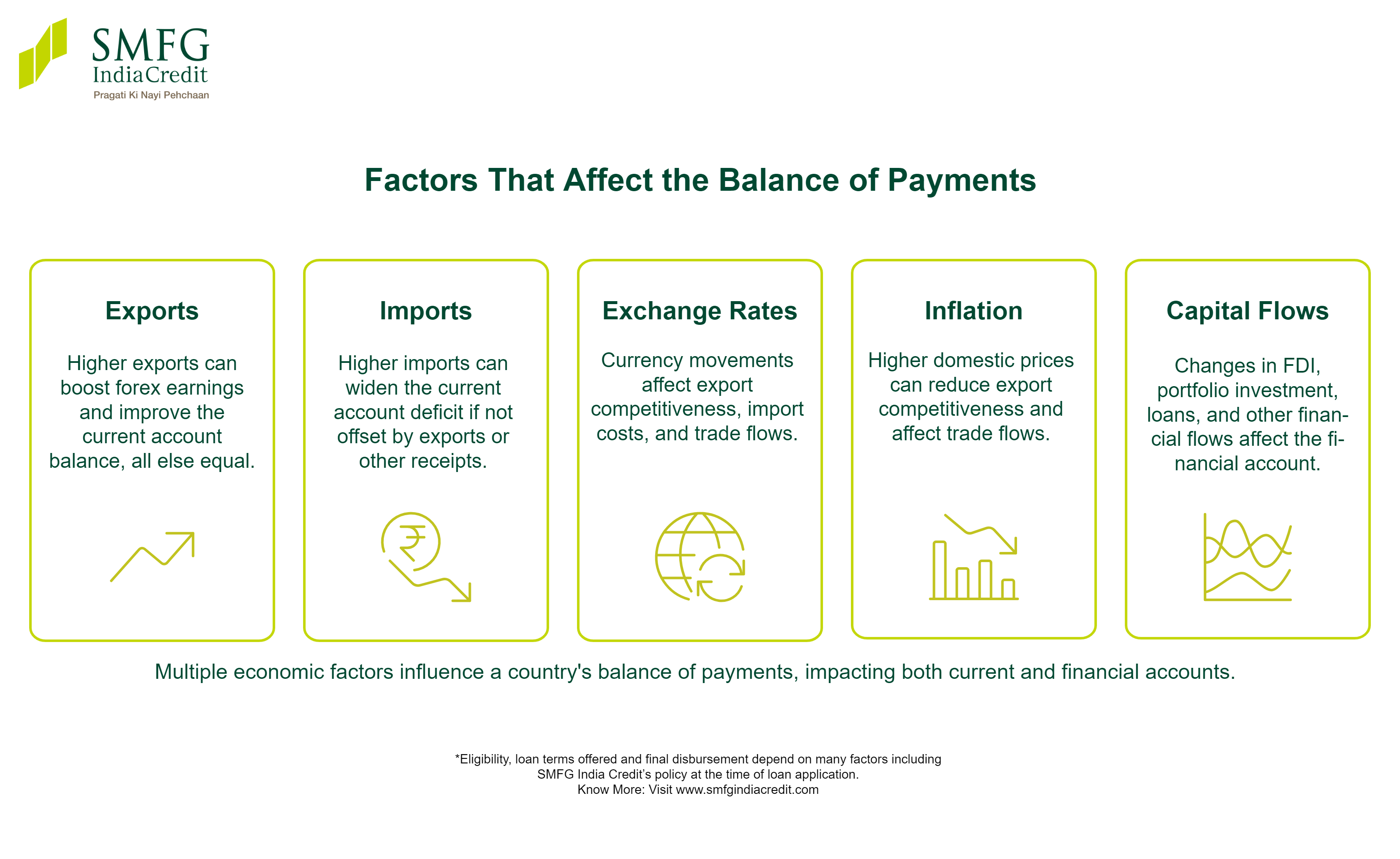
A country's BOP position can change as domestic and global economic conditions shift. Some of the main factors affecting the balance of payments are the level of exports and imports, movements in exchange rates, inflation, and cross-border capital flows. Their impact may be seen across both the current and financial accounts.
- Exports: Higher exports can increase foreign exchange earnings and improve the current account balance, provided other factors remain unchanged.
- Imports: Rising imports increase payments to other countries and can widen a current account deficit if the increase is not matched by higher exports or other current account receipts.
- Exchange Rates: Currency appreciation or depreciation can influence export competitiveness, import costs, and trade flows, although the extent and timing of the impact can vary.
- Inflation: If domestic prices rise faster than those of trading partners, locally produced goods may become relatively less competitive, potentially affecting exports and imports.
- Capital Flows: Changes in foreign direct investment, portfolio investment, loans, and other financial flows affect the financial account and can influence a country's overall external position.
Balance of Payments vs Balance of Trade
The balance of payments and balance of trade are related but serve different purposes. The balance of trade covers exports and imports of goods and forms part of the current account, while the balance of payments provides a broader record of a country's economic transactions with the rest of the world.
|
Basis
|
Balance of Payments (BOP)
|
Balance of Trade (BOT)
|
|
Meaning
|
Records economic transactions between a country's residents and the rest of the world
|
Measures the difference between the value of exports and imports of goods
|
|
Scope
|
Covers a broad range of international transactions
|
Limited to trade in goods
|
|
Includes
|
Goods, services, income, transfers, and financial transactions
|
Exports and imports of goods
|
|
Accounts
|
Includes the current, capital, and financial accounts
|
Forms part of the goods component of the current account
|
|
Purpose
|
Helps assess a country's overall external economic position
|
Indicates whether merchandise trade results in a surplus or deficit
|
How a Balance of Payments Deficit or Surplus Affects the Economy
A deficit or surplus in a BOP component can influence exchange rates, foreign exchange reserves, external borrowing, and broader economic conditions. The actual impact depends on factors such as the type of imbalance, its duration, and prevailing economic conditions.
|
Balance of Payments Deficit
|
Balance of Payments Surplus
|
|
May put pressure on foreign exchange reserves
|
May support the accumulation of foreign exchange reserves
|
|
Can put downward pressure on the domestic currency
|
Can put upward pressure on the domestic currency
|
|
May increase reliance on foreign investment or external borrowing
|
May reduce reliance on external financing
|
|
Persistent deficits may lead to measures aimed at supporting exports or managing imports
|
Persistent surpluses may provide greater flexibility in managing external obligations
|
How Business Loans Support Businesses Amid BOP Changes
Changes in trade conditions, exchange rates, and import costs can affect a company's working capital requirements and operating expenses. A business loan can provide additional funding to manage short-term cash flow needs, purchase inventory, invest in equipment, or support expansion.
Broader economic conditions associated with BOP trends can also influence the financing environment for businesses. Comparing business loan interest rates, repayment terms, and available funding options can help businesses choose suitable financing to support investment, expansion, or other growth plans.
Conclusion
The balance of payments (BOP) provides a comprehensive view of a country's economic transactions with the rest of the world for a specified period. Its current, capital, and financial accounts help track trade, investment, and financial flows and assess the country's external economic position.
These broader economic movements can also affect the environment in which businesses operate and plan for growth. When additional funding is required to pursue such plans, eligible enterprises can consider an SMFG India Credit business loan of up to Rs. 1 crore* to meet their financing needs.
Before applying, you can use the business loan eligibility calculator to estimate your borrowing potential based on required financial details.
The business loan EMI calculator can then help you estimate your monthly instalments and plan repayments more effectively.
When you're ready, apply online with minimal business loan documents required, or contact us for more details.