A cash credit loan, or a CC loan, is a popular working capital financing option that can help businesses meet their short-term operational expenses without taking a fixed-term loan. Cash credit loans may be used by manufacturers, wholesalers, retailers, traders, and Micro, Small and Medium Enterprises (MSMEs) that require flexible access to funds for regular business operations.
Read on to understand what a CC loan is and how it can help businesses manage cash flow more efficiently.
What Is a Cash Credit Loan?
A cash credit loan (CC loan) is a short-term credit facility offered by financial institutions to help businesses finance their day-to-day working capital requirements. Unlike a traditional term loan, where the entire loan amount is disbursed at once, a cash credit facility allows eligible businesses to draw funds as required, subject to the approved limit and applicable terms.
Cash Credit (CC) Loan Full Form and Meaning
The full form of a CC loan is Cash Credit Loan.
The CC loan meaning refers to a working capital credit facility that allows eligible businesses to borrow funds up to a sanctioned limit, subject to the lender's applicable terms and conditions.
*The availability of a cash credit loan facility is subject to the policies and eligibility criteria of the lender or Non-Banking Financial Company (NBFC). It is advisable to check with the specific lending institution before choosing this option. For more information, please feel free to reach out to us.
How Does a Cash Credit Loan Work?
Once the lender approves the facility, the borrower can withdraw funds as required for eligible business purposes, subject to the sanctioned limit, available drawing power, and applicable terms and conditions.
As the CC loan repayments are made, the available credit is restored, allowing the borrower to access funds again without submitting a fresh loan application each time. This revolving structure makes cash credit particularly useful for businesses with fluctuating working capital requirements.
Cash Credit Loan Features
A CC loan offers several features that make it a commonly used working capital finance option for businesses. Some of the key features include:
- Revolving Facility: Funds can be withdrawn, repaid, and reused within the available credit limit.
- Interest on Utilisation: Interest is generally charged on the amount utilised.
- Working Capital Support: Funds can be used for eligible business expenses such as inventory purchases, salaries, supplier payments, and utilities.
- Flexible Access: Businesses can access funds as required within the available limit without applying for a new loan each time.
- Sanctioned Limit: The limit is determined based on factors such as turnover, financial position, working capital requirements, repayment capacity, and the lender's assessment criteria.
- Typically Collateral-backed: Depending on the lender and facility, security may include stock, receivables, deposits, property, or other eligible assets.
- Periodic Review: Cash credit facilities are generally reviewed or renewed periodically in accordance with the lender's policies.
- Seasonal Support: The facility can help businesses manage temporary working capital requirements arising from seasonal fluctuations.
Cash Credit Loan Interest Rates
The interest rate on a cash credit loan varies from one lender to another and depends on several business- and borrower-specific factors.
Unlike a traditional business loan interest rate, where interest is generally calculated on the outstanding loan principal following disbursal, a business cash credit loan generally charges interest based on the amount actually utilised from the available credit facility.
Interest is typically calculated on the outstanding amount and debited at intervals specified by the lender. Some lenders may also levy processing fees, renewal charges, documentation charges, or other applicable fees in addition to interest.
The table below explains how interest is generally applied under a cash credit facility.
|
Particular
|
Details
|
|
Interest charged on
|
Utilised amount
|
|
Interest on unused limit
|
Generally not charged, subject to lender terms
|
|
Calculation basis
|
Outstanding amount during the utilisation period
|
|
Applicable charges
|
Processing fee, renewal fee, documentation charges, or other lender-specific fees
|
|
Interest rate
|
Varies depending on the lender, borrower profile, and facility terms
|
Factors Affecting Cash Credit Interest Rates
Some of the key factors that influence cash credit interest rates include:
- Credit Profile: A strong credit score (CIBIL) and repayment record may help you secure better rates.
- Collateral: The type, value, and acceptability of the security offered may influence the interest rate applicable to the facility.
- Business Performance: Stable revenue, cash flow, and profitability can support more favourable pricing.
- Turnover and Repayment Capacity: Higher turnover and stronger repayment ability may reduce perceived lending risk.
- Credit Utilisation: Responsible use and timely repayments can support better future borrowing terms.
- Lender Policies: Interest rates can vary depending on the lender's internal assessment criteria, applicable benchmarks, market conditions, and regulatory requirements.
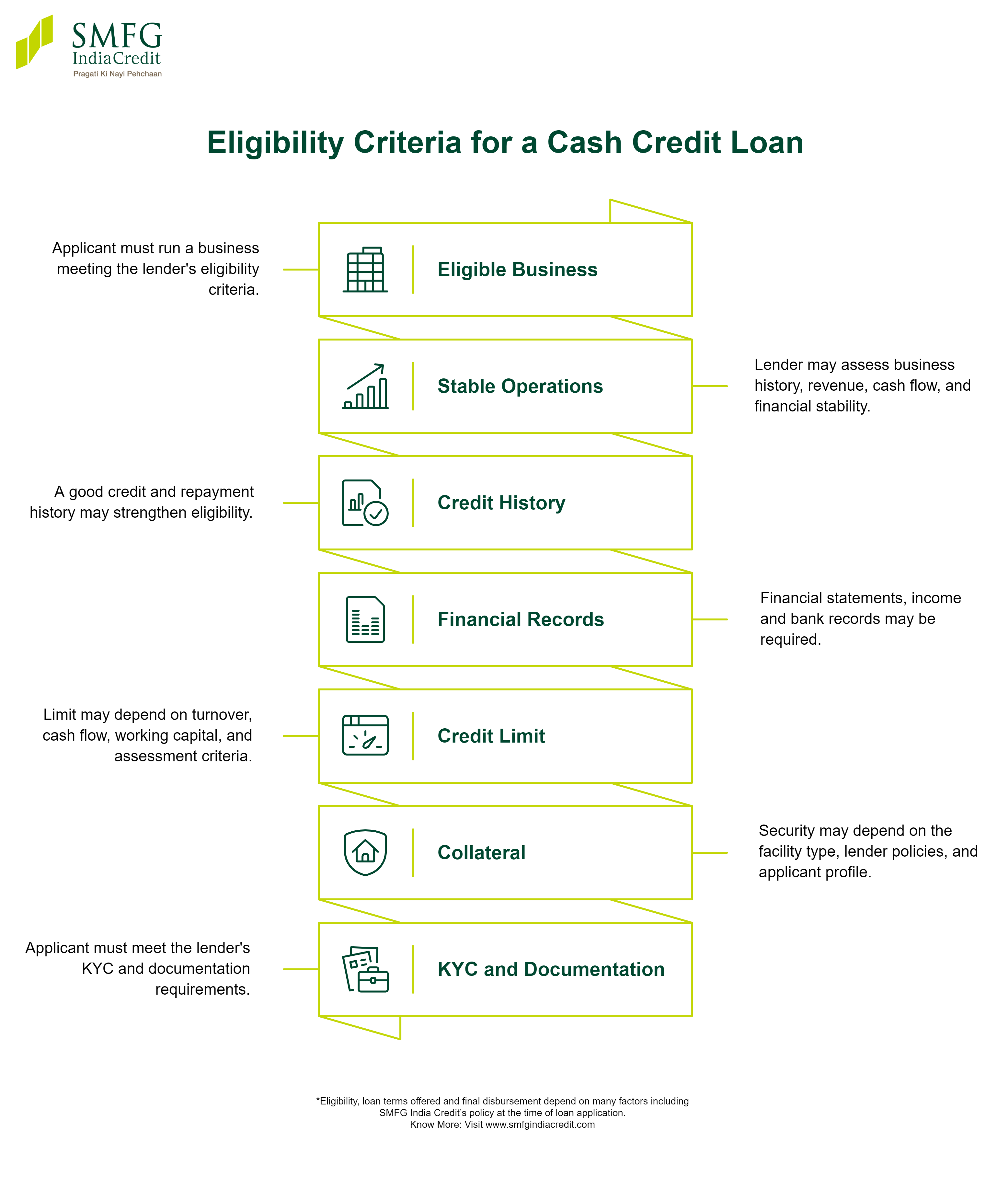
Eligibility Criteria for a Cash Credit Loan
Cash credit loan eligibility varies across lenders and financial institutions. Lenders typically assess the applicant's financial position, business performance, repayment capacity, working capital requirements, and overall creditworthiness before sanctioning a cash credit limit.
Although specific requirements differ, businesses generally need to satisfy the following conditions:
- Eligible Business: The applicant should operate a business or commercial enterprise that meets the lender's eligibility requirements.
- Stable Operations: The lender may consider the business's operating history, revenue, cash flow, and overall financial stability.
- Credit History: A satisfactory credit and repayment history may strengthen the applicant's eligibility for the facility.
- Financial Records: Financial statements, income records, bank statements, and other relevant records may be required to assess the business's financial position.
- Credit Limit: The sanctioned limit may be determined based on factors such as turnover, cash flow, working capital requirements, financial position, and the lender's assessment criteria.
- Collateral: Security may be required depending on the type of facility, lender policies, and applicant profile.
- KYC and Documentation: The applicant must satisfy the lender's applicable KYC and documentation requirements.
Documents Required for a Cash Credit Loan
Commonly required cash credit loan documents include:
Identity and Address proof
- PAN card
- Aadhaar card, passport, voter ID, or driving licence
- Utility bills, ration card, or other acceptable address proof
Business Documents
- Business registration certificate
- Partnership deed, Memorandum and Articles of Association (where applicable)
- GST Registration certificate, if applicable
- Business licences or trade licences
Financial Documents
- Bank statements for the period specified by the lender
- CA-audited financial statements or balance sheets, where necessary
- Profit and Loss Account
- Income Tax Returns
- GST returns, where applicable
Collateral-related Documents (if required)
- Property ownership documents
- Fixed deposit details
- Stock statements
- Receivables statements
- Other security documents accepted by the lender
*Please note that the above list is indicative. The exact documents required will depend on the applicant's business structure, individual application, type of facility, and the lender's requirements at the time of application.
Cash Credit Loan vs Overdraft
Cash credit and overdraft facilities both provide flexible access to funds, but they differ in terms of purpose, security, and the way lenders generally structure them.
The following table compares the two financing options.
|
Basis
|
CC Loan
|
Overdraft Facility
|
|
Primary purpose
|
Working capital loan option for businesses
|
Short-term funding for businesses and individuals
|
|
Credit limit
|
Based on working capital assessment
|
Based on current account balance, deposits, income, or approved limit
|
|
Security
|
Often secured against inventory, receivables, property, or other assets
|
May be secured or unsecured depending on the facility
|
|
Interest
|
Generally charged on the utilised amount
|
Generally charged on the overdrawn amount
|
|
Typical users
|
Businesses requiring ongoing working capital
|
Businesses and individuals needing temporary liquidity
|
|
Renewal
|
Usually reviewed and renewed periodically
|
Renewal terms depend on the lender and facility type
|
Benefits of a Cash Credit Loan for Businesses
Some of the key CC loan for businesses benefits include:
- Working Capital Support: Helps cover eligible routine expenses such as inventory purchases, supplier payments, salaries, and utilities.
- Improved Cash Flow Management: Helps businesses manage temporary cash flow gaps arising from uneven inflows and outflows.
- Interest on Utilised Funds: Interest is generally charged on the amount actually utilised.
- Flexible Access: Funds can be withdrawn, repaid, and reused within the available credit limit, subject to the facility terms.
- Support During Cash Flow Gaps: Provides access to funds during seasonal fluctuations or delays in customer payments.
- Support for Business Growth: Can help finance additional inventory, new orders, and higher operating requirements as the business grows.
When Should a Business Choose a Cash Credit Loan?
A business may consider a CC loan when it has recurring or short-term working capital requirements, including:
- Seasonal Demand: Finance additional inventory or other operating requirements ahead of peak business periods.
- Delayed Customer Payments: Manage cash flow gaps while waiting for payments from customers.
- Inventory Purchases: Fund stock purchases without placing additional pressure on regular business cash flow.
- Operating Expenses: Meet eligible day-to-day expenses such as salaries, rent, utilities, transport, and supplier payments.
- Temporary Cash Flow Gaps: Access additional funds when short-term differences arise between business inflows and outflows.
- Recurring Funding Needs: Withdraw, repay, and reuse funds within the available limit when working capital requirements fluctuate over time.
Business Loan vs Cash Credit Loan
A CC loan provides repeated access to funds within an approved limit and is primarily designed for recurring working capital needs. A business loan, on the other hand, typically provides a defined loan amount that is repaid over an agreed tenure, making it more suitable for planned expenses such as expansion, equipment purchases, or other business investments.
Cash credit limits are determined based on the lender's assessment of the business's working capital requirements and financial position. The amount that can actually be withdrawn may also be subject to the available drawing power, which can be assessed using factors such as stocks, receivables, or cash flows, depending on the facility.
For businesses that require a specific amount rather than a reusable credit facility, a term loan may be a more suitable alternative. Applicants can use a business loan eligibility calculator to get an indicative estimate of the amount they may be eligible to borrow before applying, helping them make a more informed borrowing decision.
Conclusion
A CC loan is a flexible working capital financing solution that allows eligible businesses to access funds as needed within the available credit limit. Interest is generally charged on the amount utilised, making it a useful option for managing recurring or fluctuating working capital requirements.
If you're exploring alternative financing options or need funds for planned business requirements or expansion, you may consider an unsecured business loan of up to Rs. 1 crore* from SMFG India Credit. You can use our business loan EMI calculator to estimate your monthly repayments and plan your finances before applying.
Check your eligibility and apply online with minimal business loan documents required.