If you run or plan to register an MSME in India, understanding the NIC code for Udyam registration is essential. The National Industrial Classification code is a standardised system used to classify business activities across sectors, and selecting the correct one during registration determines your eligibility for government schemes, subsidies, and financial support.
The NIC code's meaning is simple: it is a numeric identifier that tells the government exactly what type of economic activity your business carries out.
What Is a NIC Code?
The NIC code, short for National Industrial Classification code, is a classification system developed by the Government of India to categorise all types of economic activities. It was designed by the Ministry of Statistics and Programme Implementation (MoSPI) and is used to collect, organise, and analyse data on industries across the country.
An NIC code is a 5-digit classification code that identifies the type of business activity, ranging from a broad industry sector to a specific sub-activity. India currently follows the NIC 2025 framework, which replaced NIC 2008 to align with international standards and is mandatory for registrations such as MSME and Udyam. Selecting the correct NIC code helps ensure that businesses are accurately classified for regulatory, statistical, and administrative purposes.
What Is the NIC Code in Udyam Registration?
Udyam Registration is a government initiative to register and support MSMEs in India. During the registration process, you are required to provide your NIC code to specify the type of business activity you are engaged in.
Why the NIC Code Is Important for MSMEs
The importance of NIC code extends beyond business classification to registrations, regulatory compliance, and access to applicable government schemes. Here is why it matters:
- Government Schemes: The Ministry of MSME and other government departments offer sector-specific support programmes. Your NIC code helps identify the schemes that may be relevant to your business, subject to the applicable eligibility criteria.
- Taxation and Compliance: The correct NIC code supports accurate business classification for taxation and other regulatory compliance requirements.
- Subsidies and Grants: Many industry-specific financial assistance schemes use the NIC code as part of their eligibility and classification criteria.
- Industry Classification Accuracy: Selecting the correct code helps reduce the likelihood of registration errors, processing delays, or the need to update business records later.
- Policy Support: Accurate NIC code data helps the government understand industry trends and formulate policies to support different sectors.
MSME owners often experience that choosing an incorrect NIC code during registration leads to misclassification, rejection of benefit claims, or the need to restart the registration process. This makes the MSME NIC code's importance even more evident.
Importance of NIC Code in Udyam Registration
The NIC code for businesses is a vital component of Udyam Registration, as it classifies enterprises based on their activities.
This classification helps the government identify, track, and categorise businesses across sectors, enabling targeted schemes, tax exemptions, and benefits.
Additionally, the NIC code simplifies the differentiation between similar businesses, ensuring proper categorisation and preventing delays in accessing benefits.
Accurate use of the NIC code not only streamlines registration but also ensures that MSMEs receive the right support to grow, in alignment with government objectives.
Where Is the NIC Code Used?
The NIC code is used across multiple regulatory and financial processes in India:
- Udyam Registration: Mandatory for classifying your MSME on the Udyam Portal under the correct business activity category.
- Company Incorporation: Required when registering a company with the Ministry of Corporate Affairs (MCA).
- Income Tax and GST Filing: NIC codes help tax authorities identify the industry your business belongs to, which affects applicable rates and exemptions.
- GSTIN Classification: Your NIC code aligns with how your business activity is reported under the Goods and Services Tax framework.
- PAN-based Business Records: Linked to your business PAN for government identification and tracking.
MSME NIC Code List
The NIC code list follows a hierarchical structure. Each business activity falls under a Section, which breaks into Divisions (2-digit), Groups (3-digit), Classes (4-digit), and Sub-classes (5-digit). Below is a sector-wise overview of the Udyam NIC code list covering the most commonly used codes across manufacturing, services, and trade.
|
NIC Division
|
Industry Category
|
Examples of Business Activities
|
|
01
|
Agriculture, Forestry, and Fishing
|
Crop cultivation, horticulture, dairy farming, livestock rearing
|
|
10
|
Manufacture of Food Products
|
Food processing, packaged foods, bakeries, edible oil production
|
|
13
|
Manufacture of Textiles
|
Garment manufacturing, weaving, textile processing
|
|
27
|
Manufacture of Electrical Equipment
|
Electrical appliances, cables, lighting equipment
|
|
41
|
Construction of Buildings
|
Residential and commercial construction projects
|
|
45
|
Wholesale and Retail Trade; Repair of Motor Vehicles
|
Automobile dealerships, vehicle servicing and repairs
|
|
47
|
Retail Trade (Other than Motor Vehicles and Motorcycles)
|
Grocery stores, clothing stores, consumer goods retailing
|
|
56
|
Food and Beverage Service Activities
|
Restaurants, cafés, catering services, takeaway outlets
|
|
62
|
Computer Programming and IT Services
|
Software development, IT consulting, web and mobile application development
|
|
86
|
Human Health Activities
|
Clinics, diagnostic centres, healthcare services
|
This is only an illustrative list and not the complete NIC directory. The complete directory contains detailed five-digit codes under each division to classify specific business activities. Before submitting your Udyam registration, refer to the latest official industry-wise NIC code list or use the search facility available on the Udyam portal to identify the code that best matches your business.
How to Find NIC Code Online
You can find the NIC code online through the Udyam registration portal or official government NIC code lists. The NIC code search process helps you identify the activity code that best matches your business before registration. For a more detailed NIC code lookup, refer to the full NIC classification PDF issued by the government.
Steps to find your NIC code:
- Visit the Udyam Registration portal or the official NIC classification list.
- Search by your business activity, product, or service.
- Review the relevant division, group, class, and subclass.
- Select the code that most closely matches your primary business activity, for example, the retail shop NIC code or the service business NIC codes.
- Save the selected code for use during Udyam registration.
How to Update or Change the NIC Code in Udyam Registration
If your business activities change over time, you should update the NIC code details in your Udyam Registration to ensure your business records remain accurate. Whether you need to change the NIC code in Udyam Portal because you have added a new line of business or discontinued an existing one, the process can be completed online. You can also modify the NIC code online by updating your business activity details through the Udyam Registration portal.
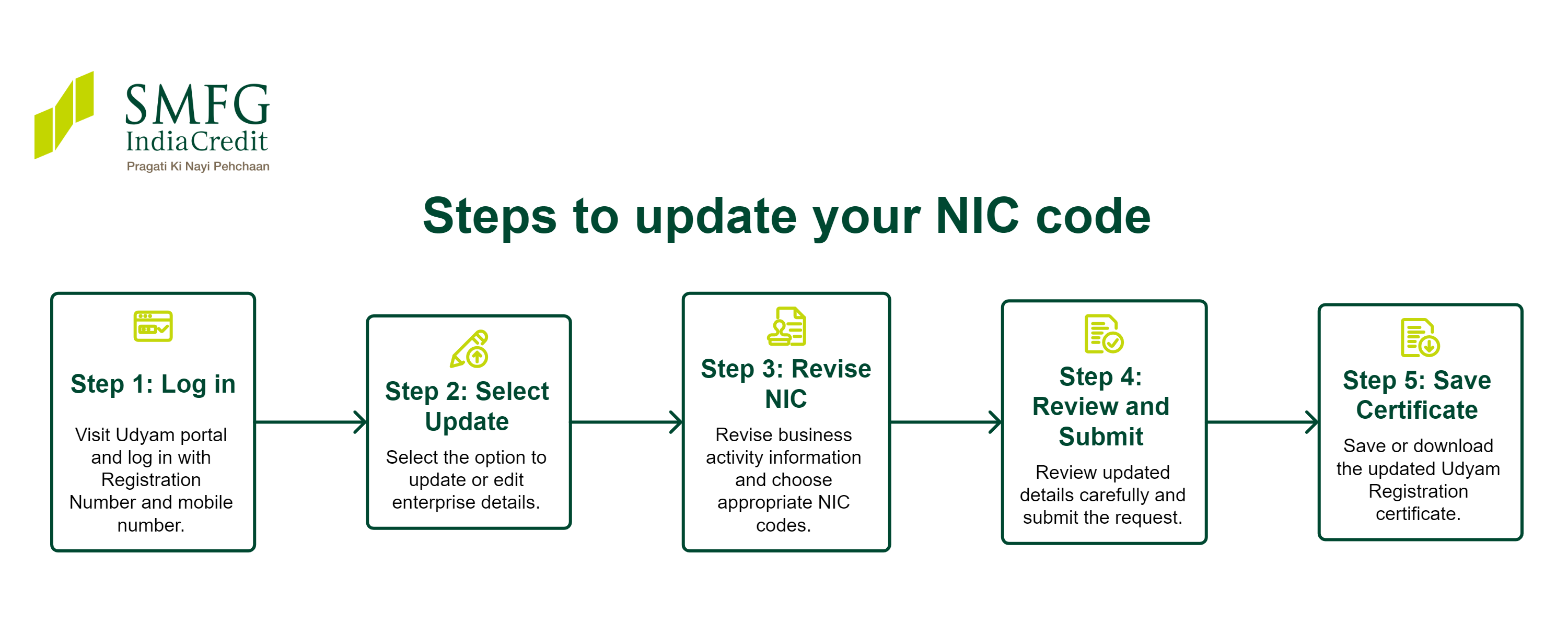
Steps to update your NIC code:
- Visit the official Udyam Registration portal and log in using your Udyam Registration Number and the registered mobile number.
- Select the option to update or edit your enterprise details.
- Revise the business activity information and choose the appropriate NIC code(s).
- Review the updated details carefully and submit the request.
- Save or download the updated Udyam Registration certificate once the changes are processed.
Keep in mind that any change to your NIC code may affect your sector classification and eligibility for specific government schemes. If you run a manufacturing business and shift to a service sector activity, your MSME category and applicable benefits may change accordingly.
Benefits of Udyog Aadhaar Registration
Registering your business under Udyog Aadhaar (now replaced by Udyam Registration) or completing Udyam Registration using the correct NIC code unlocks a range of government-backed benefits:
- Easier access to MSME loans through priority lending
- Lower interest rates under government schemes
- Collateral-free loans via credit guarantee programmes
- Protection against delayed payments from buyers
- Eligibility for MSME-exclusive government tenders
- Subsidies for patent registration and ISO certification
- Electricity bill concessions in some states
- Access to certain tax and GST benefits
- Support for technology upgrades and modernisation initiatives
Conclusion
The NIC code for MSME registration is one of the most important inputs in your Udyam Registration. Getting it right ensures your business is classified accurately, that you receive the benefits your sector qualifies for, and that there are no delays or complications with government compliance. Whether you run a manufacturing business, a retail shop, or a service sector company, there is a specific NIC code that defines your activity.
Use the official Udyam NIC code list to identify the appropriate code, verify it on the Udyam Portal, and complete your registration with confidence.
Once your MSME is registered, if you need funding to support business growth, SMFG India Credit offers unsecured business loans of up to Rs. 1 crore* at competitive interest rates.
Check your business loan eligibility and apply online to take the next step in your business journey.
Use our business loan EMI calculator and eligibility calculator to plan your finances effectively before applying.
Review the business loan documents beforehand for a hassle-free and quick application process.