TReDS, or the Trade Receivables Electronic Discounting System, is an RBI-regulated digital platform that helps MSMEs receive faster payments against their invoices through invoice discounting. The TReDS meaning mainly relates to improving MSME cash flow by reducing delays in payments from corporate buyers and government entities. By allowing financiers to discount approved invoices online, the platform helps small businesses access working capital more efficiently and maintain smoother day-to-day business operations.
What Is TReDS?
The TReDS full form is Trade Receivables Electronic Discounting System, an RBI-regulated online mechanism designed to help MSMEs receive quicker payments against approved invoices. The Trade Receivables Electronic Discounting System meaning mainly refers to invoice financing through digital bidding by banks, NBFCs, and other approved financiers on the TReDS platform in India. MSMEs upload invoices raised on corporate buyers, and participating financiers bid to provide early payment at competitive rates.
For example, a small manufacturing business supplying goods to a large company can upload its approved invoice on TReDS and receive faster payment from a financier instead of waiting for the buyer’s full credit period.
How Does TReDS Work?
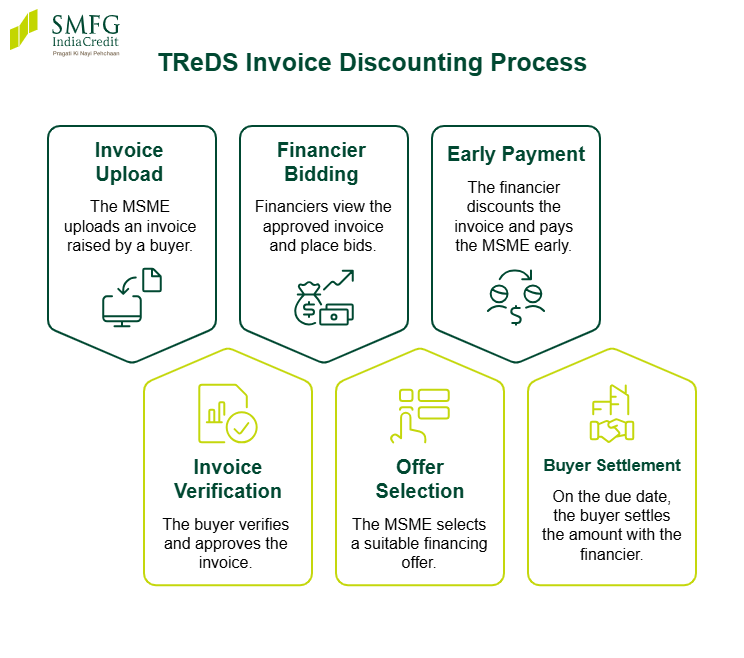
The TReDS platform for MSME businesses works through a fully digital and transparent invoice discounting process. It connects MSME sellers, corporate buyers, and financiers on one platform, making it easier to access early payments against approved invoices. Understanding how TReDS works in India can help small businesses manage receivables and working capital more effectively.
- The MSME uploads an invoice raised by a buyer.
- The buyer verifies and approves the invoice.
- Financiers view the approved invoice and place bids.
- The MSME selects a suitable financing offer.
- The financier discounts the invoice and pays the MSME early.
- On the due date, the buyer settles the amount with the financier.
This TReDS invoice financing process helps reduce payment delays and improves cash flow visibility.
Who Is Required to Register on the TReDS?
Registration on the TReDS platform in India is generally required for MSMEs seeking invoice financing, along with corporate buyers and participating financiers such as banks and NBFCs. RBI guidelines have also encouraged mandatory onboarding for certain companies meeting prescribed turnover thresholds (over Rs. 500 crore) to support timely MSME payments.
|
Participant Type
|
Role on TReDS
|
Registration Requirement
|
|
MSMEs
|
Upload invoices for financing
|
Required
|
|
Corporate Buyers
|
Approve invoices for discounting
|
Required
|
|
Banks and NBFCs
|
Provide invoice financing
|
Required
|
|
Government Entities / PSUs
|
Buyer participation for payments
|
Applicable in selected cases
|
Key Features & Aspects of TReDS Platform
The TReDS platform offers a structured and technology-driven system that helps MSMEs receive quicker payments against approved invoices. As an RBI-regulated digital invoice discounting platform, it simplifies receivables financing while improving transparency and reducing paperwork for participating businesses and financiers.
Key features and aspects of TReDS include:
- RBI-regulated financing ecosystem
- Fully paperless and online process
- Collateral-free invoice financing for MSMEs
- Competitive bidding by multiple financiers
- Transparent transaction and approval workflow
- Faster disbursement against approved invoices
- Improved cash flow management for MSMEs
- Reduced payment delays from buyers
Advantages of TReDS for MSMEs
TReDS helps MSMEs improve liquidity by enabling faster payments against approved invoices without waiting for long buyer credit periods. The platform supports MSME working capital financing through digital invoice discounting, helping businesses manage operational expenses and maintain smoother day-to-day cash flow.
Key advantages of TReDS for MSMEs include:
- Faster realisation of invoice payments
- Collateral-free financing support
- Reduced payment delays from buyers
- Lower financing costs through competitive bidding
- Simpler working capital management
- Improved liquidity and cash flow visibility
- TReDS benefits for suppliers through transparent digital transactions
Alongside invoice discounting through TReDS, a business loan may help MSMEs manage additional operational expenses such as inventory purchases, equipment upgrades, or business expansion without disrupting daily cash flow.
Enterprises planning financing can also use a business loan eligibility calculator to estimate borrowing capacity and assess repayment suitability before applying for additional working capital support.
Benefits of TReDS for Buyers and Financiers
TReDS benefits not only MSMEs but also buyers and participating financiers by improving payment efficiency and strengthening the receivables financing ecosystem. Buyers can support better supplier relationships through timely invoice approvals, while banks and NBFCs gain access to structured short-term financing opportunities on a regulated digital platform.
Benefits for buyers and financiers include:
- Improved supplier trust and payment transparency
- Better compliance with MSMED Act payment timelines
- Faster and paperless financing workflows
- Lower operational delays in invoice settlement
- Additional financing opportunities for banks and NBFCs
- Improved digital transaction efficiency and monitoring
Eligibility Criteria for TReDS Registration
Businesses and financial institutions must meet certain eligibility conditions before participating in the TReDS registration process. The platform generally allows MSMEs, buyers, and financiers to register subject to regulatory and compliance requirements prescribed under RBI guidelines.
Eligibility criteria for TReDS registration include:
- MSMEs registered under the MSMED Act with valid Udyam Registration.
- Corporate buyers, PSUs, and government entities with valid documentation and KYC status.
- RBI-approved banks, NBFCs, and financial institutions as financiers.
- Completion of platform onboarding and verification requirements.
Documents Required for TReDS Registration
Businesses registering on the TReDS platform are generally required to submit identity, business, and banking documents for verification and onboarding. Additional incorporation and compliance documents may also be requested depending on the type of entity and financier requirements.
Commonly required documents for TReDS registration include:
- PAN card of the business entity
- GST registration certificate
- Udyam Registration certificate
- KYC documents of authorised signatories
- Company incorporation documents where applicable
- Board resolution or authorisation letter for companies and LLPs
Charges and Discount Rates Under TReDS
TReDS transactions may involve platform usage fees, financing charges, and invoice discounting rates charged by participating financiers. The applicable discount rate generally depends on factors such as the buyer’s credit profile, invoice tenure, and competitive bidding among financiers on the platform. Stronger buyer credibility may often help MSMEs secure financing at relatively lower rates.
For example, if an MSME uploads an approved invoice of Rs. 5 lakhs with a 60-day payment period and a financier offers discounting at 10% annualised cost, the MSME may receive the invoice amount after deduction of applicable financing charges and platform fees.
TReDS Registration Process: Step-by-Step
The registration process is generally completed online through a registered TReDS platform after document verification and onboarding formalities. It typically involves the following steps:
- Visit an RBI-approved TReDS platform (such as RXIL, Invoicemart, or M1xchange).
- Select the participant category (MSME, buyer, or financier).
- Complete the online registration form.
- Upload KYC, GST, PAN, and business documents.
- Submit banking and authorised signatory details.
- Complete verification and approval formalities.
- Activate the account and start invoice transactions on the platform.
Conclusion
The TReDS meaning extends beyond invoice discounting by helping MSMEs improve liquidity, reduce payment delays, and manage receivables more efficiently. The platform also supports structured factoring and reverse factoring solutions through a transparent, RBI-regulated digital financing ecosystem.
For enterprises requiring additional working capital support beyond receivables financing, SMFG India Credit offers unsecured funds of up to Rs. 1 crore* at attractive business loan interest rates.
Check your potential monthly repayments using a business loan EMI calculator and apply through a convenient digital process.