Launched in September 2014, the Make in India scheme aims to turn the country into a global manufacturing hub. It set out to raise manufacturing's share of the economy, draw in foreign investment, and create jobs across priority sectors such as electronics, automobiles, defence, and semiconductors. More than a decade on, it continues to shape India's industrial growth.
What Is the Make in India Scheme?
The Make in India scheme is a Government of India initiative led by the Ministry of Commerce and Industry. Its core idea is simple: encourage companies, both Indian and foreign, to manufacture their products within the country rather than import them. The scheme was introduced to revive a manufacturing sector that contributed only about 15% of the economy at the time, far below regional peers.
When Was the Make in India Scheme Launched?
The Make in India scheme was launched on 25 September 2014 by the Government of India. At the time, manufacturing growth had slowed, and the services sector, while strong, was not generating enough jobs for a young and growing workforce. Against this backdrop, the government set out a clear manufacturing vision: lift the sector's share of the economy, attract investment and build India into a trusted production base for the world.
Objectives of the Make in India Scheme
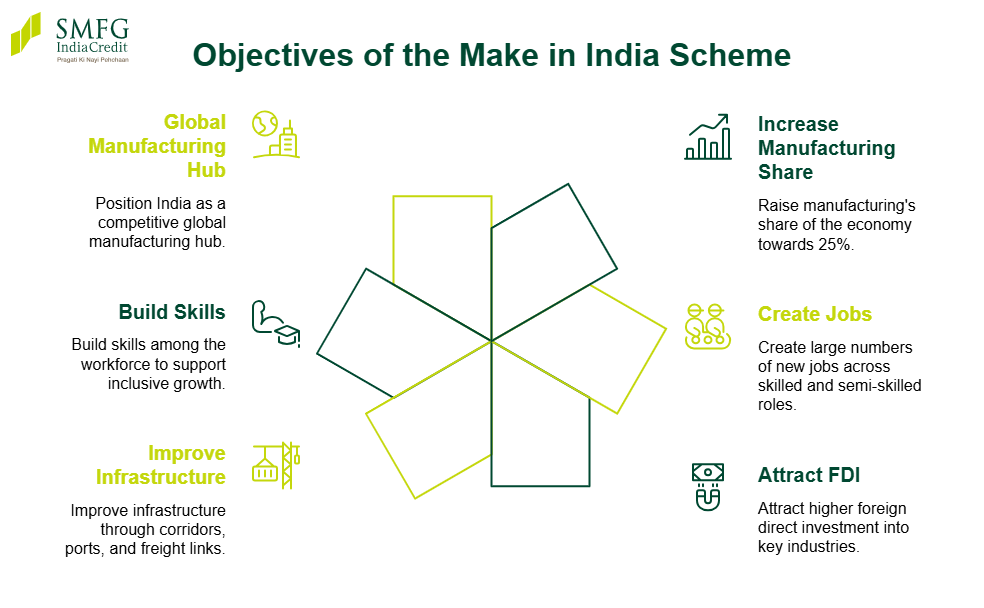
The scheme was built around a set of long-term goals for the manufacturing sector. Its main objectives are:
- Increasing manufacturing's share of GDP towards 25%
- Creating large numbers of new jobs across skilled and semi-skilled roles
- Attracting higher foreign direct investment (FDI) into key industries
- Improving infrastructure through corridors, ports, and freight links
- Building skills among the workforce to support inclusive growth
- Positioning India as a competitive global manufacturing hub
Together, these targets aim to balance economic growth with wider employment and technology gains.
Key Sectors Under Make in India
The scheme identified 25 focus sectors spanning both manufacturing and services, so the Make in India advantages reach across the economy. On the manufacturing side, the priority areas include:
- Automobiles and auto components
- Electronics system design and manufacturing
- Pharmaceuticals and medical devices
- Aerospace and defence manufacturing
- Textiles and apparel
- New and renewable energy
- Capital goods, chemicals, and food processing
Semiconductors have since become a major addition, supported by a dedicated programme, the India Semiconductor Mission (ISM). Service sectors such as IT, tourism, transport and logistics, and financial services are also covered. This widespread coverage means small and large businesses across many industries can take part.
Make in India Scheme Benefits
The initiative offers gains for the wider economy as well as individual businesses. The key benefits of the Make in India Scheme include:
- Stronger economic growth as manufacturing output rises
- New employment across skilled and unskilled levels
- Higher foreign investment and access to modern technology
- Better infrastructure through corridors, ports and power links
- Growth in exports and a smaller import bill
- More opportunities for small manufacturers and suppliers
- Development of rural and semi-urban areas where factories are set up
For domestic businesses, the focus on local production opens fresh demand and the chance to join larger supply chains.
Key Make in India Government Initiatives
Make in India does not work alone. Several connected Make in India government schemes support its goals, each tackling a different piece of the puzzle.
|
Initiative
|
What It Supports
|
|
Production Linked Incentive (PLI)
|
Rewards companies for higher local production across sectors such as electronics and pharma
|
|
Startup India
|
Builds an ecosystem for new businesses and innovation
|
|
Digital India
|
Drives a digitally empowered, knowledge-based economy
|
|
Invest India
|
Supports investors with guidance, facilitation, and investment assistance
|
|
Skill India
|
Trains the workforce to meet manufacturing needs
|
|
Industrial Corridors
|
Develops planned manufacturing zones across regions
|
|
Ease of Doing Business reforms
|
Simplifies licences, registration and compliance
|
The PLI scheme in particular has become a central tool, linking government support directly to output and exports.
Impact of Make in India on the Indian Economy
The initiative has played a significant role in strengthening India's manufacturing sector by encouraging domestic production, attracting investments, and creating employment opportunities. It has also supported the growth of exports and reduced dependence on imports across several industries.
Over the years, sectors such as electronics, automobiles, defence, and renewable energy have witnessed increased manufacturing activity, contributing to the country's broader economic development and reinforcing India's position as a global manufacturing hub.
Challenges Faced by the Make in India Initiative
Progress has been real, but so are the hurdles. Several challenges continue to affect Make in India’s long-term goals:
- Gaps in physical infrastructure such as roads, power, and logistics
- Regulatory complexity and slow approvals at some levels
- A shortage of formally skilled workers
- Difficulties around land acquisition for large projects
- Stiff competition from established manufacturing nations
- Concerns about environmental impact and resource use
Closing these gaps, especially in infrastructure and skilling, is widely seen as the key to meeting the scheme's larger targets.
Make in India vs Made in India: Key Difference
The two terms are often used interchangeably, but they refer to different concepts.
|
Aspect
|
Make in India
|
Made in India
|
|
What it is
|
A government scheme and policy push
|
A label on a product
|
|
Purpose
|
Attract investment and strengthen manufacturing
|
Show a product's country of origin
|
|
Scope
|
Nationwide industrial strategy
|
Specific to individual goods
|
In short, Make in India is the broad policy, while a "Made in India" tag simply tells you a product was manufactured here.
Success Stories of Make in India
Several multinational companies have expanded their operations under the Make in India initiative. Fiat Chrysler announced plans to manufacture Jeep SUVs in India for exports, while Airbus aims to increase aerospace parts sourcing from Indian suppliers. Technology giants such as Xiaomi, Foxconn, Apple, Google, Huawei, and Hitachi have strengthened local manufacturing and R&D investments.
The defence sector has also attracted interest from global players across Germany, Japan, France, Spain, and Russia, highlighting India's growing appeal as a manufacturing and export destination.
Latest Updates Related to the Make in India Scheme
Recent developments under the Make in India programme include the introduction of Make in India 2.0, a stronger focus on sectors such as electric vehicles, semiconductors, and renewable energy, and infrastructure improvements through the National Logistics Policy.
The government also continues to promote self-reliance, ease of doing business, digital approvals, and sustainable manufacturing while encouraging global investments and technology partnerships.
How a Business Loan Can Support Make in India Goals
As manufacturing activity expands under the Make in India initiative, businesses often require timely access to capital for machinery, infrastructure, inventory, and production scaling. A business loan can help enterprises manage these operational and expansion needs more efficiently.
Before applying for funding, enterprises can use a business loan eligibility calculator to estimate borrowing capacity and make informed decisions based on their financial profile and requirements.
Conclusion
The Make in India scheme was introduced to strengthen manufacturing as a key driver of economic growth and employment, and it has made notable progress in sectors such as electronics and mobile phone production. Although challenges related to infrastructure, workforce skills, and global competition remain, the initiative continues to create opportunities for businesses to expand and participate in both domestic and international supply chains.
To support enterprises looking to benefit from the Make in India initiative, SMFG India Credit offers unsecured financing of up to Rs. 1 crore* at competitive business loan interest rates.
Review the business loan documents required and apply today with a convenient digital process.