The Government of India has long recognised the importance of MSMEs in driving economic growth. To streamline their support, it introduced two key registration systems: Udyog Aadhaar and Udyam Registration. While both aimed to simplify MSME registration, there are crucial differences between the two. Understanding these changes is essential for compliance, availing government benefits, improving ease of doing business, and securing financial support, such as a business loan or an MSME loan.
In this article, we break down the difference between Udyog Aadhaar and Udyam Registration, outline the key updates, and guide you on how to migrate from one to the other.
Related Read: 7 Ways in Which Borrowers Can Use Business Loan
What Is Udyog Aadhaar?
Udyog Aadhaar was introduced in September 2015 by the Ministry of MSME as a simplified, Aadhaar-based MSME registration process. It replaced the earlier EM-I/II system, allowing MSMEs to register through a self-declaration process. The system enabled small businesses to gain easier access to government schemes, subsidies, and financial support.
However, over time, limitations such as data duplication, lack of integration with other systems, and the absence of real-time verification mechanisms led to the need for an upgraded system.
Today, Udyog Aadhaar has been discontinued, and all enterprises must shift to Udyam Registration to remain eligible for MSME schemes.
https://www.bankbazaar.com/aadhar-card/udyog-aadhar.html
What Is Udyam Registration?
Launched on 1st July 2020 , Udyam Registration is the current and only valid process for MSME registration in India. It streamlines and automates the entire registration flow using integration with Income Tax and GST systems.
This system is free, online, paperless, and completely Aadhaar-based. Whether you're starting a micro, small, or medium enterprise, Udyam registration ensures you're recognised under MSME classification and eligible for related schemes.
Applicants need only their Aadhaar number, PAN, and GSTIN (if applicable). Upon registration, they receive a certificate with a unique Udyam Registration Number (URN) and a QR code for verification.
Difference Between Udyog Aadhaar and Udyam Registration
The Udyog Aadhar vs Udyam registration comparison can be summarised in the table below:
|
Criteria
|
Udyog Aadhaar
|
Udyam Registration
|
|
Launch Year
|
2015
|
2020
|
|
Registration Type
|
Aadhaar-based self-declaration
|
Aadhaar, PAN, and GST integrated
|
|
Process
|
Semi-digital, document upload required
|
Fully digital, paperless, self-declaration
|
|
Number of Registrations
|
Multiple UAMs possible
|
Only one per Aadhaar with all activities listed
|
|
Verification
|
Manual
|
Automatic with govt databases
|
|
Certificate
|
No QR code
|
Digital with QR code for instant verification
|
|
Status
|
Discontinued
|
Mandatory and active
|
This difference between Udyog Aadhaar and Udyam clearly shows why the latter is a more secure, transparent, and efficient system.
Why Was Udyam Registration Introduced?
The Government introduced Udyam Registration to address the inefficiencies and loopholes in the Udyog Aadhaar system. The goal was to:
- Eliminate multiple or fake registrations
- Ensure accurate MSME classification based on investment and turnover
- Link registrations with PAN and GST databases for transparency
- Offer real-time verification and instant certificate generation
Overall, the Udyam Registration process makes MSME certification more credible and easier to validate.
Who Should Apply for Udyam Registration?
All micro, small, and medium enterprises engaged in manufacturing, services, or both must apply for Udyam Registration. Even those previously registered under Udyog Aadhaar must migrate to the new system.
This includes:
- Proprietorships
- Partnership firms
- Hindu Undivided Families (HUFs)
- Limited Liability Partnerships (LLPs)
- Private limited companies
By completing registration for micro, small, and medium enterprises, businesses can access easier credit, tax exemptions, and government tenders reserved for MSMEs.
Valid registration also streamlines business loan documentation, making it simpler for lenders to verify your MSME status.
How to Migrate from Udyog Aadhaar to Udyam Registration
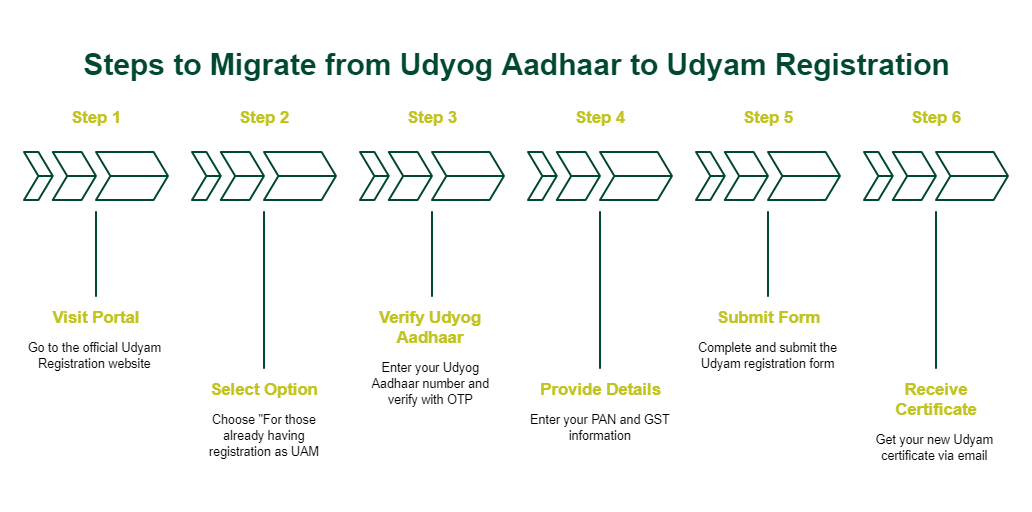
Migrating from Udyog Aadhaar to Udyam is simple and mandatory. Here are the steps:
- Visit the official Udyam Registration portal.
- Select the "For those already having registration as UAM" option.
- Enter your Udyog Aadhaar number and verify with OTP.
- Provide PAN and GST details.
- Complete the registration form and submit.
- Receive your new Udyam certificate via email.
Once your business is registered under Udyam, keeping updated financial records and maintaining strong creditworthiness can significantly improve your chances of securing funding through a business or MSME loan. When applying, compare business loan interest rates across lenders and review associated costs such as processing fees and prepayment charges, to make an informed decision.
Benefits of Udyam Registration Over Udyog Aadhaar
Here are the major benefits of Udyam Registration:
- Better access to MSME loans and credit guarantees.
- Faster verification through database integration.
- Real-time certificate issuance with QR code.
- Mandatory compliance with updated MSME definitions.
- Simplified process requiring no document uploads.
Additionally, with Udyam Registration in place, MSMEs can strengthen their case when applying for funding. You can use a business loan EMI calculator to estimate repayment amounts in advance, making it easier to plan cash flow before committing.
Conclusion
The difference between Udyam and Udyog Aadhaar marks a significant step forward in India’s digital governance. With greater transparency, security, and ease of use, Udyam is now the standard for small business registration in India.
If you haven’t migrated yet, it’s time to register through the official portal and unlock all the benefits of being a verified MSME. Once registered, you can explore tailored financing options to fuel your business’s next phase of growth.
SMFG India Credit offers unsecured business loans up to INR 1 crore*, with competitive interest rates and flexible tenures of up to 60 months*. Estimate your borrowing potential with our business loan eligibility calculator and apply online today to strengthen your enterprise with accessible funding.