Introduction: What Is the CGFMU Scheme?
The CGFMU scheme provides credit guarantee cover for eligible microloans, helping lenders extend collateral-free credit to micro units and eligible borrowers. The CGFMU full form is Credit Guarantee Fund for Micro Units, a government-backed framework administered through National Credit Guarantee Trustee Company Ltd (NCGTC). Rather than being a separate CGFMU loan, the scheme supports eligible credit facilities extended by Member Lending Institutions. It also provides guarantee coverage for eligible loans under the Pradhan Mantri MUDRA Yojana, which is why it is often associated with the MUDRA loan guarantee scheme.
What Is the CGFMU Scheme?
The CGFMU meaning refers to a government-backed mechanism that provides credit guarantee support for eligible loans extended to micro units and other covered borrowers. The Credit Guarantee Fund for Micro Units does not lend money directly. Instead, it provides guarantee cover to eligible Member Lending Institutions against defaults on qualifying credit facilities, subject to the scheme guidelines.
By reducing the need for collateral for covered loans, CGFMU helps facilitate formal credit access for micro enterprises, including eligible businesses and micro enterprises within the broader MSME sector.
CGFMU Full Form and Meaning
CGFMU stands for Credit Guarantee Fund for Micro Units. It is not a loan scheme that provides funds directly to borrowers. Instead, the CGFMU scheme is a guarantee mechanism that supports eligible lenders when they extend qualifying credit facilities to micro units and other covered borrowers.
Through CGFMU coverage, lenders receive protection against eligible defaults, subject to the scheme guidelines. This mechanism supports access to credit, including eligible collateral-free MUDRA loan facilities, without requiring borrowers to provide any security for covered loans.
Latest Update on the CGFMU Scheme
The CGFMU scheme continues to operate as a credit guarantee mechanism for eligible microloans, including qualifying loans linked to the Pradhan Mantri MUDRA Yojana (PMMY). Managed by NCGTC, the scheme supports eligible lending institutions by providing guarantee cover against defaults on covered credit facilities, helping facilitate collateral-free institutional credit for micro and small enterprises.
Please note: CGFMU should not be confused with the Credit Guarantee Scheme for Microfinance Institutions-2.0 (CGSMFI-2.0). This is a separate guarantee scheme whose validity has been extended until 31 August 2026, or until guarantees worth Rs. 20,000 crore are issued, whichever is earlier.
CGFMU Scheme Objectives
The main objective of the CGFMU is to promote and support micro and small enterprise (MSME) loans. The CGFMU is a trust fund managed by the National Credit Guarantee Trustee Company (NCGTC), which operates under the aegis of the Government of India.
The purpose of the CGFMU is to guarantee payment against default for microloans. This substantially reduces the risk for lending institutions so they can extend their credit facilities to micro and small enterprises.
The reduced risk enables them to extend unsecured loans to micro-enterprises that might otherwise be excluded due to a lack of collateral or third-party guarantees.
Nature of CGFMU Facility
The CGFMU acts as a guarantor on microloans obtained through eligible member lending institutions. The CGFMU doesn't directly lend money, but instead, it guarantees a portion of the loan amount (up to 75%) in the case of a default.
Quantum of Finance Under CGFMU
The CGFMU provides coverage to microloans under the PMMY, granted by participating lending institutions, up to Rs. 20 lakhs.
It also covers overdraft loan amounts sanctioned under Pradhan Mantri Jan Dhan Yojana (PMJDY) accounts of up to Rs. 10,000. Furthermore, the CGFMU also extends its guarantee to Self Help Group (SHG) portfolios ranging from Rs. 10 lakhs to Rs. 20 lakhs.
The loan terms and interest rates under the CGFMU scheme are determined by the lending institution. They may vary from one lender to another. However, the lending institutions must comply with regulatory and CGFMU guidelines to be eligible for the guarantee.
How Does the CGFMU Scheme Work?
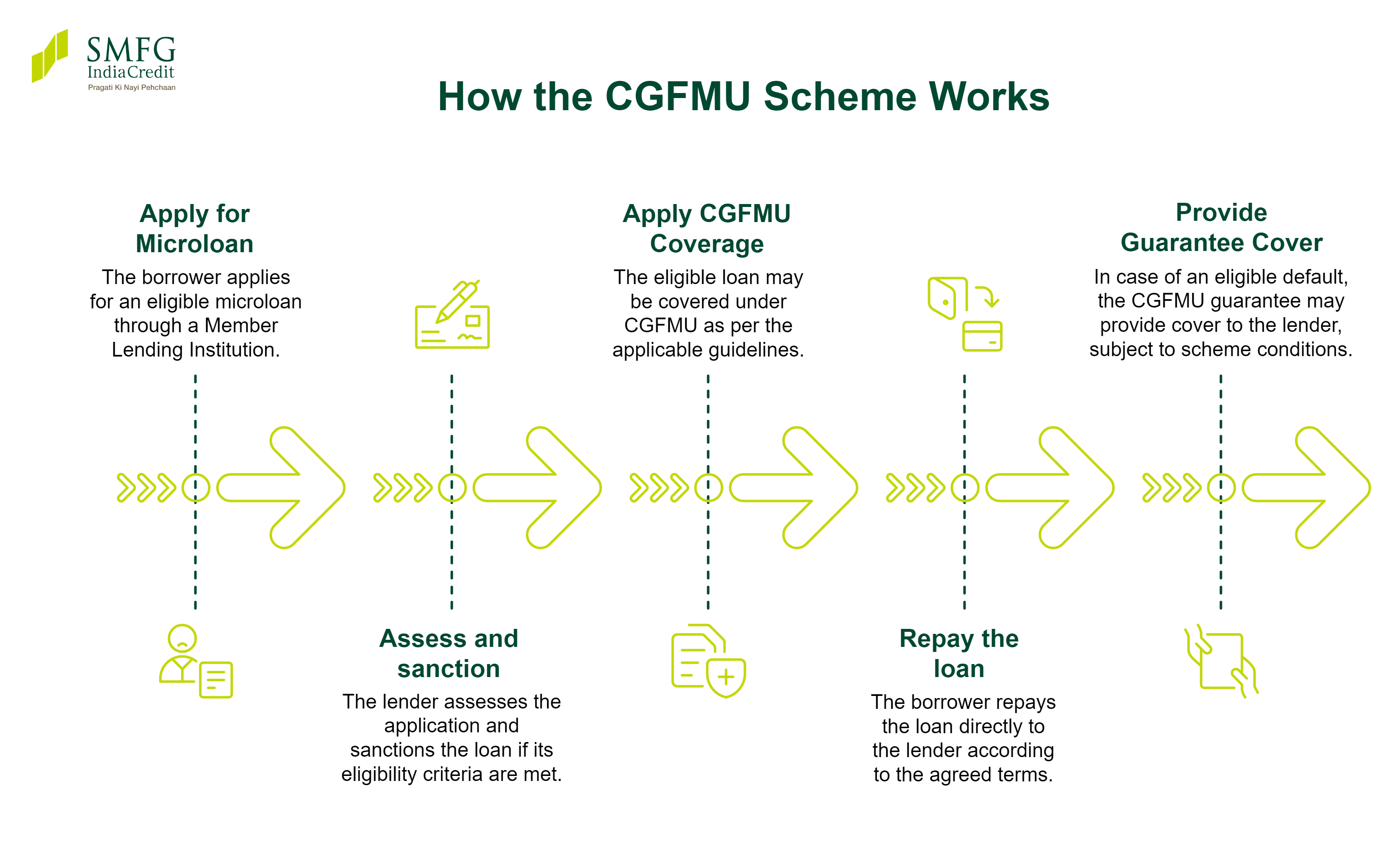
The CGFMU scheme operates through eligible Member Lending Institutions rather than providing funds directly to borrowers. The applicable CGFMU coverage limit depends on the type and category of the eligible credit facility under the scheme.
- The borrower applies for an eligible microloan through a Member Lending Institution.
- The lender assesses the application and sanctions the loan if its eligibility criteria are met.
- The eligible loan may be covered under CGFMU as per the applicable guidelines.
- The borrower repays the loan directly to the lender according to the agreed terms.
- In case of an eligible default, the CGFMU guarantee may provide cover to the lender, subject to scheme conditions.
Who Manages CGFMU?
The Credit Guarantee Fund for Micro Units (CGFMU) is managed by the National Credit Guarantee Trustee Company Limited (NCGTC), a Government of India company established to manage and operate various credit guarantee funds. NCGTC acts as the trustee for CGFMU and administers the guarantee mechanism in accordance with the applicable scheme guidelines.
NCGTC manages several government-backed credit guarantee schemes, each serving different borrower categories and purposes. Therefore, CGFMU should not be confused with other schemes such as CGTMSE or the CGSMFI, which have separate eligibility conditions, coverage structures, and operational guidelines.
CGFMU Guarantee Coverage Details
The CGFMU guarantee coverage protects eligible Member Lending Institutions against a specified portion of the amount in default on covered loans, typically up to 75%. However, the exact credit guarantee coverage may vary depending on facility category under the applicable CGFMU guidelines. This collateral-free loan guarantee mechanism helps lenders extend qualifying credit without requiring collateral or third-party guarantees.
While the CGFMU coverage protects the lender against eligible credit losses, it does not waive or reduce the borrower's repayment obligation. The borrower remains responsible for repaying the outstanding loan, interest, and applicable charges according to the agreed loan terms, even if the lender receives a claim under the guarantee mechanism.
Who Is Eligible for CGFMU Coverage?
CGFMU eligibility depends on the type of credit facility, borrower category, and applicable scheme conditions. Eligible loans must be extended by a Member Lending Institution and meet the requirements prescribed under CGFMU. Approval is not automatic, as the lending institution assesses the borrower and loan application according to its credit policies and the scheme guidelines.
Eligible Borrowers Under CGFMU
Depending on the applicable loan category, eligible borrowers may include:
- Micro enterprises
- Small shop owners and traders
- Service providers
- Manufacturers
- Self-employed individuals
- Artisans and other eligible micro-entrepreneurs
- Eligible borrowers under the Pradhan Mantri MUDRA Yojana (PMMY)
Eligible Lending Institutions Under CGFMU
Borrowers do not apply directly to CGFMU for a loan. Instead, eligible credit facilities are provided through Member Lending Institutions (MLIs) registered or permitted under the scheme. Depending on the applicable CGFMU guidelines, these may include:
- Banks
- Non-banking financial companies (NBFCs)
- Microfinance institutions (MFIs)
- Other eligible financial institutions permitted under the scheme
Features of CGFMU Scheme
The CGFMU scheme supports access to collateral-free institutional credit by providing guarantee cover to eligible Member Lending Institutions. Its features are designed to support qualifying micro units and PMMY-linked lending while protecting lenders against a portion of eligible defaults. The applicable CGFMU loan limit depends on borrower eligibility and credit facility category covered under the scheme.
|
Feature
|
Details
|
|
Collateral-Free Credit
|
Supports eligible loans without collateral or third-party guarantees
|
|
Guarantee Cover
|
Covers eligible microloan portfolios against specified defaults, subject to scheme guidelines
|
|
PMMY Support
|
Provides guarantee coverage for eligible loans sanctioned under PMMY
|
|
Lender Protection
|
Reduces the lender's exposure to eligible credit losses
|
|
Micro Unit Coverage
|
Covers eligible new and existing micro units, subject to scheme conditions
|
|
Borrower Responsibility
|
Borrowers remain responsible for repaying the loan, interest, and applicable charges
|
Benefits of CGFMU Scheme for Borrowers
The CGFMU benefits for borrowers primarily arise from improved access to collateral-free institutional credit. By providing guarantee support to eligible lenders, the scheme can help micro-enterprises obtain financing even when they do not have sufficient assets to offer as collateral.
- Improves access to eligible collateral-free microloans.
- Supports entrepreneurs in starting, sustaining, or expanding eligible business activities.
- Helps small businesses build a formal credit and repayment history.
- Can support funding requirements such as working capital, equipment, inventory, and business expansion.
- May provide an alternative for eligible entrepreneurs who find it difficult to obtain a startup business loan from a traditional financial institution due to collateral requirements.
Benefits of CGFMU Scheme for Lenders
CGFMU primarily operates as a credit guarantee mechanism for eligible Member Lending Institutions. By covering a specified portion of eligible defaults, the scheme reduces the lender's exposure and can encourage formal lending to qualifying micro units.
- Provides partial guarantee coverage against eligible defaults.
- Supports lending to eligible borrowers without collateral or third-party guarantees.
- Encourages greater credit flow to micro-enterprises and eligible PMMY borrowers.
- Helps lenders manage exposure across covered microloan portfolios.
However, CGFMU coverage does not replace the lender's credit assessment or due diligence. Lenders must continue to evaluate applications according to applicable lending and scheme requirements, while borrowers remain fully responsible for repayment under the agreed loan terms.
CGFMU Fees and Charges
If you are wondering what the CGFMU fee is, the applicable guarantee fee and CGFMU charges depend on the scheme guidelines and covered facility. Exact rates should be verified against the latest NCGTC/CGFMU fee circular. Borrowers should also confirm the overall borrowing costs with their lender, including:
- Interest rate
- Processing fee
- Insurance charges, if applicable
- Documentation charges, if applicable
- Other applicable loan charges
- Total repayment cost
Documents Required for CGFMU-Backed Loans
The documents required for a CGFMU-backed loan depend on the lender, loan type, business, and borrower profile. Common requirements may include:
- Identity and address proof
- PAN
- Business registration or ownership proof
- Bank statements
- Udyam registration, if available
- Business plan, quotations, or invoices, where applicable
- Income or financial proof
- GST registration, if applicable
- Completed loan application form
Additional documents may be requested by the lender based on its credit assessment and applicable scheme requirements.
How to Apply for a CGFMU-Covered Loan
Borrowers do not apply directly to CGFMU for funding. Instead, the loan application is made through an eligible MLI, and qualifying loans may subsequently receive guarantee coverage under the scheme.
- Identify an eligible lender participating in the CGFMU scheme.
- Choose a suitable loan under PMMY or another eligible business loan category.
- Check the lender's eligibility criteria and applicable loan requirements.
- Submit the completed application along with the required documents.
- The lender evaluates your business profile, repayment capacity, and other relevant factors.
- If approved, the lender sanctions and disburses the loan.
- The eligible facility may be covered under CGFMU as per the scheme guidelines.
- Repay the loan to the lender according to the agreed repayment schedule.
Interest Rate and Tenure Under CGFMU-Backed Loans
CGFMU does not prescribe a single interest rate or repayment tenure for covered loans. These terms are determined by the Member Lending Institution based on the loan category, borrower profile, repayment capacity, and applicable regulatory requirements. Borrowers should therefore compare the complete loan terms before applying.
- Interest Rate: Determined by the lender as per applicable guidelines
- Loan Tenure: Varies by lender and credit facility
- Repayment Schedule: Based on the sanctioned loan terms
- Other Charges: Processing and other applicable charges may vary
How CGFMU Supports Micro Enterprises and Financial Inclusion
CGFMU supports financial inclusion by helping eligible lenders extend collateral-free credit to micro enterprises that may have limited assets to offer as security. This can improve access to formal financing for first-time entrepreneurs, small traders, artisans, service providers, and self-employed individuals who meet the applicable lending and scheme requirements.
Guarantee-backed microcredit can also support women entrepreneurs and businesses in rural and semi-urban areas, where access to conventional sources of business finance may be relatively limited. Eligible borrowers can use such credit for purposes such as working capital, equipment purchases, inventory, and other business requirements.
By encouraging lending through regulated financial institutions, CGFMU can also help micro enterprises move away from informal borrowing. Regular repayment of formal credit may enable borrowers to establish a credit history, strengthen their financial records, improve their future business loan eligibility, and access suitable financing as their enterprises grow.
CGFMU-Covered Loans vs Regular Business Loans
CGFMU coverage applies only to eligible credit facilities and borrower categories that meet the prescribed scheme conditions. Loan limits and other requirements may also restrict its suitability for certain funding needs. A regular business loan can offer an alternative for established businesses seeking funds for working capital, equipment, expansion, inventory, or other business purposes beyond the applicable CGFMU framework.
Before applying, a business loan eligibility calculator can help you estimate the loan amount you may qualify for based on factors such as business turnover and existing obligations.
Once you have an indicative loan amount, a business loan EMI calculator can help estimate monthly repayments across different loan amounts, interest rates, and tenures. This can help you select a repayment structure that aligns with your business cash flow and repayment capacity.
Business Loan Support for MSMEs from SMFG India Credit
SMFG India Credit offers unsecured business loans of up to Rs. 1 Crore* to eligible MSMEs for requirements such as working capital, equipment purchases, inventory, and business expansion. Competitive interest rates and flexible repayment tenures of up to 60 months* allow businesses to plan repayments according to their financial capacity.
Enterprise owners can apply online with minimal business loan documents, saving time and effort so they can focus on their core business needs.
Conclusion
The CGFMU scheme supports access to collateral-free credit for eligible micro enterprises by providing guarantee coverage to lending institutions. Through the Credit Guarantee Fund for Micro Units, qualifying borrowers can access formal credit while lenders receive partial protection against eligible defaults. Borrowers, however, remain responsible for repaying their loans as agreed.
If you're exploring financial support for your enterprise, SMFG India Credit offers unsecured business loans tailored for MSME requirements. Check your eligibility and access up to Rs. 1 Crore* at competitive business loan interest rates and flexible tenures of up to 60 months*.