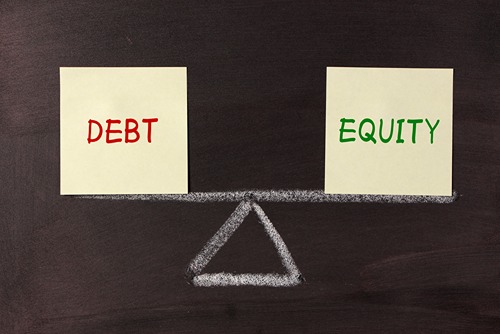
Understanding financial metrics is crucial for businesses aiming to thrive in a competitive landscape. Among these, the debt-to-equity ratio (D/E ratio) is a key indicator of a company's financial health.
Let’s dive into what the D/E ratio means in finance, how it’s calculated, and why it matters for enterprises seeking a business loan.
What Is Equity?
Equity represents the ownership value in a company after deducting its liabilities from its total assets. Simply put, it’s the portion of the business that shareholders own outright. Equity can stem from initial investments, retained earnings, or additional capital infusions.
What Is Debt-to-Equity Ratio?
The D/E ratio measures the proportion of a company’s debt relative to its equity. It’s a finance leverage ratio that indicates how much a business relies on borrowed funds (debt) versus owner-invested funds (equity).
Debt Equity Ratio Formula and Calculation
The D/E ratio formula is:
Debt-to-Equity Ratio = Total Debt / Total Equity
Here’s how it works:
- Total Debt: Includes short-term and long-term liabilities like loans and bonds.
- Total Equity: Comprises shareholder equity, retained earnings, and other equity components.
Debt-to-Equity Ratio Example
Consider an enterprise applying for a business loan. If it has INR 2,00,000 in debt and INR 4,00,000 in equity, the D/E ratio is:
D/E Ratio = 2,00,000 / 4,00,000 = 0.5
How to Calculate Debt-to-Equity Ratio?
Follow these steps:
- Determine Total Debt from financial statements, including secured and unsecured loans, bonds, debentures, and other liabilities.
- Identify Total Equity, which includes shareholders' capital, retained earnings, and other equity components.
- Divide Total Debt by Total Equity to obtain the Debt-to-Equity Ratio.
What Is the Significance of the Debt-to-Equity Ratio Equation?
The importance of the debt-to-equity ratio lies in its ability to assess a company's financial risk and capital structure. A high ratio (greater than 2) may indicate over-reliance on debt, raising concerns about financial stability and repayment capacity. Conversely, a low ratio (below 1) suggests good stability but may also indicate underutilised leverage, potentially limiting growth opportunities.
Modifying the Debt-to-Equity Ratio
Businesses can adjust their D/E ratio by paying off debt, issuing equity, or strategically taking on new loans. For example, securing a business loan increases debt but can also drive growth, potentially strengthening equity over time.
Debt-to-Equity Ratio Interpretation
The interpretation of the debt-to-equity ratio depends on the context. A ratio of 1 signifies equal debt and equity. A ratio above 1 indicates higher reliance on debt financing, while a ratio below 1 suggests greater dependence on equity, which is common in financially conservative firms.
Is There an Ideal D/E Ratio?
The ideal D/E ratio for businesses isn’t universal – it depends on industry norms. However, in most cases, a D/E ratio above 2 may indicate excessive reliance on debt, increasing financial risk.
What Insights Does the D/E Ratio Provide?
The purpose of the debt-to-equity ratio is to offer insights into a company’s financial structure, risk exposure, and growth potential. It helps stakeholders assess how leveraged a company is and its ability to manage business loan repayments.
The Debt-to-Equity Ratio for Personal Finances
Individuals can also apply this concept. Personal debt (e.g., loans) divided by net worth (total assets minus liabilities) mirrors the corporate D/E ratio, serving as a useful tool for financial planning and debt management.
Benefits of a High D/E Ratio
A high D/E ratio can amplify returns on equity during growth phases, especially for enterprises leveraging business loans to scale. However, it heightens financial risk if cash flows become unstable.
Limitations of the Debt-to-Equity Ratio
While a valuable metric, the D/E ratio has its limitations. It does not consider cash flow quality or off-balance-sheet liabilities, which can distort a company's true financial position. Therefore, it should be used alongside other financial indicators for a comprehensive analysis.
What Is the Connection Between Debt-to-Equity Ratio and Return on Equity (ROE)?
A higher D/E ratio can enhance ROE by leveraging debt to generate profits. However, excessive debt can reduce returns if interest costs outweigh earnings.
For example, a firm with INR 5,00,000 in debt and INR 2,50,000 in equity has a D/E ratio of 2. If it earns INR 1,00,000 in profit, ROE is 40% [(Net Profit/Total Equity)*100], highlighting the potential benefits of financial leverage.
What Is the Long-Term Debt-to-Equity Ratio?
This variation of the D/E ratio focuses only on long-term debt, excluding short-term obligations. It provides a clearer picture of a company’s sustained leverage and long-term financial commitments.
What Does a Negative Debt-to-Equity Ratio Signal?
A negative D/E ratio occurs when total equity is negative, meaning liabilities exceed assets. This signals financial distress and, in severe cases, insolvency risks, indicating that the company may struggle to meet its obligations.
Which Industries Have High Debt-to-Equity Ratios?
Industries with capital-intensive operations tend to have higher D/E ratios due to significant borrowing for infrastructure and expansion. These include utilities, real estate, and telecom, where long-term investments are essential. In contrast, sectors like technology and retail typically have lower D/E ratios.
Conclusion
The debt-to-equity (D/E) ratio is more than just a number – it provides valuable insights into a company’s financial strategy. For businesses aiming for growth, understanding and optimising this ratio can help balance risk and opportunity.
If you’re seeking financial support to expand your business, SMFG India Credit offers unsecured business loans of up to INR 1 crore* at attractive interest rates. Use our business loan eligibility calculator to estimate the maximum amount you may be able to borrow and apply online today!