GST registration is a mandatory step for millions of businesses across India, and having the right documents required for GST registration ready before you begin is what separates a smooth application from a delayed or rejected one.
Whether you are a sole proprietor, a partnership firm, or a private limited company, the GST registration documents you submit determine how quickly your GSTIN is issued.
This guide gives you a complete, entity-wise breakdown of every GST document you need.
Who Should Register for GST?
Before diving into the GST document checklist, it helps to know whether you are required to register in the first place. GST registration is mandatory for:
- Businesses with an annual turnover exceeding Rs. 40 lakhs for goods or Rs. 20 lakhs for services.
- Businesses in special category states such as Arunachal Pradesh, Assam, Jammu & Kashmir, Himachal Pradesh, Manipur, Meghalaya, Mizoram, Nagaland, Sikkim, Tripura, and Uttarakhand, where thresholds are Rs. 20 lakhs for goods and Rs. 10 lakhs for services.
- E-commerce operators and sellers, regardless of turnover.
- Businesses making interstate supplies of goods (services subject to threshold exemptions).
- Casual Taxable Persons (CTP), i.e., those who supply goods or services occasionally in a state where they have no fixed place of business.
- Non-Resident Taxable Persons (NRTP) supplying goods or services in India.
- Agents of a supplier, input service distributors, and those required to deduct TDS under GST.
If you fall into any of the above categories, gathering your GST registration documents is your immediate next step.
What Are the Main Documents Required for GST Registration?
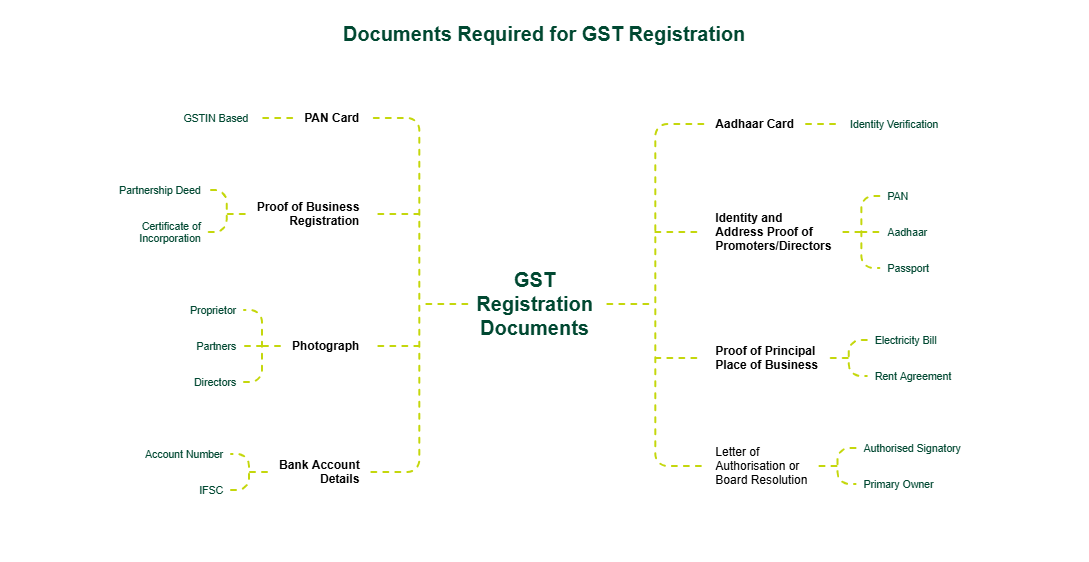
Certain documents are common across all GST registration document lists, regardless of business type:
- PAN card: Mandatory for all applicants. The GSTIN is PAN-based, so a valid PAN is non-negotiable
- Aadhaar Card: Required for identity verification and Aadhaar-based authentication.
- Proof of Business Registration: This varies by entity type (partnership deed, certificate of incorporation, etc.)
- Identity and Address Proof of Promoters/Directors: PAN, Aadhaar, passport, voter ID, or driving licence
- Photograph: Passport-size photograph of the proprietor, partners, or directors
- Proof of Principal Place of Business: Electricity bill, rent agreement, or property tax receipt (typically not older than 2 months)
- Bank Account Details: Cancelled cheque or bank statement showing account number, IFSC, and branch details
- Letter of Authorisation or Board Resolution: May be required when the authorised signatory is not the primary owner
These are the GST documents required for every applicant, and form the core GST registration supporting documents you must have ready before beginning the online application on the GST portal.
GST Registration Documents for Different Business Types
The exact list of documents for GST registration varies depending on your business structure. Here is a quick comparison:
|
Business Type
|
Key Additional Documents
|
|
Sole Proprietorship
|
PAN, Aadhaar, photograph, bank details, and address proof
|
|
Partnership Firm
|
Partnership deed, partners' PAN and Aadhaar, authorisation letter
|
|
LLP
|
LLP agreement, certificate of incorporation, designated partners' details
|
|
Private/Public Company
|
Certificate of incorporation, MOA/AOA, board resolution, directors' KYC
|
|
Casual Taxable Person
|
Advance tax deposit proof, estimated turnover declaration
|
|
Non-Resident Taxable Person
|
Passport/tax identification number, advance tax deposit
|
Document Requirements for Sole Proprietors and Individuals
GST registration documents for proprietorship are generally the most straightforward of all entity types. Here is what sole proprietors and individual applicants need:
- PAN card of the proprietor
- Aadhaar card (linked to mobile number for OTP verification)
- Passport-size photograph
- Proof of principal place of business (electricity bill, rent agreement, or NOC from owner)
- Bank account details: Cancelled cheque or bank passbook first page
- Any registration proof, such as the Shop & Establishment Act certificate (if applicable)
Since there is no separate legal entity, the proprietor's personal documents serve as the business documents. This makes new GST registration documents for sole proprietors relatively quick to compile.
Documents for Partnership Firms and LLPs
GST registration documents for partnership firms and LLPs require a few additional layers of documentation compared to sole proprietorships:
For Partnership Firms:
- Partnership deed (registered or unregistered)
- PAN cards of all partners
- Aadhaar cards of all partners
- Photographs of all partners
- Proof of principal place of business
- Bank account details of the firm
- Authorisation letter naming the authorised signatory
For LLPs:
- LLP agreement
- Certificate of incorporation issued by the Ministry of Corporate Affairs (MCA)
- PAN and Aadhaar of designated partners
- Digital Signature Certificate (DSC) of authorised partner — mandatory for LLPs
- Proof of registered office address
The DSC requirement for LLPs is important. Without it, the online application cannot be submitted. Factor in the time to obtain a DSC (typically 1–3 working days) when planning your registration timeline.
Documents for Companies (Public and Private)
The list of documents for GST registration for private and public limited companies is the most comprehensive. Companies must submit:
- PAN card of the company
- Certificate of Incorporation from the Registrar of Companies (ROC)
- Memorandum of Association (MOA) and Articles of Association (AOA)
- Board Resolution authorising a director or employee to act as an authorised signatory for GST purposes
- PAN and Aadhaar of all directors
- Photographs of all directors
- DSC of the authorised signatory – mandatory for all companies
- Proof of registered office — electricity bill or rent agreement, plus NOC from the property owner if the premises are rented
- Bank account details — cancelled cheque or bank statement
Special GST Registration Types: Casual and Non-Resident Taxable Persons
Two categories of registrants have unique GST registration document requirements:
Casual Taxable Person (CTP): A CTP is someone who supplies goods or services in a state where they do not have a fixed place of business – for example, a trader who participates in exhibitions or seasonal markets in different states. Required documents include:
- Standard identity and address proof
- Estimated turnover declaration for the registration period
- An advance deposit of GST equal to the estimated tax liability for the period
Non-Resident Taxable Person (NRTP): Foreign nationals or businesses supplying goods or services in India must provide:
- A valid passport (for individuals) or tax identification number issued by the home country (for businesses)
- Advance deposit of estimated GST liability
- Appointment of an authorised representative in India
Both categories receive time-limited registrations and must apply at least 5 days before the commencement of business in India.
Documents Required Based on Nature of Business Activity
Certain business activities attract additional GST registration proof documents beyond the standard list:
|
Business Activity
|
Additional Document Required
|
|
E-commerce Operator
|
Declaration of marketplace status, platform registration proof
|
|
Tax Deductor (TDS under GST)
|
TAN details, government entity registration proof
|
|
Input Service Distributor
|
ISD registration declaration, parent entity's GSTIN
|
Key Considerations While Submitting Documents Required for GST Registration
Getting the GST document checklist right is only half the job. How you submit matters just as much:
File formats: The GST portal accepts JPG and PDF formats. Photographs must be in JPG; other documents can be in either format.
File size limits: Each document typically has a maximum size of 100 KB to 1 MB. Ensure scanned documents are clear but compressed within limits.
Digital Signature Certificate (DSC): Mandatory for all companies and LLPs. The authorised signatory's DSC must be registered on the GST portal before submission.
Aadhaar authentication: Ensure the Aadhaar is linked to an active mobile number.
Document accuracy: Mismatches between documents, for example, a business name on the PAN that differs from the trade name, are among the most common reasons for application rejection. Cross-check all documents for GST registration carefully before uploading.
Processing time: Once submitted, GST registration is typically processed within 3–7 working days if documents are in order. If the officer raises queries (Form GST REG-03), you have 7 days to respond with clarifications or additional GST registration supporting documents.
Note: Document requirements and upload specifications may be revised periodically. Always refer to the official GST portal for the most updated list of documents and guidelines before starting your application.
Conclusion
Having the correct GST registration documents ready is one of the biggest determinants of whether your application is approved smoothly and without unnecessary delays. Once your registration is in place and you begin routine GST filings along with day-to-day business expenses, the next priority is ensuring your enterprise has the financial support it needs to grow.
SMFG India Credit offers unsecured business loans tailored to support your working capital and expansion needs. With competitive interest rates and flexible tenures that help keep EMIs manageable, you can plan confidently and borrow smartly. Check your eligibility, review the required business loan documents, and apply online. You can also use our business loan eligibility calculator and EMI calculators to plan your finances before applying.
* Please note that this article is for your knowledge only. Loans are disbursed at the sole discretion of SMFG India Credit. Final approval, loan terms, disbursal process, foreclosure charges and foreclosure process will be subject to SMFG India Credit's policy at the time of loan application. If you wish to know more about our products and services, please contact us