Every time you apply for a loan or credit card, the lender runs a check on your credit report. This leaves a record called a CIBIL enquiry. Multiple such entries in a short period can trigger a CIBIL score drop enquiry effect that may hurt your loan approval chances.
Knowing how to remove loan enquiries from CIBIL, or at least minimise their impact, is essential for protecting your credit health. This guide covers exactly that: what enquiries are, when CIBIL enquiry removal is possible, and the step-by-step process to dispute incorrect entries.
What Is a CIBIL Enquiry?
The CIBIL enquiry meaning refers to a record created on your credit report whenever a financial institution accesses it. This typically happens when you apply for a financial product, such as a personal loan or a credit card, and the lender needs to assess your creditworthiness before approving the application. Every such access is logged by a credit bureau like TransUnion CIBIL and becomes part of your credit history.
Since lenders can view these records, multiple enquiries in a short period may affect your CIBIL score.
To avoid unnecessary hard enquiries, it may help to use tools such as a personal loan EMI calculator before applying for credit. Making informed decisions and applying selectively can be better than submitting applications to multiple lenders at the same time.
Types of CIBIL Enquiries (Soft Enquiry vs Hard Enquiry)
Not all enquiries are the same. There are two types:
Soft Enquiry: A soft enquiry on your credit report occurs when you check your own CIBIL score or when a financial institution runs a background check for a pre-approved offer. Soft enquiries are not visible to other lenders and do not affect your CIBIL score.
Hard Enquiry: A hard enquiry in CIBIL is triggered when you formally submit a loan application or apply for a credit card, and the lender requests access to your credit report. This is visible to other lenders and can temporarily lower your score. A single hard enquiry credit score impact is minor, but multiple in a short span can signal financial stress to lenders.
What Is a Loan Enquiry in CIBIL?
A loan enquiry CIBIL entry is a specific type of hard enquiry created when you apply for a personal loan, home loan, car loan, or any other credit product. It typically records details such as the lender's name, the date of the credit check, and the type of credit sought. This entry stays on your report and contributes to any CIBIL enquiry impact on your overall score.
Does a Loan Enquiry Affect a CIBIL Score?
Yes, a hard enquiry does affect your CIBIL score, though the CIBIL enquiry impact is typically small for a single entry. Here is how it works:
- One hard enquiry may temporarily lower your score by a few points.
- Multiple hard enquiries within a short period have a more significant combined effect, as they suggest credit-hungry behaviour to lenders.
- The hard enquiry effect on credit score fades over time, particularly if you maintain healthy repayment habits, keep your credit utilisation ratio low, and pay all EMIs on time.
If you are planning to borrow, it is worth checking your personal loan eligibility, or the eligibility criteria for other credit products, to avoid triggering unnecessary hard enquiries.
When Can You Remove a Loan Enquiry?
Knowing how to remove a loan enquiry in CIBIL starts with understanding which enquiries are actually eligible for removal. You can raise a CIBIL dispute process request and potentially have an entry removed in these cases:
- Unauthorised CIBIL Enquiry: Someone accessed your credit report without your knowledge or consent, possibly due to identity theft or fraud.
- Incorrect Enquiry: The entry contains incorrect details, such as an incorrect lender name, an incorrect date, or a duplicate enquiry.
- Reporting Error: The credit bureau or lender uploaded data incorrectly or mixed up two borrower profiles.
If your situation falls into any of the above categories, credit report enquiry removal is possible through the formal dispute process.
When You Cannot Remove a Loan Enquiry
If you applied for a loan or credit card and gave the lender consent to check your report, that is a valid enquiry. Wanting to know how to delete an enquiry in CIBIL does not help in this case, because genuine credit enquiries cannot be removed.
A valid hard enquiry will remain on your credit report for up to two years as part of your credit history. The RBI (Reserve Bank of India) guidelines do not provide a mechanism for removing legitimate entries. The only path forward is time and responsible credit behaviour. Once you maintain consistent on-time EMI payments, reduce your credit utilisation ratio, and avoid fresh hard enquiries, the CIBIL score drop enquiry effect diminishes naturally.
How to Remove a Loan Enquiry from CIBIL
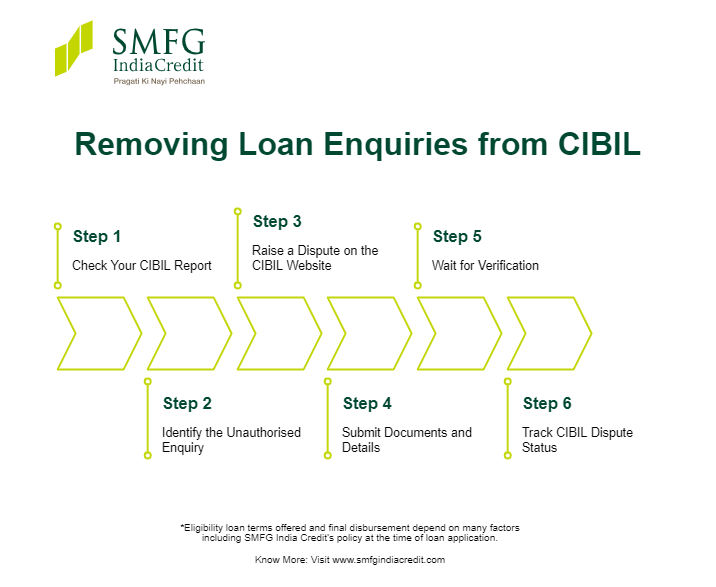
If you have identified an unauthorised or incorrect enquiry, here is how to remove loan enquiries from CIBIL through the formal dispute route.
Step 1: Check Your CIBIL Report
Log in to your TransUnion CIBIL account and download your full credit report. Go to the "Enquiry Information" section and check CIBIL enquiry entries carefully.
Step 2: Identify the Unauthorised Enquiry
Look for entries linked to lenders you never approached, duplicate or unauthorised CIBIL enquiries, or enquiries raised on dates when you did not apply for any credit product.
Step 3: Raise a Dispute on the CIBIL Website
Visit the Consumer Dispute Resolution section in your CIBIL account, provide the details about the specific incorrect enquiry, and submit your CIBIL dispute process request online.
Step 4: Submit Documents and Details
If available, attach documents such as proof of identity theft or any evidence that you did not initiate the application. This speeds up verification and strengthens your case for CIBIL report correction.
Step 5: Wait for Verification
Once the dispute is submitted, CIBIL may contact the lender to verify the enquiry details. The resolution process usually takes up to 30 days.
Step 6: Track CIBIL Dispute Status
Use the dispute ID or reference number provided by CIBIL to monitor the enquiry removal status online. If the enquiry is found incorrect, it will be corrected or removed from your credit report.
If you plan to apply for credit in the future, it may also help to keep important paperwork, such as personal loan documents, ready in advance for a smoother application process later.
How to Check Loan Enquiries in CIBIL Report
To check CIBIL enquiry details at any time, log in to your CIBIL account and download your full credit report. Navigate to the “Enquiry Information” section, which typically lists hard enquiries along with lender names, enquiry dates, and the type of credit applied for.
Reviewing this section regularly helps you spot any unfamiliar entries early and initiate the credit enquiry removal in India before the entry has time to compound with other negative marks.
Impact of a Hard Enquiry on Credit Score
The hard enquiry impact on credit score is typically minor but worth noting:
- Minor Drop: Each hard enquiry may slightly lower your score, usually by a few points.
- Short-Term Effect: The dip is usually temporary and fades if you continue to manage credit responsibly.
- Multiple Enquiries: However, several enquiries in a short time can signal credit stress and reduce your score more noticeably.
Why Does a Credit Score Drop After a Hard Enquiry?
A hard enquiry lowers your credit score slightly because it indicates you're actively seeking credit. This may be perceived as a risk signal by lenders, especially if multiple applications are made within a short span.
Each enquiry suggests a potential increase in your debt load, which could affect your ability to repay. However, the impact of a single hard enquiry is typically small and temporary. On the other hand, repeated hard enquiries over a short period can lead to a more noticeable decline in your credit score.
How Long Does a Loan Enquiry Stay on CIBIL?
A hard enquiry remains on your credit report for up to two years. However, the CIBIL enquiry duration that actively affects your score is shorter. The negative impact of most hard enquiries fades within a few months, particularly if you continue making on-time payments and maintain a healthy credit utilisation ratio. After the two-year mark, the entry drops off your report entirely.
Tips to Prevent Credit Score Decline After a Loan Enquiry
- Space Out Applications: Avoid applying for multiple loans or credit cards within a short period.
- Use Pre-Qualification: Before applying, check if you’re eligible for any pre-approved loan offers that don't trigger hard enquiries.
- Maintain Good Credit Habits: Always pay your EMIs and credit card bills on time, keep your credit utilisation ratio low, and maintain a balanced credit mix.
Conclusion
Only unauthorised or incorrect enquiries can be removed through the CIBIL dispute process. Valid enquiries created during genuine loan applications stay on your credit report for up to two years and cannot be deleted.
The best approach to credit report management and CIBIL enquiry removal is to check your report regularly, dispute suspicious entries promptly, and build strong credit habits that reduce the long-term impact of any hard enquiry on your CIBIL score.
If you plan to apply for credit in the near future, SMFG India Credit offers unsecured funds of up to Rs. 10 Lakhs* at personal loan interest rates starting from 12.5%* per annum.
Review the required documents, assess your borrowing capacity using the personal loan eligibility calculator, and apply online today.