When deciding how much EMI you can pay, it is important to look at your take-home salary rather than your gross salary, as the former reflects the money actually available each month. A safe EMI for a salary depends on several factors, including monthly expenses, existing loans, lifestyle costs, emergency savings, and financial goals. Understanding EMI affordability can help you avoid stretching your finances and assess your repayment capacity more realistically. This article explains how to plan an EMI based on salary and what to consider before taking on a new loan.
What Is a Safe EMI for Your Salary?
A safe EMI is one you can pay each month without cutting into essential expenses, emergency savings, or long-term financial goals. As a general benchmark, keeping total EMIs within around 30%-40% of your take-home salary can help maintain a manageable EMI-to-salary ratio. However, the right safe EMI limit depends on your monthly budget, other commitments, and overall repayment capacity. If your income varies from month to month, choosing a lower safe EMI percentage of salary may provide greater financial stability during periods when earnings are lower.
Ideal EMI-to-Salary Ratio
The salary-to-EMI ratio shows how much of your net monthly income goes towards your total Equated Monthly Instalment (EMI) payments. Ideally, all loan obligations together should remain within 30%-40% of your salary. For more conservative planning, an ideal EMI percentage of 25%-30% can leave greater room for other expenses and goals. Once the EMI percentage of salary moves beyond 50%, the debt burden can become harder to manage, particularly when unexpected expenses arise.
EMI-to-Salary Ratio Table
The table below gives a broad view of the ideal EMI-to-salary ratio and how different levels may affect EMI affordability.
|
EMI as % of Salary
|
Level
|
What It Means
|
|
25%-30%
|
Comfortable
|
Leaves room for savings, an emergency fund, and regular expenses
|
|
30%-40%
|
Generally manageable
|
Allows for loan repayments while keeping other financial commitments in view
|
|
40%-50%
|
Stretched
|
A higher EMI percentage may put pressure on the monthly budget
|
|
Above 50%
|
Heavily stretched
|
Leaves less income available for expenses, savings, and unexpected costs
|
How Much EMI Is Safe Based on Monthly Salary?
You can estimate an EMI based on salary by applying a 30%-40% range to your take-home income. This gives you a starting EMI amount for each salary slab, but any existing EMI must be counted within this range. For instance, the safe EMI for a Rs. 50,000 salary may differ from the safe EMI for a Rs. 1 lakh salary, even when both borrowers follow the same percentage guideline.
Salary-Wise Safe EMI Table
This salary EMI table shows safe EMI by salary using the 30% rule and 40% rule.
|
Monthly Take-Home Salary
|
EMI at 30%
|
EMI at 40%
|
|
Rs. 30,000
|
Rs. 9,000
|
Rs. 12,000
|
|
Rs. 50,000
|
Rs. 15,000
|
Rs. 20,000
|
|
Rs. 75,000
|
Rs. 22,500
|
Rs. 30,000
|
|
Rs. 1 lakh
|
Rs. 30,000
|
Rs. 40,000
|
|
Rs. 1.5 lakhs
|
Rs. 45,000
|
Rs. 60,000
|
|
Rs. 2 lakhs
|
Rs. 60,000
|
Rs. 80,000
|
Tools like a personal loan EMI calculator can help you assess your EMI limit and overall loan affordability based on your preferred loan amount, interest rate, and loan tenure.
However, the actual personal loan EMI eligibility depends on the lender's criteria and assessment.
Disclaimer: These examples are illustrative only and should not be treated as a guarantee of loan eligibility or affordability.
What Is FOIR and Why Does It Matter?
The FOIR meaning is straightforward: the Fixed Obligation to Income Ratio measures how much of your income is committed to regular debt payments. A lender or a Non-Banking Financial Company (NBFC) may consider FOIR in a loan while assessing your loan eligibility, as it indicates how much room you have for another EMI. A lower FOIR generally suggests greater repayment capacity, although the acceptable level can vary depending on the lender and applicant profile.
Fixed Obligation to Income Ratio Formula
The FOIR formula is:
FOIR = (Total Fixed Monthly Obligations / Monthly Income) × 100
To understand how to calculate FOIR, add your fixed monthly obligations, such as EMIs on existing loans, credit card dues, and the proposed EMI. Divide this amount by your monthly income and multiply by 100.
For example, let's say you are considering a personal loan. If your monthly income is Rs. 60,000 and your total fixed obligations, including the proposed EMI, are Rs. 24,000, the FOIR for a personal loan would be:
(Rs. 24,000 / Rs. 60,000) × 100 = 40%
Tip: Use tools like a personal loan eligibility calculator alongside your FOIR calculation. This can give you a better idea of whether the loan amount you are considering may result in an EMI that is manageable with your existing obligations.
How to Calculate a Safe EMI from Salary
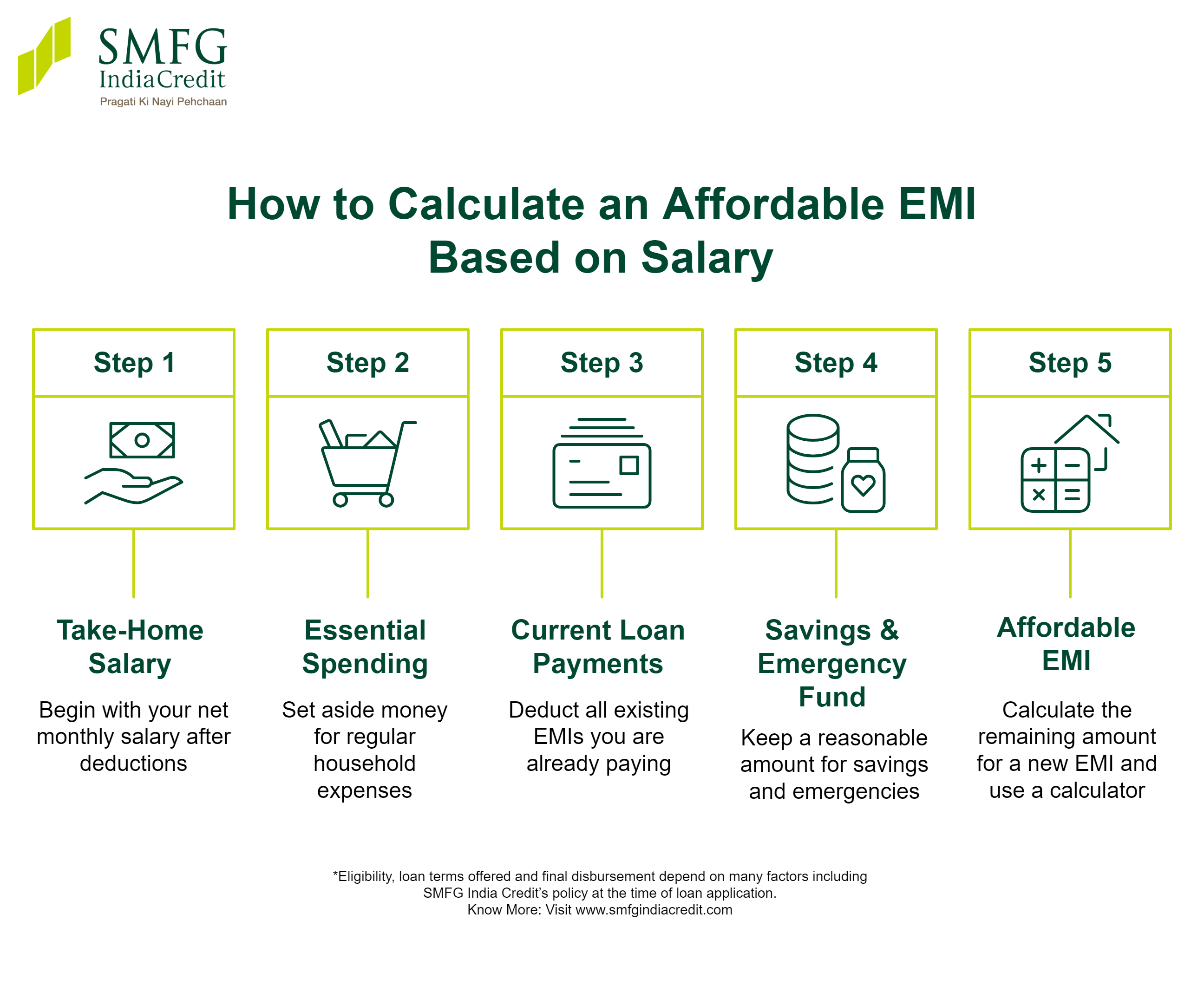
A practical EMI calculation from salary should begin with the money you actually receive each month. For example, if you are considering a home loan, these steps can help you work out an EMI that fits your finances:
- Start With Your Take-Home Salary: Use your monthly net salary after applicable deductions rather than your gross income.
- Account for Essential Spending: Set aside money for regular household expenses, including groceries, utilities, rent, transport, and other necessities.
- Deduct Current Loan Payments: Include all existing EMIs you are already required to pay each month.
- Protect Your Savings: Keep a reasonable amount aside for savings and contributions towards an emergency fund instead of committing all surplus income to repayment.
- Work Out the Affordable EMI: The amount left can help you decide how much room you have for a new loan EMI. An EMI affordability calculator can then help you compare different loan amounts, interest rates, and tenures.
Safe EMI Calculation Example
Here is an ideal EMI calculation example for someone considering a loan with a monthly salary of Rs. 80,000:
- Essential expenses: Rs. 35,000
- Savings target: Rs. 12,000
- Existing EMI: Rs. 8,000
- Remaining disposable income: Rs. 25,000
Rather than using the entire Rs. 25,000 for the new EMI, keeping some room for unexpected costs would be more practical. In this EMI affordability example, an EMI of around Rs. 12,000 - Rs. 17,000 may be considered, depending on the borrower's repayment comfort and other financial commitments.
Factors That Decide Safe EMI Amount
There is no single EMI amount that works for everyone, even when two borrowers earn the same salary. Some important factors affecting EMI affordability include:
- Salary Stability: Greater income stability can make it easier to plan regular repayments, while variable income may call for a lower EMI.
- Existing Loans: Current debt repayments reduce the amount available for a new EMI.
- Emergency Savings: Keeping enough money aside for unexpected expenses should remain part of EMI planning.
- Dependents and Living Costs: The number of dependents, city of residence, and monthly rent can significantly affect how much income remains available.
- Loan Terms: The interest rate and loan tenure directly influence the monthly instalment.
- Future Priorities: Your financial planning goals, such as education, buying a home, or retirement, also need room in your budget.
These safe EMI factors make affordability a personal calculation rather than a fixed percentage that suits every borrower.
Mistakes to Avoid While Deciding EMI Amount
A few common EMI planning mistakes can leave less room in your monthly budget than expected. Before deciding what you can comfortably repay, watch out for these loan EMI mistakes:
- Using Gross Income: Calculating EMI vs salary using gross salary can overstate the amount actually available for repayments.
- Forgetting Current Commitments: Always account for existing loans before adding another EMI.
- Borrowing the Maximum Offered: The approval amount may be higher than what comfortably fits your finances, so borrow according to your needs and repayment capacity.
- Overlooking Variable Expenses: Medical bills, repairs, travel, and other irregular costs can affect your available income.
- Skipping Emergency Savings: Maintain an emergency fund for unexpected financial needs.
- Choosing a Longer Tenure Only to Lower EMI: A longer loan tenure can reduce the monthly instalment but may increase the overall interest costs.
How Much EMI Is Too Much?
An EMI may be too high if paying it regularly leaves you struggling to cover essential expenses, save money, or manage unexpected costs. Rather than treating the maximum EMI for salary as a fixed figure, consider how much of your monthly income is already committed to debt. Signs that your repayments may be getting difficult to manage include:
- You regularly use savings or credit cards to meet routine expenses after paying EMIs.
- Your total EMI-to-income ratio is approaching or exceeding 50%.
- You have little or no money left for emergency savings and other financial goals.
- A temporary drop in income could make it difficult to meet repayments on time.
- Your Debt-to-Income (DTI) ratio continues to increase as you take on additional debt.
Keeping some room in your monthly budget can make repayments easier to manage over time.
EMI vs Savings: How to Balance Both
Loan repayments are important, but they should not leave you with little or nothing to save each month. When deciding how much EMI you can afford, look at your regular expenses and savings needs alongside your salary-to-EMI ratio.
- Set a monthly savings target before deciding how much income can go towards an EMI.
- Keep contributing to an emergency fund so unexpected expenses do not immediately affect loan repayments.
- Account for short- and long-term goals, such as travel, education, buying a home, or retirement.
- Avoid increasing your EMI simply because your income has increased, especially if your savings have not grown at the same pace.
- Review your EMI budgeting whenever your income, expenses, or financial commitments change.
The aim is to repay comfortably while continuing to build savings for other priorities.
Conclusion
Your take-home salary gives you a more realistic basis for deciding how much EMI is safe for your salary, but income alone does not tell the whole story. Existing financial commitments, future expenses, and your FOIR also need to be considered. Keeping your total EMI ratio around 30%-40% is a useful general benchmark, while a lower range may suit those with irregular income. A safe EMI for salary should allow for comfortable loan repayment without leaving savings, emergencies, or other financial planning priorities short. Looking at all these factors together can give you a more practical view of your EMI affordability.
If you need funds for a planned or urgent expense, SMFG India Credit offers unsecured personal financing of up to Rs. 10 lakhs* at competitive personal loan interest rates.
Check your personal loan eligibility and apply online with a convenient, 100% paperless process.
Prepare the personal loan documents required beforehand to ensure a smooth, hassle-free application experience.