India's real estate business is one of the most resilient and rewarding sectors for entrepreneurs today. Whether you are an aspiring broker, an independent agent, or a first-time entrepreneur, knowing how to start a real estate business in India the right way, with the right registrations, the right funding, and a clear market strategy, is what separates those who thrive from those who struggle.
This real estate startup guide covers everything you need: from choosing your niche to RERA registration, business models, costs, and the 8 steps to launch your real estate business in India with confidence.
What Is the Real Estate Business?
The real estate business meaning encompasses any commercial activity involving property, i.e. buying, selling, leasing, renting, developing, or advising on land and buildings. A property business in India can take many forms: residential brokerage, commercial leasing, property development, or real estate consulting.
In practice, most people entering the real estate business in India start as brokers or agents, connecting buyers and sellers in exchange for a commission. Over time, many scale into full-service agencies, property management firms, or real estate development companies.
The real estate business generally has a low entry barrier compared to manufacturing or retail, making it a popular choice for entrepreneurial Indians across Tier 1, Tier 2, and Tier 3 cities.
Steps to Start a Real Estate Business
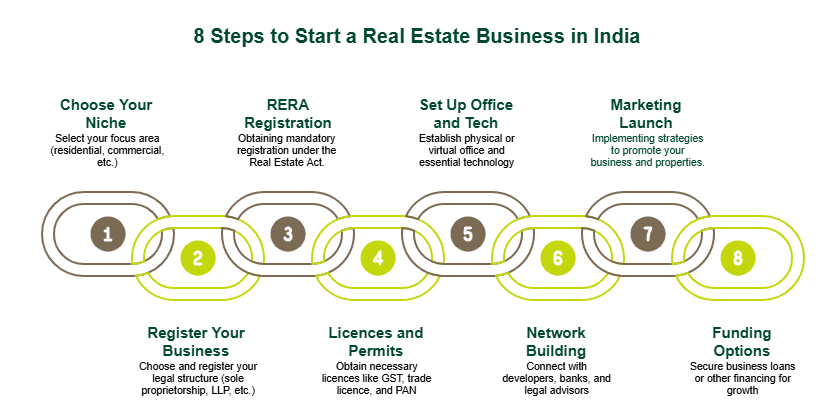
Here is the 8-step framework to launch your real estate business in India systematically:
- Choose your niche: Residential, commercial, industrial, or a geography-specific focus.
- Register your business: Sole proprietorship, LLP, or private limited company.
- Obtain RERA registration: Mandatory for agents and developers under the Real Estate (Regulation and Development) Act, 2016.
- Get your licences and permits: These may include GST registration, a trade licence, Shop & Establishment Act compliance, and a PAN.
- Set up your office and tech stack: Physical or virtual office, CRM, listing platform access, and essential communication tools.
- Build your network: Developers, banks, housing finance companies, architects, and legal advisors.
- Launch your marketing: Real estate marketing strategies include building a digital presence, using social media, tapping into local referrals, and listing properties on leading portals.
- Explore real estate funding options: Business loans, working capital finance, or a Loan Against Property for larger operations.
This framework covers both the legal and operational sides of your real estate business setup in India. Each step directly contributes to compliance, credibility, and long-term business growth. Skipping any step, particularly RERA registration, can result in penalties and reputational risks.
Benefits of Starting Your Own Real Estate Business
The real estate business remains one of the most attractive entrepreneurial paths in India for several reasons:
- High income potential: A single deal for a residential real estate in an Indian metro city can yield commissions of Rs. 50,000 to Rs. 5 lakh or more.
- Scalability: A solo broker or real estate agent can grow into an agency with minimal capital. The asset-light model means your biggest investment is time, not inventory.
- Recurring revenue: Property management, rental income, and repeat clients create ongoing income streams.
- Local market advantage: Knowledge of your city or neighbourhood is a genuine competitive edge for real estate agents.
- Low entry barrier: Unlike manufacturing or F&B, a real estate business in India can be started from a home office with a laptop and phone.
- Growth tailwinds: Rapid urbanisation, government housing schemes, and infrastructure expansion are driving demand across Tier 2 cities and Tier 3 cities.
Cost to Start a Real Estate Business
The real estate startup cost varies widely depending on scale and city. The following are the typical costs involved in setting up and operating a real estate business in India:
Small-scale real estate agent or broker (home office): Rs. 25,000 to Rs. 75,000
Covers RERA registration fees (varies by state), basic marketing, visiting cards, a simple website, and essential digital tools such as CRM or listing subscriptions.
Mid-size agency (rented office, small team): Rs. 1 lakh to Rs. 3 lakh
Includes office deposit and interiors, initial staff salaries, CRM software, basic branding, and recurring listing platform access.
Full-service real estate firm: Rs. 5 lakh and above
Suitable for firms with a larger office, multiple agents, professional branding, legal support, and a structured marketing budget across online and offline channels.
Key cost factors for your real estate business include RERA registration fees (which vary by state), office location, whether you hire employees from day one, and how aggressively you plan to market your services.
How Business Loans Can Fund Your Real Estate Venture
A dedicated business loan for real estate can play an important role in helping you manage and grow your real estate venture efficiently. This type of financing can support working capital needs, office setup, technology investments, marketing activities, staff salaries, and other operational expenses that help you scale your services in a competitive market.
However, most business loan eligibility criteria generally require a minimum operational history of three years, along with proof of stable income and profitability for the previous two financial years.
If you are new to the real estate business and do not yet meet these criteria, you may explore alternative financing options. Practical routes include a Loan Against Property if you own a residential or commercial estate to leverage, or a personal loan with a co-applicant who has a strong credit profile and steady income.
Real Estate Business Models: Residential vs Commercial vs Industrial
Choosing the right real estate business model is one of the most important early decisions you will make. Here is a comparison:
|
Business Model
|
Client Type
|
Average Deal Size
|
Sales Cycle
|
Earning Potential
|
|
Residential Real Estate
|
Individual buyers/renters
|
Rs. 20L – Rs. 2Cr+
|
2–6 months
|
Medium-High (volume driven)
|
|
Commercial Real Estate
|
Businesses, corporates
|
Rs. 50L – Rs. 20Cr+
|
3–12 months
|
High (fewer, larger deals)
|
|
Industrial Real Estate
|
Manufacturers, logistics firms
|
Rs. 1Cr – Rs. 100Cr+
|
6–18 months
|
Very High (specialist knowledge needed)
|
|
Property Management
|
Landlords, housing societies
|
Recurring monthly fees
|
Ongoing
|
Steady, recurring
|
Please note that the above table is for illustrative purposes only. Actual deal sizes, sales cycles, and earnings may vary by city, market conditions, and experience level.
Complete Guide to RERA Registration for Real Estate Business
RERA, the Real Estate (Regulation and Development) Act, 2016, is the single most important compliance requirement for any real estate business in India. It is mandatory for real estate agents facilitating the sale or purchase of properties in a registered project, and for developers launching residential or commercial projects above 500 sq. metres or 8 units.
Why RERA matters:
- Establishes legal credibility with buyers and developers
- Non-compliance may attract penalties or, in severe cases, imprisonment
- Most reputed property developers only work with RERA-registered agents
- Each state operates its own portal – MahaRERA (Maharashtra), TNRERA (Tamil Nadu), UP RERA, Karnataka RERA – and registration must be done in the state where you operate
RERA Registration Process and Documents
- Visit your state’s RERA portal and select Agent Registration.
- Fill in your business and personal details.
- Upload required documents, including PAN card, address proof of office, business registration certificate, photograph, and bank account details.
- Pay the applicable fee, which varies across states.
- Await approval, which typically takes 15 to 30 days. Renew your registration periodically as per state guidelines.
Cost Breakdown: Starting a Real Estate Business in India
Here is a detailed view of what real estate startup cost components look like across different setup scales:
|
Cost Component
|
Low Setup
|
Medium Setup
|
High Setup
|
|
RERA Registration
|
Rs. 10,000
|
Rs. 25,000
|
Rs. 50,000+
|
|
Office Setup
|
Rs. 0 (home)
|
Rs. 50,000 – Rs. 1L
|
Rs. 2L – Rs. 5L
|
|
CRM & Tech Tools
|
Rs. 5,000/yr
|
Rs. 20,000/yr
|
Rs. 1L+/yr
|
|
Marketing (digital)
|
Rs. 10,000
|
Rs. 50,000
|
Rs. 2L+
|
|
Staff (6 months)
|
Rs. 0
|
Rs. 3L – Rs. 6L
|
Rs. 10L+
|
|
GST Registration (Through GST Portal)
|
Rs. 0
|
Rs. 0
|
Rs. 0
|
|
Total Estimated
|
Rs. 25,000–Rs. 75,000
|
Rs. 1L–Rs. 3L
|
Rs. 5L+
|
Understanding your real estate business capital requirements upfront helps you determine whether self-funding or a dedicated loan is the right path.
Emerging Trends in Indian Real Estate for 2026
The real estate business in India is being reshaped by several forces heading into 2026:
- Tier 2 and Tier 3 cities' growth: Cities like Indore, Surat, and Coimbatore are seeing rapid residential and commercial expansion.
- Warehousing and logistics: E-commerce growth is driving demand for industrial real estate.
- Co-living and managed rentals: Young urban migrants are fuelling demand for curated rental products.
- Digital property discovery: A strong PropTech presence is no longer optional for a competitive real estate business.
- Affordable housing: Government programmes like PMAY (Pradhan Mantri Awas Yojana) continue to drive demand at affordable price points, especially in Tier 2 cities.
- Infrastructure-led growth: Metro expansions and highway corridors are creating micro-market booms across India.
Required Licences and Permits for Indian Real Estate Agents
There is no single national licence for a real estate business in India, but several registrations are mandatory or strongly advisable:
- RERA registration: Mandatory for agents and developers (state-specific).
- GST registration: Required if annual brokerage income exceeds Rs. 20 lakhs.
- Shop & Establishment Act licence: Required if you operate a physical office with employees.
- Trade licence: Issued by the local municipal corporation; required in most states.
- PAN card: Mandatory for all financial transactions and income tax filing.
Real estate licenses in India are typically governed state-by-state. RERA has brought significant structure to a sector that previously had no central regulatory framework.
How Much Capital Is Needed to Start a Real Estate Business?
Capital requirements depend entirely on how you enter the real estate business:
- Solo broker with no office: Rs. 25,000 to Rs. 75,000, primarily covering RERA fees, a basic website, and digital marketing for your first 3 months.
- Small agency (2–5 agents, rented office): Rs. 1 lakh to Rs. 3 lakhs, covering office setup, salaries, and a 6-month runway while deals build up.
- Full-service real estate firm: Rs. 5 lakhs to Rs. 25 lakhs, brand building, a larger team, legal support, and a robust marketing budget.
Working capital for the first 6 months is often the biggest challenge in a real estate business. Deals take time to close, and expenses start from day one. Planning this gap carefully, or financing it with a suitable loan option, is what allows most successful real estate business owners to survive the early stage and scale into profitability.
Conclusion
Starting a real estate business in India has never been more viable or more competitive. The 8-step framework in this guide gives you a clear path: choose your niche, register under RERA, get your licences in order, build your network, and market consistently.
Whether you operate as a solo real estate agent or build a full-service agency, the fundamentals remain the same: stay RERA-compliant, stay visible, and stay financially prepared.
For entrepreneurs scaling their real estate business, SMFG India Credit offers unsecured business loans of up to Rs. 1 crore*. Competitive interest rates and flexible repayment tenures of up to 60 months* help you focus on growth rather than cash flow constraints.
Use our EMI calculator and eligibility calculators to plan your finances, review the documents required, check your business loan eligibility, and apply online today.
Please note that all costs mentioned in this article are indicative. Actual investment and operational expenses may vary based on location, business model, and market conditions.