A hospitality venture requires completing several legal requirements, from hotel business registration in India and building permits to fire safety certificates and health trade licenses.
Compliance avoids legal challenges, builds trust with guests and industry peers, and supports access to applicable tax benefits. A properly licensed hotel demonstrates professionalism and reliability in the competitive hospitality industry.
Introduction to Hotel Licenses in India
The licenses required for a hotel business in India come from multiple levels of government: central, state, and local authorities. Every hotel, regardless of size or star rating, must meet a specific set of legal requirements before it can operate. Hotel licenses in India span construction safety, food handling, labour welfare, environmental compliance, and tax obligations.
The hotel registration process in India involves coordinating with departments ranging from municipal corporations and fire departments to the FSSAI and EPFO.
What Licenses Does a Hotel Business Need?
Before diving into each approval in detail, here is a quick overview of the licenses required for the hotel business in India:
- Building permit
- Fire safety permit
- Police license
- Health trade license
- Business registration (company or LLP)
- ESI registration
- PF registration
- Bar license (if serving alcohol)
- FSSAI food business license
- GST registration for hotel business
- Eating house license
- Lift clearance license (if elevators are installed)
- Music license (if playing recorded music)
- Signage license
- Certificate of Environmental Clearance (CEC)
This hotel license list covers the core hotel permits in India, though specific requirements can vary by state, hotel size, and the amenities offered.
Why Licenses Are Important for the Hotel Business
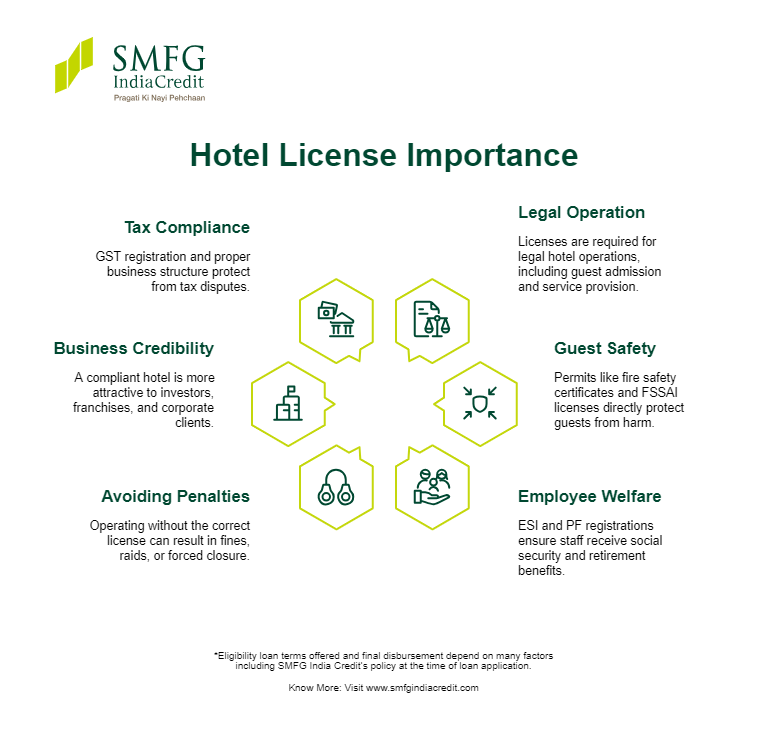
Hotel compliance laws exist to protect guests, employees, and the broader public. Understanding the importance of hotel licenses is essential for maintaining lawful operations and meeting applicable hotel business regulations. Here is why the hotel license requirements matter:
- Legal Operation: Without the required licenses, a hotel cannot legally admit guests, serve food, or operate a bar. Hotel business registration is the foundation for all subsequent approvals.
- Guest Safety: Permits like the fire safety certificate, lift clearance, and FSSAI license directly protect guests from harm.
- Employee Welfare: ESI and PF registrations ensure your staff receive social security and retirement benefits as required by law.
- Avoiding Penalties: Operating without the correct hotel business license can result in fines, raids, or forced closure.
- Business Credibility: A fully compliant hotel with a valid hotel registration certificate is more attractive to investors, franchises, and corporate clients.
- Tax Compliance: GST registration and proper business structure protect you from tax disputes and allow you to claim input tax credits.
Types of Licenses Required for Hotel Business
The hotel registration process involves obtaining approvals across several categories: construction and safety, food and beverage operations, labour and tax compliance, and environmental clearances. Below is a detailed breakdown of the licenses you will need for the hotel business.
Building Permit
Issued by the local municipal authority or town planning department, a building permit ensures that the hotel’s construction adheres to safety and design standards outlined in the National Building Code of India. Key requirements include the relevant hotel license application form, site plans, architectural and structural drawings, land title documents, and No Objection Certificates (NOCs).
The process typically takes 2 to 4 months and costs between Rs. 50,000 and Rs. 5,00,000, varying on factors such as the hotel's size and location.
*Permits are generally valid for three to four years, though this can differ based on the building's height and local regulations. It’s advisable to consult with local authorities to confirm specific requirements and validity periods.
Fire Safety Permit
The Fire Safety Permit is issued by the local fire department and verifies that the hotel adheres to fire safety regulations. This is one of the most crucial hotel license requirements in India as it ensures the hotel is equipped with necessary fire prevention and safety measures. The application process generally takes 1 to 2 months, with costs ranging from Rs. 10,000 to Rs. 50,000, depending on the hotel's size and risk profile.
Police License for Hotel
The Police license is issued by the local police department and is required to ensure that the hotel maintains proper guest records and adheres to local law enforcement regulations. The license application usually takes 1 to 2 months to process and costs between Rs. 5,000 and Rs. 20,000, depending on local requirements and the hotel's compliance.
Health Trade License or Trade License
A Health Trade license is necessary for hotels to ensure that their food and beverage operations meet health and hygiene standards. Issued by the local municipal health department, this license takes about 1 to 2 months to obtain and costs between Rs. 10,000 and Rs. 50,000, influenced by the hotel's size and location. It is crucial for ensuring public health safety in hotel operations.
Business Registration
Business Registration involves registering the hotel as a legal entity, such as a company or LLP. This process grants the business a unique identity and limits the promoters' liability. The registration typically takes 1 to 2 months and costs between Rs. 10,000 and Rs. 50,000, depending on the chosen legal structure. This step is fundamental for formalising the business and ensuring regulatory compliance.
ESI Registration
ESI (Employees' State Insurance) Registration is mandatory for hotels employing 10 or more staff members. It provides social security benefits to employees, such as medical care and maternity benefits. The registration process is relatively quick, taking about 1 to 2 weeks. Employers are required to contribute 4.75% of employees' wages, while employees contribute 1.75%. Compliance with ESI ensures employees receive necessary social security benefits.
PF Registration
PF (Provident Fund) Registration is required for hotels with 20 or more employees. Administered by the Employees' Provident Fund Organisation (EPFO), this registration provides retirement benefits to staff by helping them save for their future. The registration process generally takes about 1 to 2 weeks. Both the employer and employee contribute 12% of the employee’s wages each to PF.
Bar License
A Bar license is required for hotels that serve alcoholic beverages and is issued by the state excise department or a similar authority. This license ensures compliance with local alcohol regulations. The application process can take 2 to 4 months and costs between Rs. 50,000 and Rs. 5,00,000, depending on the state and the hotel’s location.
Since alcohol regulations can vary significantly across states, it is essential to consult with the local excise department for precise requirements and procedures.
FSSAI Food Business License
The FSSAI Food Business license is issued by the Food Safety and Standards Authority of India (FSSAI) and ensures that the hotel's food operations comply with safety standards. This license is essential for maintaining food safety and protecting consumer health. It usually takes 1 to 2 months to process and costs between Rs. 7,500 and Rs. 1,00,000, depending on the hotel's size, the nature of its food business, and its risk category.
GST Registration
GST Registration is mandatory for hotels with an annual turnover exceeding Rs. 20 lakhs (or Rs. 10 lakhs in special category states). This registration allows hotels to collect and remit Goods and Services Tax (GST) from guests and to claim input tax credits on their purchases. The registration process is swift, generally taking 1 to 2 weeks, and there is no registration fee. Obtaining GST Registration ensures compliance with Goods and Services Tax regulations and supports the legal operation of hotels under GST laws.
Eating House License
The Eating House license is issued by the local municipal authority and is required for hotels that provide food and beverages to the public. This license ensures compliance with food service regulations and standards of hygiene and safety. It typically takes 1 to 2 months to obtain and costs between Rs. 10,000 and Rs. 50,000, based on the hotel's size and location.
Lift Clearance License
A Lift Clearance license is required for hotels with elevators to ensure compliance with safety and regulatory standards. This license is issued by the local electrical inspector or relevant authority, depending on the region. The process usually takes 1 to 2 months and costs between Rs. 10,000 and Rs. 50,000, depending on the number and size of the elevators and local regulations.
Music License
A Music License is required for hotels that play recorded music or videos, including background music and live performances. This license is issued by copyright societies such as the Phonographic Performance Limited (PPL) and the Indian Performing Rights Society (IPRS). The application process takes about 1 to 2 weeks and costs between Rs. 10,000 and Rs. 1,00,000, based on the hotel’s size and the extent of music usage. Compliance with copyright laws allows hotels to legally play copyrighted music.
Signage License
A Signage license is required for hotels to install outdoor advertisements and signs. This license is issued by the local municipal authority or relevant regulatory body responsible for public advertising displays. It typically takes 1 to 2 months to process and costs between Rs. 10,000 and Rs. 50,000, depending on the size and location of the signage. This license ensures that advertising displays comply with local standards and regulations.
Certificate of Environmental Clearance (CEC)
The Certificate of Environmental Clearance (CEC) is issued by the Ministry of Environment, Forest, and Climate Change. It ensures that the hotel's operations do not adversely affect the environment. The process generally takes 3 to 6 months and costs between Rs. 1,00,000 and Rs. 10,00,000, depending on the hotel's size and environmental impact. This clearance is essential for compliance with environmental regulations and sustainable operations.
The CEC ensures compliance with environmental regulations and is typically valid for up to 10 years, requiring renewal if the project extends beyond this period.
*Please note that the information above provides estimated timelines and registration costs. Actual timelines and costs may vary based on factors such as the hotel’s location, size, and local regulations. It’s recommended to consult with a legal professional for personalised guidance.
How to Get Hotel Licenses: Step-by-Step Process
Here is the typical hotel license process step by step:
- Choose a business structure such as a company, LLP, or sole proprietorship.
- Obtain land, building, and construction approvals from local authorities.
- Apply for fire safety permits and lift clearance certificates.
- Complete registrations such as GST, FSSAI, PF, and ESI.
- Apply for local licenses, including health trade, eating house, signage, and police permits.
- Obtain a bar license from the state excise department if required.
- Apply for environmental clearance if the project meets eligibility criteria.
- Complete departmental inspections and receive approvals.
- Maintain records and renew licenses on time to ensure compliance.
*Please note that these are general hotel registration steps. The exact process and documents required for hotel license applications may vary by state, location, hotel size, and services offered.
How to Expand Your Hotel Business with a Loan
Expanding a hotel business often requires significant capital for renovations, adding rooms, upgrading amenities, or opening new properties. A business loan can help fund these expansion plans while supporting day-to-day cash flow management. Most lenders generally require hotels to have at least three years of business operations, along with financial records and relevant business loan documents, before approving financing.
Before applying, hotel owners should evaluate repayment capacity and overall borrowing requirements carefully. Using a business loan eligibility calculator can help estimate the loan amount you may qualify for based on factors such as turnover and existing obligations.
Conclusion
If you’re considering how to start a hotel business in India, ensuring compliance with regulations should be your priority. These hotel business licenses and registrations are essential for not only operating legally but also for building trust and credibility in the competitive hospitality industry.
From managing daily operations to obtaining the necessary licenses, hotel business expenses can keep mounting. To support your financial needs, SMFG India Credit offers tailored business loans, without any collateral, for hotels that have been operating for at least 3 years.
Check your business loan eligibility and apply now for loans of up to Rs. 1 crore* at competitive interest rates.


 Business Loan in Pune
 Business Loan in Patna
 Business Loan in Mumbai
 Business Loan in Jaipur
 Business Loan in Indore
 Business Loan in Hyderabad
 Business Loan in Delhi
 Business Loan in Chennai
 Business Loan in Bangalore
 Business Loan in Ahmedabad