The GST refund process lets you recover excess tax paid or unutilised Input Tax Credit (ITC) directly through the GST Portal. Under Goods and Services Tax (GST), the Government of India has made the entire GST refund process fully online, so you can file your claim, upload documents, and track your refund status without visiting any tax office.
If you have overpaid tax, exported goods or services, or accumulated ITC due to an inverted duty structure, you are entitled to claim a refund. Filing accurately and within the prescribed timelines is crucial for ensuring a smooth GST refund online experience and avoiding delays or rejections. Let’s understand in more detail how to claim a GST refund.
What Is GST Refund in India?
The GST refund meaning refers to the reimbursement of excess Goods and Services Tax (GST) paid by a registered taxpayer. This happens when the tax paid exceeds the actual tax liability, when ITC accumulates beyond what can be offset against output tax, or in specific situations such as exports and supplies to Special Economic Zones (SEZs).
The refund process under GST is governed by Section 54 of the Central GST (CGST) Act. The Government of India has standardised the process through a single online form, making it accessible for manufacturers, exporters, service providers, and other registered taxpayers. Refunds below ₹1,000 are not eligible for processing.
When Can You Claim a GST Refund?
So, when and who can claim a GST refund? You can apply if you satisfy these GST refund eligibility criteria:
- You paid extra GST due to an error or mistake in filing
- You have accumulated ITC from exports or deemed exports of goods or services
- You paid Integrated GST (IGST) on the export of services with tax payment
- Your business made purchases for UN organisations or foreign embassies
- You are on an inverted duty structure, meaning the tax on your inputs is higher than the tax on your outputs
- The final tax amount was determined after a provisional assessment, appeal, or official order, and you had already paid more
- You are an international tourist buying goods in India and leaving the country
Types of GST Refund
The refund process in GST covers several distinct categories. Knowing which GST refund type in India applies to your situation helps you select the correct form and upload the right documents:
- Excess cash balance in the electronic cash ledger
- Excess tax paid through GSTR-3B
- Accumulated ITC due to exports of goods and services without payment of tax
- Accumulated ITC due to supplies to SEZ units or SEZ developers without payment of tax
- ITC accumulation due to the inverted tax structure
- IGST refund for export of services with tax payment
- Deemed export refund, claimed either by the recipient or the supplier
- Refund on assessment, provisional assessment, appeal, or any other order
- Refund on any other ground, such as excess interest paid via GSTR-3B
Time Limit to Claim GST Refund
As per the GST refund rules in India, you must file your application within two years from the relevant date for the GST refund. The relevant date differs based on the type of refund you are claiming.
Below are some key cases that determine the GST refund application time limit:
|
Applicable Situation for GST Refund
|
Relevant Date as Per the Section 54 GST Refund Rules
|
|
Deemed exports
|
Date of filing the return related to such deemed exports
|
|
Export of goods or services
|
Date of dispatch, loading, or when goods cross the frontier
|
|
ITC accumulation due to zero-rated or nil-rated supplies
|
Date of filing the return under Section 39 for the period in which the refund claim arises
|
|
Export of services before receipt of payment
|
Date of receipt of convertible foreign exchange, or receipt of INR, where permitted by RBI
|
GST Refund Documents
The documents you need depend on the type of Goods and Services Tax refund you are claiming. Here is a general GST refund checklist:
- GST refund application form RFD-01, along with the Application Reference Number (ARN)
- Tax invoices related to the refund claim
- Proof of tax payment, such as challans
- GSTR-3B printout for the relevant month
- Export documents, such as shipping bills or Letter of Undertaking (LUT), for export-related refunds
- Bank Realisation Certificate (BRC) or Foreign Inward Remittance Certificate (FIRC) for export of services
- Undertaking by the claimant as per the relevant GST circulars
- Bank account details for the refund credit
Overview of the GST Refund Process
The GST refund procedure follows three broad stages:
- Application Stage: You file Form RFD-01 on the GST Portal with all supporting documents. The GST refund application process is completed electronically, and an ARN is generated.
- Processing Stage: A GST officer reviews your application and documents. They may raise a deficiency memo (Form RFD-03) or seek clarification (Form RFD-08). You must respond within 15 days using Form RFD-09.
- Approval and Credit Stage: The officer issues a sanction or rejection order (Form RFD-06). If approved, a payment order (Form RFD-05) is passed, and the refund is credited to your official account via NEFT, RTGS, or ECS.
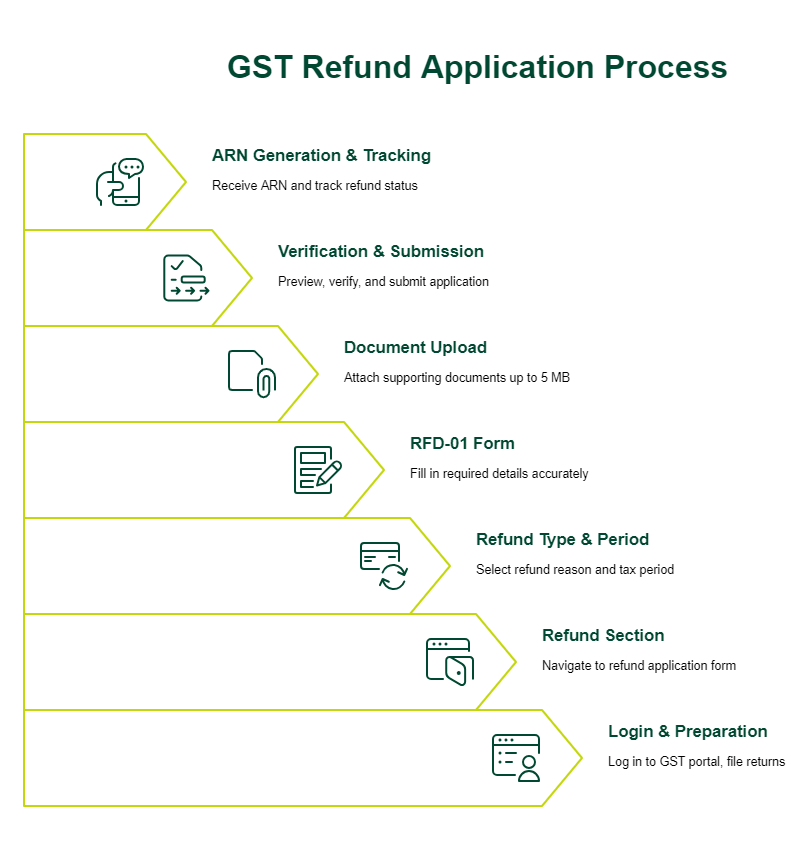
Step-by-Step Guide to Claim GST Refund Online
Here is a detailed walkthrough of how to claim GST refund on purchases:
Step 1: Log in to the GST Portal
Go to the official GST Portal and log in using your registered credentials. Make sure all your pending GSTR-1 and GSTR-3B returns are filed before you begin, as the portal requires this for most refund types.
Step 2: Navigate to the Refund Section
Once logged in, go to Services > Refunds > Refund Preapplication Form. This takes you to the GST refund section, where you can start a fresh application.
Step 3: Select Refund Type and Tax Period
On the refund application page, select the reason for your refund from the dropdown list. Based on the refund type selected, choose the relevant tax period. For refund types such as excess cash balance or assessment-based refunds, the tax period selection step does not apply.
If you want to file a nil refund application, a dialogue box will appear asking you to confirm. Nil refund applications can be filed using EVC or Digital Signature Certificate (DSC).
Step 4: Fill the GST RFD-01 Form
Enter all required details on the form based on your refund category. For export-based refunds, download the relevant statement (Statement 2, 3, 4, or 5B depending on type), fill in the invoice details, generate the JSON or CSV file, and upload it to the portal. The GST refund RFD-01 form requires accuracy at every step; errors here can lead to delays or rejection.
For accumulated ITC due to an inverted duty structure, you will need to enter details such as turnover of inverted-rated supply, tax payable, adjusted total turnover, and net ITC.
Step 5: Upload Documents
Attach all supporting documents relevant to your refund claim. You can upload up to 10 documents, with a maximum file size of 5 MB each. These include invoices, export proof, lender details, and any declarations required under GST refund rules.
Step 6: Verify and Submit the Application
Preview your application carefully. Check the undertaking and self-declaration boxes. Then file the application using either your Electronic Verification Code (EVC) or Digital Signature Certificate (DSC). Once submitted, the application cannot be modified.
Step 7: ARN Generation and Tracking
After successful submission, an Application Reference Number (ARN) is generated and displayed on the screen. The GST refund ARN is also sent to your registered email address and mobile number. Use this ARN to track your GST refund status online at any time.
How to Claim GST Refund for Exports (IGST Paid on Export of Goods)
For exports with payment of IGST, no separate RFD-01 application is needed. Here is how the process works:
- Fill Table 6A in GSTR-1 with shipping bill details related to your export transactions.
- Report summary details in item 3.1(b) of GSTR-3B and pay the corresponding IGST.
- The GST Portal treats the shipping bill as the refund application.
- Export data is shared with ICEGATE, where Customs cross-checks it against the Export General Manifest (EGM).
- Once verified, the IGST refund is processed and credited to your bank account.
- You receive a confirmation via SMS and email once the credit is done.
GST Refund Processing Timeline
Once your GST refund application is submitted:
- An acknowledgement in Form RFD-02 is issued within 15 days if the application is complete
- For provisional refunds (Form RFD-04), at least 90% of the claimed amount is released within 7 days of acknowledgement
- The full GST refund timeline from application to credit is typically 30 to 60 days, depending on the complexity of your case and the verification required
If the officer finds a deficiency, they will issue Form RFD-03, which restarts the timeline after you file a fresh application.
How to Track GST Refund Status Online
You have two ways to track your GST refund online:
Post-login tracking: Log in to the GST Portal, go to the Services tab, and select Track Application Status under Refunds. Choose the financial year and confirm your official account details to get a complete update on your application.
Pre-login tracking: Visit the GST Portal without logging in, click on Track Application Status, and enter your ARN.
For IGST refunds on export of goods, you need to log in, select the fiscal year and quarterly files, and enter invoice details to get a comprehensive status update.
What Are the 3 Stages of GST Refund Status?
Stage 1: Refund request submitted.
You file your application on the GST Portal with all the required details and documents. The ARN is generated, and the application moves to the GST officer's dashboard as a pending task.
Stage 2: Application under processing.
The GST officer reviews your application. At this stage, they may seek clarification, raise a deficiency memo, or approve the provisional refund. You can track this stage using your ARN.
Stage 3: Refund approved and credited.
The officer issues the sanction order, and the refund amount is transferred directly to your official account. A confirmation is sent to your registered email and mobile number.
GST Refund Example
Here is a straightforward GST refund example to illustrate how excess payment works:
Mr. B had a GST liability of ₹50,000 for September but paid ₹5,00,000 by mistake, resulting in an excess payment of ₹4,50,000. He can file a GST refund application for this excess amount within two years from the date of payment. Once approved, the amount is credited back to his bank account.
For interest on delayed GST refunds, if the refund is not processed within 60 days of the application, the Government of India pays interest at 6% per annum for the delay period.
Common Mistakes to Avoid While Claiming GST Refund
- Filing the refund application before submitting all pending GSTR-1 and GSTR-3B returns.
- Entering incorrect invoice details or mismatched figures between GSTR-1 and GSTR-3B.
- Missing the two-year deadline from the relevant date for the GST refund.
- Uploading incomplete or incorrect documents leads to a deficiency memo.
- Not responding to Form RFD-08 (clarification notice) within the 15-day window.
- Claiming ITC that is not eligible for refund, such as ITC on construction services meant for sale.
- Submitting the pre-application form with errors, as it cannot be edited once submitted.
Conclusion
The GST refund process is largely digital and structured to help you recover excess tax efficiently. From selecting the right refund type and filing Form RFD-01 to tracking GST refunds using the ARN, each step has a defined timeline and process. File accurately, meet your deadlines, and keep your returns up to date to avoid delays or rejection.
For enterprises managing cash flow during the refund processing period, an unsecured business loan from SMFG India Credit can help bridge temporary gaps while you wait for your refund to be credited. Check your eligibility and apply today to access funds of up to Rs. 1 crore* at competitive interest rates.
Explore More on GST