Under the GST (Goods and Services Tax) framework, businesses often come across questions such as what IGST is and how it applies to their transactions. The IGST meaning refers to Integrated GST in India, which is levied on the supply of goods and services between states, as well as on imports. IGST, explained simply, ensures that tax is collected fairly and later shared between the Centre and the destination state where the goods or services are consumed.
Meaning of IGST (Integrated Goods and Services Tax)
The IGST full form is Integrated Goods and Services Tax. As per the IGST definition under the IGST Act, it is a type of tax levied on inter-state supplies of goods and services, including imports into India. The IGST tax forms a key part of the GST framework, ensuring seamless tax collection and distribution between the Centre and the states. The gst council determines the rules and IGST rates, while the GST Network (GSTN) manages registration, return filing and settlement processes to enable smooth implementation of the Integrated Goods and Services Tax across the country.
Why IGST Was Introduced Under GST
Before the GST reform in India, inter-state trade was subject to multiple indirect taxes, including Central Sales Tax, which often led to cascading effects and compliance challenges.
Tax unification under GST aimed to simplify this structure by introducing a single interstate tax mechanism. IGST on interstate supply was designed to ensure that tax is collected by the Centre and later apportioned to the destination state based on the value of supply. This system removed the need for separate state-level levies on inter-state transactions and enabled seamless Input Tax Credit (ITC) across states. As a result, businesses now operate under a more transparent and consistent framework for interstate movement of goods and services.
How IGST Works: Applicability & Mechanism
IGST applicability arises when goods or services are supplied from one state to another, or when goods are imported into India. In such cases, inter-state GST is charged instead of CGST and SGST.
The IGST rate generally mirrors the total of CGST and SGST combined. For example, if a seller in Maharashtra supplies goods worth Rs. 1,00,000 to a buyer in Karnataka at 18%, an IGST mechanism example would involve charging Rs. 18,000 as IGST. The seller reports this transaction on the GST portal, and the input tax credit is later adjusted and shared between the Centre and the destination state.
How to Calculate IGST?
Understanding how to calculate IGST is fairly straightforward.
The IGST calculation method involves applying the applicable IGST rate to the taxable value of supply.
In simple terms, IGST tax calculation is done by multiplying the value of goods or services by the prescribed IGST rate.
For example, if goods worth Rs. 50,000 attract an IGST rate of 18%, the calculation would be:
IGST = Rs. 50,000 × 18% = Rs. 9,000.
The total invoice value would therefore be Rs. 59,000. This method ensures clarity and uniformity in inter-state transactions.
IGST Formula
The basic IGST formula used for tax computation is simple and consistent across transactions.
IGST = Taxable Value × IGST Rate
Under this IGST calculation formula, the taxable value refers to the value of supply after excluding GST, while the IGST rate is the applicable percentage notified for the goods or services.
Examples of IGST Calculation
To understand how to calculate IGST, consider a simple example. Suppose a supplier in Delhi sells goods worth Rs. 40,000 to a buyer in Tamil Nadu at an 18% rate. Using the IGST formula, the tax would be Rs. 40,000 × 18% = Rs. 7,200. The total invoice value becomes Rs. 47,200.
In another IGST example, if goods valued at Rs. 1,20,000 attract 5%, the IGST payable is Rs. 6,000. Businesses must report these details accurately during IGST return filing on the GST portal to ensure proper input tax credit settlement.
Who Collects IGST & How It Is Shared Between Centre & States
Under the IGST rules in India, IGST is collected by the Central Government on inter-state supplies and imports. However, the tax is not retained entirely by the Centre. The IGST distribution model ensures proper IGST revenue sharing between the Centre and the destination state where the goods or services are consumed. Based on return data filed through the GST Network (GSTN), the amount is apportioned accordingly. This system supports a fair central and state GST share, ensuring that revenue ultimately reaches the state where consumption takes place, while maintaining administrative efficiency at the central level.
Benefits of IGST for Businesses
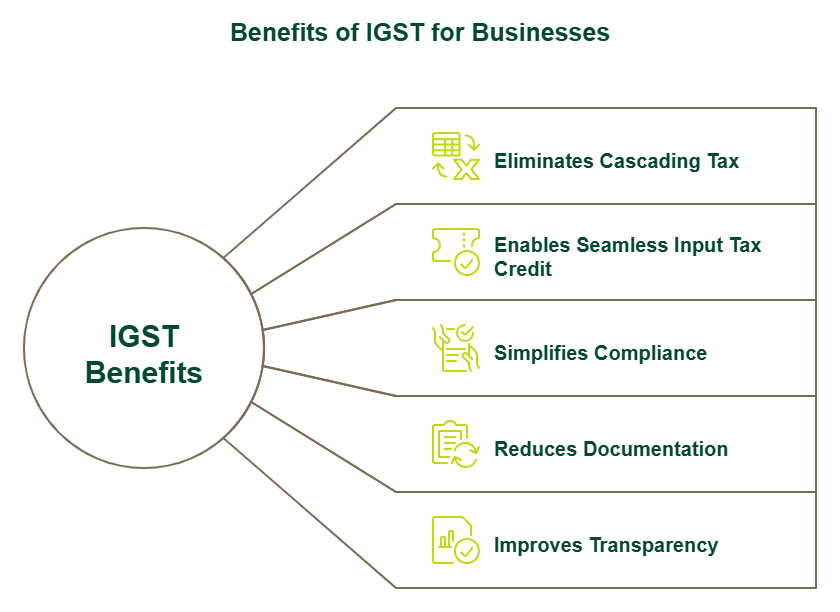
The introduction of IGST has brought several advantages for businesses engaged in the interstate supply of goods and services. By streamlining tax collection and distribution, it supports smoother operations across state borders. Many IGST benefits align closely with broader GST benefits, particularly in improving compliance and credit utilisation. This has contributed to better business efficiency through IGST within the unified tax framework.
- Eliminates cascading tax on inter-state transactions
- Enables seamless input tax credit across states
- Simplifies compliance under a single tax structure
- Reduces documentation compared to earlier tax regimes
- Improves transparency in interstate supply reporting
IGST Applicability on Goods vs Services
IGST applies to both goods and services when the transaction qualifies as an interstate supply under the GST Council laws. IGST on goods is charged when goods are supplied from one state to another, including stock transfers between branches located in different states. The place of supply and the location of the supplier determine whether interstate supply conditions are met.
Similarly, IGST on services is applicable when the supplier and the recipient are located in different states, or when services are imported into India. The determination is based on specific interstate supply conditions laid down in GST provisions, particularly the place of supply rules. If these conditions are satisfied, the IGST rate is levied instead of CGST and SGST, ensuring uniform taxation across state boundaries.
How IGST Improves Ease of Doing Business
The introduction of IGST for ease of doing business has supported a more predictable and streamlined tax environment. By replacing multiple indirect taxes with a single structure, GST simplification has reduced procedural complexity in inter-state transactions. A unified levy on interstate supplies has limited classification disputes and reduced confusion over tax jurisdiction.
The IGST refund process, particularly for exporters, has also improved liquidity by allowing quicker credit adjustments and refunds on zero-rated supplies. In addition, IGST on imports and exports ensures uniform taxation and smoother credit flow across the supply chain. These measures collectively strengthen compliance, reduce litigation risks, and help businesses operate more efficiently across state and national boundaries.
Common Misconceptions About IGST
There is often confusion around how IGST differs from other components of GST. One common GST misconception is that IGST and SGST are interchangeable. In reality, IGST applies only to inter-state supplies or imports, while SGST is levied on intra-state transactions along with CGST. The nature of the supply determines which tax is charged.
Another frequent IGST confusion is that it is applicable to every transaction between two businesses. IGST is not applicable when both the supplier and recipient are located in the same state, and the place of supply is also within that state. Clearing such GST misconceptions helps businesses apply the correct tax treatment and avoid compliance errors.
Conclusion
So, what is IGST? It refers to the Integrated Goods and Services Tax levied on inter-state supplies and imports under the GST regime. The IGST Act provides the legal framework for its implementation, ensuring that tax collected by the Centre is fairly apportioned to the destination state. Understanding IGST applicability in India, along with its calculation and compliance requirements, helps businesses manage inter-state transactions efficiently. The IGST benefits include seamless input tax credit across states, reduced cascading of taxes and improved transparency in tax settlement.
While managing GST obligations, businesses must also balance working capital needs, operational costs, and growth plans. To support your enterprise finance requirements, SMFG India Credit offers business loans of up to Rs. 1 crore*. Eligible enterprises can benefit from competitive business loan interest rates and flexible tenures of up to 60 months*. You may use the business loan eligibility calculator and EMI calculator to plan repayments and apply online with minimal business loan documentation.