In India’s indirect tax framework, understanding what SGST is proves to be essential for businesses and consumers alike. The SGST full form is State Goods and Services Tax, and it forms a crucial component of the Goods and Services Tax structure. If you are wondering about the SGST meaning and how it operates within GST, this guide explains the concept, applicability, calculation, compliance, and practical implications in a clear and structured manner.
What Is SGST?
The SGST definition refers to the tax levied by state governments on the supply of goods and services within a particular state. Under the broader GST system, SGST is applicable on intra-state transactions, meaning when the supplier and buyer are located in the same state.
If you want SGST explained simply, it is the portion of GST that is collected by the respective state government. When a transaction occurs within a state, the GST charged is divided equally between CGST (Central GST) and SGST. Therefore, SGST under GST ensures that states receive their rightful share of tax revenue.
SGST Full Form and Meaning
As seen above, the SGST full form is State Goods and Services Tax. It is the tax collected by the state government on intra-state transactions.
The SGST meaning becomes clearer when viewed within the GST structure. GST is a unified indirect tax, but it is split into components. SGST stands for the state’s share of GST revenue. It represents the state tax in GST and ensures fiscal autonomy while maintaining a unified taxation system across India.
Why SGST Was Introduced Under GST
Before GST, states levied multiple indirect taxes such as VAT, luxury tax, and entertainment tax. With the introduction of the GST structure in India, these were subsumed into a unified tax framework. The purpose of SGST was to preserve the revenue rights of state governments under the federal tax system.
The SGST Act governs the levy and collection of State Goods and Services Tax. The objective behind SGST was to create a transparent and efficient taxation system while ensuring state revenue under GST is protected. Through SGST, the Goods and Services Tax structure balances central and state fiscal powers.
Thus, SGST was introduced to maintain cooperative federalism while simplifying indirect taxation.
How SGST Works in Intra-State Transactions
SGST applies to intra-state sales, meaning transactions occurring within the same state. When goods or services are supplied within a state, GST is split equally between CGST and SGST.
For example, if a product attracts 18% intra-state supply GST, it is divided into:
This CGST and SGST split ensures both the central and state governments receive equal shares. The SGST collection process begins when the seller charges GST on the invoice. The SGST portion is deposited with the state government through the official GST portal.
SGST Rates in India
SGST rates in India correspond directly to the overall GST tax slab rates. Since GST is divided equally between CGST and SGST for intra-state supplies, SGST represents half of the total GST rate.
SGST Rate Chart
|
GST Slab
|
Total GST
|
SGST Percentage
|
|
5%
|
5%
|
2.5%
|
|
12%
|
12%
|
6%
|
|
40%
|
40%
|
20%
|
The SGST percentage always equals half of the applicable GST slab. The government may revise SGST slab rates based on economic requirements.
SGST Applicability on Goods and Services
SGST applicability arises when goods or services are supplied within the same state. If a seller in Maharashtra supplies goods to a buyer in Maharashtra, SGST is charged along with CGST.
When is SGST applicable? It is charged when:
- Supply location and place of supply are in the same state.
- The transaction qualifies as intra-state under the SGST Act.
SGST on goods and SGST on services follow identical principles. However, if the transaction crosses state borders, IGST (Integrated GST) applies instead. Therefore, understanding SGST applicability is crucial for compliance.
Who Collects SGST and Where Does It Go?
SGST is collected by the relevant state government. Businesses collect SGST from customers and remit it through the GST portal. The funds are credited to the respective state treasury.
The SGST revenue distribution ensures that states retain financial resources for infrastructure, healthcare, education, and development. Thus, SGST represents a significant component of state government tax collection under the Goods and Services Tax framework.
SGST Input Tax Credit Rules
Under GST, businesses can claim Input Tax Credit (ITC) to avoid cascading taxation.
SGST Input Tax Credit allows taxpayers to offset State Goods and Services Tax liability using the SGST paid on purchases.
Key SGST ITC rules include:
- SGST credit can be utilised against SGST liability.
- It cannot be cross-utilised for CGST liability directly.
- ITC under GST must be claimed in GST returns.
Proper SGST credit utilisation ensures tax efficiency and reduces overall liability. Compliance with SGST Act provisions is mandatory while claiming ITC.
Common Examples of SGST Calculation
Understanding how to calculate SGST is easier with practical examples.
SGST Example Calculations
Example 1:
Product price: ₹10,000
GST rate: 18%
So, how is SGST calculated?
SGST formula:
SGST = (Taxable Value × SGST Rate) ÷ 100
Using our example:
SGST = ₹10,000 × 9% = ₹900
Thus:
- CGST = ₹900
- SGST = ₹900
- Total GST = ₹1,800
Example 2:
Service value: ₹50,000
GST slab: 5%
SGST = ₹50,000 × 2.5% = ₹1,250
In this case:
- CGST = ₹1,250
- SGST = ₹1,250
- Total GST = ₹2,500
SGST Compliance and Return Filing
Businesses registered under GST must adhere to SGST compliance requirements. SGST reporting is part of the GST returns filing procedures.
Taxpayers must:
- Upload invoice details
- Report SGST liability
- Claim SGST input tax credit
- Complete SGST return filing on time
The SGST payment process is executed via the GST portal. Delayed compliance may result in penalties under the SGST Act.
Impact of SGST on Businesses and Consumers
The impact of SGST on business operations is significant. It simplifies taxation, ensures transparency, and reduces cascading effects.
From the opposite perspective, the SGST effect on consumers is reflected in transparent pricing. Since GST pricing impact is clearly shown on invoices, consumers can see the SGST component separately.
Overall, SGST improves accountability while maintaining state-level revenue control.
Key Benefits of SGST
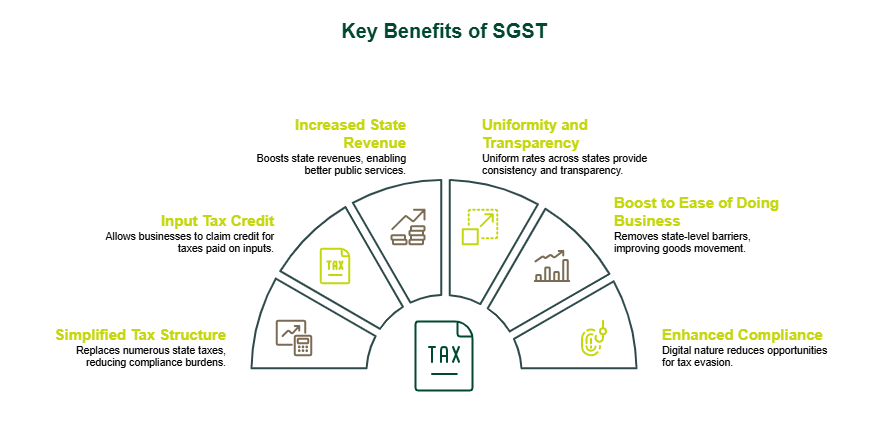
The advantages of SGST lie in its balance between uniform taxation and state fiscal independence. Key state GST benefits include:
- Ensures revenue autonomy for states
- Promotes tax transparency under GST
- Eliminates multiple state-level indirect taxes
- Enables seamless Input Tax Credit (ITC)
- Simplifies tax administration
- Strengthens cooperative federalism
- Enhances compliance through the GST portal
Common Misconceptions About SGST
Many taxpayers confuse SGST vs CGST. A common SGST misunderstanding is that it is an additional tax. In reality, SGST is simply half of the Goods and Services Tax in intra-state transactions.
Another SGST myth is that it applies to all transactions. However, inter-state supplies attract IGST, not SGST. Understanding the SGST definition and applicability eliminates such confusion.
Conclusion
To summarise, what is SGST? It is the State Goods and Services Tax levied on intra-state supplies under the GST regime. The SGST meaning reflects the state’s share of GST revenue, governed by the SGST Act. SGST rates correspond to GST slabs and apply whenever transactions occur within a state. Understanding SGST applicability in India, calculation methods, and compliance requirements is essential for smooth tax management under the Goods and Services Tax system.
Managing GST liabilities alongside operational expenses and business expansion often requires adequate working capital. To support your enterprise finance needs, SMFG India Credit offers business loans of up to Rs. 1 crore*. Eligible enterprises can benefit from competitive business loan interest rates and flexible tenures of up to 60 months*. You may use the business loan eligibility calculator and EMI calculator to plan your finances and apply online with minimal business loan documentation.
* Please note that this article is for your knowledge only. Loans are disbursed at the sole discretion of SMFG India Credit. Final approval, loan terms, disbursal process, foreclosure charges and foreclosure process will be subject to SMFG India Credit's policy at the time of loan application. If you wish to know more about our products and services, please contact us