Quick Summary
- Section 194Q of the Income Tax Act, 1961 requires buyers to deduct TDS (Tax Deducted at Source) at 0.1% on purchases of goods exceeding Rs. 50 lakhs from a resident seller in a financial year.
- For this TDS to be deducted, the buyer's turnover in the preceding year must have exceeded Rs. 10 crore.
- Introduced under the Finance Act 2021, this provision covers all goods transactions with resident sellers and does not apply to imports or services.
- If the seller does not provide a valid PAN, the Sec 194Q TDS rate rises to 5%.
- Businesses must deduct TDS at the time of credit or payment, whichever is earlier, and report it in Form 26Q on a quarterly basis.
- If the seller is a non-resident, Section 194Q is not applicable. Further, TCS under Section 206C(1H) is no longer applicable with effect from 1 April 2025.
TDS on the purchase of goods and Section 194Q of the Income Tax Act are terms every large buyer in India needs to understand. Introduced via the Finance Act 2021 and effective from 1 July 2021, this section places the responsibility of TDS deduction on the buyer, not the seller. Any business with significant purchase volumes from resident suppliers must check whether Section 194Q applies to them. Getting it wrong means interest, penalties, and potential disallowance of expenses.
What Is Section 194Q of the Income Tax Act?
Under the Income Tax Act, Section 194Q’s meaning relates to a buyer who is responsible for making payment to a resident seller for the purchase of goods and must deduct TDS at 0.1% on the amount exceeding Rs. 50 lakhs in a financial year. This requirement is also referred to as TDS deduction on purchase transactions.
The provision was introduced to widen tax compliance coverage and bring large-value goods transactions under the TDS framework. Prior to Section 194Q, only sellers were required to collect Tax Collected at Source (TCS) under Section 206C(1H). Section 194Q introduced a corresponding TDS obligation for eligible buyers.
Why Was Section 194Q Introduced?
Section 194Q came into effect with the primary aim of curbing tax evasion practices and bringing high-volume transactions within the scope of TDS. CBDT introduced this provision, which helps create an audit trail by requiring eligible buyers to deduct TDS on specified purchases of goods. The purpose of Section 194Q is to reduce the risk of underreporting income by sellers and to improve overall tax compliance across supply chains.
Applicability of Section 194Q
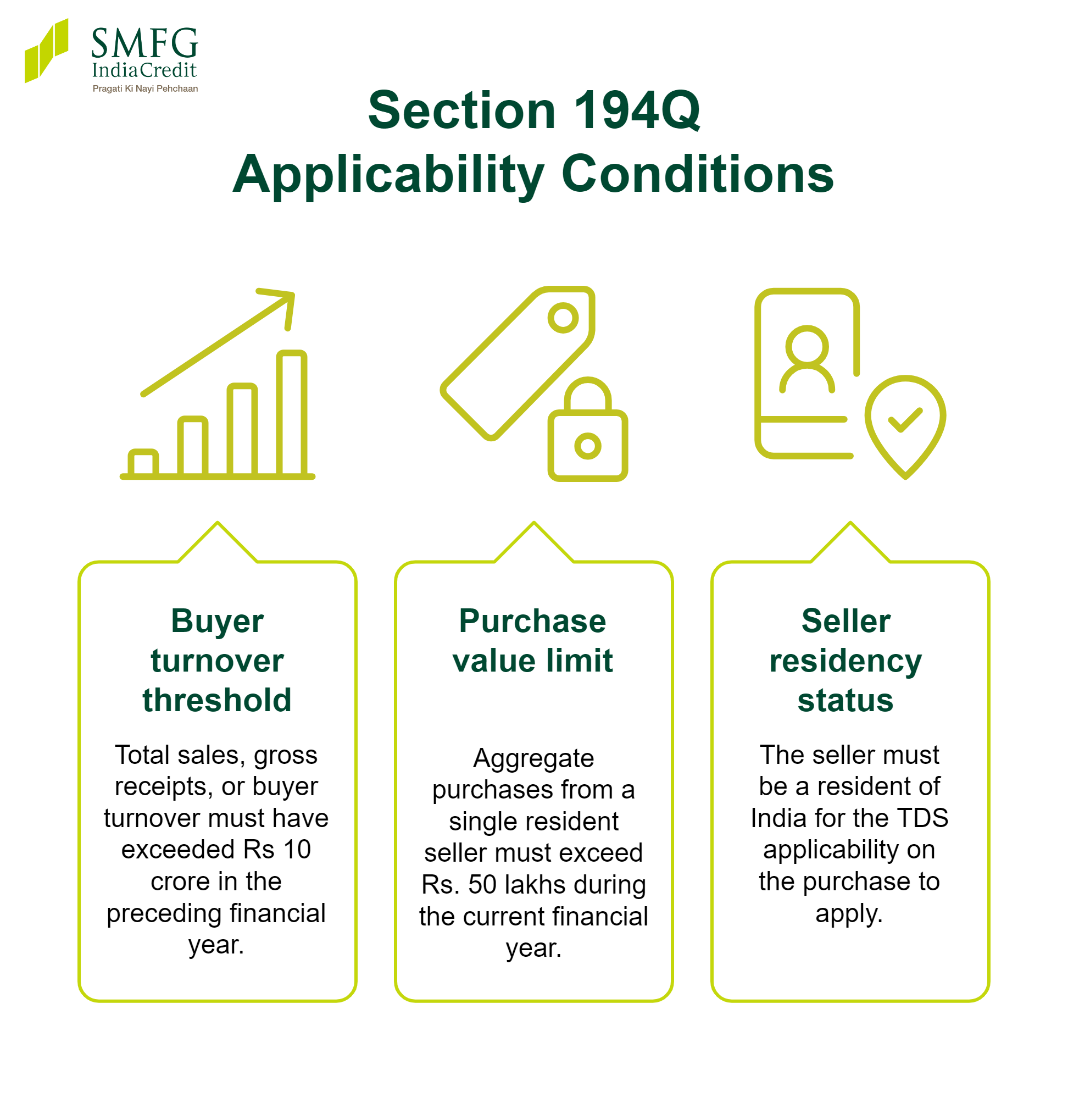
Who is liable under Section 194Q depends on three conditions being met:
- The total sales, gross receipts, or the buyer turnover threshold must have exceeded Rs. 10 crore in the immediately preceding financial year.
- The aggregate purchases from a single resident seller must exceed Rs. 50 lakhs during the current financial year.
- The seller must be a resident of India for the TDS applicability on the purchase to apply.
If all three conditions are satisfied, the Section 194Q applicability criteria are met, and the buyer must deduct TDS.
Who Must Deduct TDS Under Section 194Q?
Buyer TDS under Section 194Q is the responsibility of any entity whose total sales, gross receipts, or turnover exceeded Rs. 10 crore in the immediately preceding financial year. The buyer may be a company, partnership firm, LLP, individuals subject to tax audit, or any other eligible entity purchasing goods from a resident seller.
Section 194Q example: Company A had a turnover of Rs. 15 crore in FY 2023–24. In FY 2024–25, it purchases goods worth Rs. 80 lakhs from Supplier B, a resident seller. Since Company A's turnover exceeds Rs. 10 crore and its purchases from Supplier B exceed Rs. 50 lakhs, Company A must deduct TDS under Section 194Q on Rs. 30 lakhs, which is the amount exceeding the threshold. At a TDS rate of 0.1%, the TDS liability would be Rs. 3,000.
Section 194Q Turnover Limit
The Section 194Q turnover limit for the buyer is Rs. 10 crore in the preceding financial year. This is based on total sales or gross receipts, and GST is excluded from this calculation of the turnover threshold for Section 194Q. If your business crossed Rs. 10 crore in turnover even once in the prior year, Section 194Q applies to your purchases in the current year.
Example: If your FY 2023–24 turnover was Rs. 11 crore (excluding GST), you must check all purchase transactions in FY 2024–25 for Section 194Q compliance.
Purchase Threshold Under Section 194Q
The Section 194Q threshold for purchase is Rs. 50 lakhs per seller per financial year. The purchase of goods TDS does not apply to the first Rs. 50 lakhs purchased from any single seller. Only the amount above this Section 194Q purchase limit triggers the obligation.
This threshold for TDS deduction under 194Q is per seller, not cumulative across all vendors. If you buy Rs. 40 lakhs each from two different suppliers, neither transaction attracts Section 194Q, even though the total is Rs. 80 lakhs.
Section 194Q TDS Rate
The Section 194Q TDS rate is 0.1% on the amount exceeding Rs. 50 lakhs, provided the seller furnishes a valid PAN. This is the standard Sec 194Q TDS rate and is significantly lower than many other TDS provisions.
If the seller does not provide PAN, the TDS rate equivalent under Section 206AA kicks in, raising the rate to 5%. This five-fold increase in the TDS deduction under Section 194Q can affect both cash flow and vendor relationships.
|
Seller Situation
|
Applicable TDS Rate
|
|
PAN provided
|
0.1% on amounts exceeding Rs. 50 lakhs
|
|
PAN not provided
|
5% on amounts exceeding Rs. 50 lakhs
|
|
Non-resident seller
|
Section 194Q does not apply
|
|
Transaction covered by another TDS section
|
Section 194Q may not apply, subject to the prevailing tax laws
|
When Should TDS Be Deducted Under Section 194Q?
TDS 194Q must be deducted at the earlier of:
- The time of credit of the purchase amount to the seller's account in your books, or
- The time of actual payment to the seller
In cases of advance payment, immediate TDS deduction is essential. The timing of the TDS deduction rule is critical for Section 194Q compliance.
Section 194Q Example and Calculation
Section 194Q Tax Deduction Example
Scenario 1:
A manufacturing firm with Rs. 12 crore turnover in FY 2024–25 buys goods worth Rs. 90 lakhs (including GST of Rs. 16.2 lakhs) from a resident supplier in FY 2025–26.
Section 194Q calculation:
- Total purchase value (inclusive of GST): Rs. 90 lakhs
- Threshold: Rs. 50 lakhs
- Taxable amount: Rs. 40 lakhs
- TDS at 0.1%: Rs. 4,000
Scenario 2:
The same buyer purchases Rs. 55 lakhs from a different supplier who has not provided a PAN.
- Taxable amount: Rs. 5 lakhs (Rs. 55 lakhs minus Rs. 50 lakhs)
- TDS calculation under Section 194Q at 5% (no PAN): Rs. 25,000
Section 194Q Calculation Table
|
Purchase Value (Rs.)
|
Threshold (Rs.)
|
Taxable Amount (Rs.)
|
TDS Rate
|
TDS Deducted (Rs.)
|
|
60 lakhs
|
50 lakhs
|
10 lakhs
|
0.1%
|
1,000
|
|
90 lakhs
|
50 lakhs
|
40 lakhs
|
0.1%
|
4,000
|
|
55 lakhs (no PAN)
|
50 lakhs
|
5 lakhs
|
5%
|
25,000
|
|
45 lakhs
|
50 lakhs
|
Nil
|
N/A
|
Nil
|
*These calculations are for illustrative purposes only.
Section 194Q Exemption: When It Does Not Apply
The non-applicability of Section 194Q covers the following situations:
- Import of goods from outside India (non-resident sellers are excluded)
- Transactions where tax is deductible under another provision of the Income Tax Act, subject to the applicable provisions governing overlapping TDS/TCS requirements.
- Purchase of services comes under Section 194Q exceptions (only goods are covered)
- Buyers whose total sales, gross receipts, or turnover in the immediately preceding financial year did not exceed Rs. 10 crore
Section 194Q vs 206C(1H)
The difference between 194Q and 206C(1H) was one of the most common points of confusion for finance teams. Both provisions covered the same transactions but from opposite directions.
|
Factor
|
Section 194Q
|
Section 206C(1H)
|
|
Obligation on
|
Buyer
|
Seller
|
|
Applicable when
|
Buyer's turnover exceeds Rs. 10 crore
|
Seller's turnover exceeds Rs. 10 crore
|
|
Rate
|
0.1% (or 5% if no PAN)
|
0.1% (or 1% if no PAN)
|
|
Transaction threshold
|
Rs. 50 lakhs per seller
|
Rs. 50 lakhs per buyer
|
Note that Section 206C(1H) has been removed, effective April 1, 2025. Sellers no longer have to collect TCS on the sale of goods.
Section 194Q vs Section 194-O
Section 194-O requires e-commerce operators to deduct TDS at 1% on payments made to e-commerce participants. If a transaction is already covered under Section 194-O, Section 194Q does not apply separately. There is no double deduction.
Section 194Q Compliance Requirements
Section 194Q compliance involves the following obligations for every eligible buyer:
- Obtain a TAN (Tax Deduction Account Number) before deducting TDS
- Verify the seller's PAN before any purchase to ensure the correct Section 194A TDS rate equivalent is applied
- Deduct TDS at the earlier of credit to the seller's account or actual payment
- Deposit TDS with the government by the 7th of the following month (30th April for March deductions)
- Ensure TDS filing under Section 194Q using Form 26Q
- Maintain all purchase and deduction records for audit purposes
Due Dates for Deposit and Filing Under Section 194Q
|
Activity
|
Due Date
|
|
Monthly TDS deposit (April to February)
|
7th of the following month
|
|
TDS deposit for March
|
30th April
|
|
Form 26Q filing (Q1: April to June)
|
31st July
|
|
Form 26Q filing (Q2: July to September)
|
31st October
|
|
Form 26Q filing (Q3: October to December)
|
31st January
|
|
Form 26Q filing (Q4: January to March)
|
31st May
|
The Section 194Q due dates for TDS deposit and quarterly return filing should be followed carefully to avoid interest, late filing fees, and other penalties under the Income Tax Act.
Consequences of Non-Compliance Under 194Q
Failure to comply can result in the following Section 194Q penalties:
- Interest at 1% per month for failure to deduct TDS
- Interest at 1.5% per month for failure to deposit the TDS
- 30% disallowance of expenditure under Section 40(a)(ia)
- Exposure to penalties, scrutiny, and notices for delayed filing
Common Mistakes Businesses Make Under Section 194Q
The following are the Section 194Q mistakes to be aware of:
- Applying the threshold to individual invoices instead of the aggregate annual purchases from one seller
- Including purchases from non-resident sellers in the Section 194Q calculation
- Not validating the seller's PAN before making payments results in the higher 5% rate being applicable
- Deducting TDS on service invoices where Section 194Q does not apply
- Treating the Rs. 10 crore turnover threshold as including GST (it excludes GST)
- Missing the deduction at the point of credit when using accrual-based accounting
Section 194Q Declaration Format
Although the Income Tax Act does not prescribe a specific format for a Section 194Q declaration, it should clearly communicate the buyer's obligation to deduct TDS under the provision.
The declaration typically includes the buyer's name, PAN, and organisation details (where applicable), along with a confirmation that the turnover in the preceding financial year exceeded Rs. 10 crore. It may also contain an optional indemnity clause to address any consequences arising from incorrect information. Finally, the declaration should be dated and signed by the authorised representative to establish its authenticity and maintain proper documentation.
Impact of Section 194Q on Businesses
The business impact of Section 194Q can be seen in both accounting processes and cash flow management. Buyers must implement systems to track cumulative purchases from each seller throughout the financial year and identify when the Rs. 50 lakhs threshold is crossed. TDS deductions temporarily reduce the amount paid to the seller, which may occasionally create friction in vendor relationships, particularly with smaller suppliers that rely on timely cash inflows for working capital.
Businesses managing seasonal purchase cycles or temporary cash flow constraints may consider working capital financing to maintain liquidity while meeting compliance requirements. If your enterprise requires funding support, checking your business loan eligibility can be a useful first step.
You can also use a business loan EMI calculator to estimate monthly repayments and align borrowing with your expected cash flow.
Conclusion
Understanding the 194Q Section requirements helps businesses stay compliant, avoid penalties, and manage vendor transactions more efficiently. Since TDS on the purchase of goods and other tax obligations can also influence cash flow, having access to reliable working capital is important.
To support your enterprise financing needs, SMFG India Credit offers unsecured business loans of up to Rs. 1 Crore* at competitive interest rates.
Estimate your borrowing capacity using our business loan eligibility calculator and apply online today!