Understanding turnover in business is essential for every owner, entrepreneur, and taxpayer. Business turnover reflects the total value of sales generated during a specific period and serves as an important financial indicator. Knowing how turnover is calculated and why it matters can help you manage compliance requirements, assess business performance, and make informed financial decisions.
What Is Turnover in Business?
The business turnover meaning generally refers to the value of sales generated from a business's ordinary activities during a specific accounting period, before deducting business expenses. Depending on the nature of the business and the applicable accounting or tax provisions, turnover may include the value of goods sold or receipts from services provided.
Turnover is a commonly used financial metric because it provides an indication of the scale of a business's operations. It can help business owners, lenders, investors, and tax authorities assess the level of revenue-generating activity carried out during a financial year or another reporting period.
Unlike profit, turnover does not show how much a business retains after accounting for its expenses. A business can therefore generate a high turnover while earning relatively low profits if its costs are also high.
Business turnover can also be relevant for determining the applicability of various tax and regulatory provisions, including presumptive taxation, tax audit requirements, and Goods and Services Tax (GST) compliance. Since different provisions may prescribe turnover-based thresholds and calculation rules, businesses should maintain accurate records and determine turnover according to the requirements applicable to them.
Turnover may also be considered alongside other financial information when a business explores financing options such as a business loan.
The exact treatment and calculation of turnover can vary depending on the nature of the business and the purpose for which it is being determined. However, in general, turnover reflects the value of sales or operating receipts generated through a business's ordinary activities during a specified period.
Business Turnover Definition
Business turnover generally refers to the value of sales or gross business receipts generated from ordinary business activities during a specified period, before deducting operating expenses and other business costs.
For businesses selling goods, turnover generally reflects the value of sales from their regular operations. For service providers, it generally represents revenue generated from services rendered. Regardless of the industry, turnover primarily measures the scale of business activity rather than profitability.
Business Turnover vs Business Income
Business turnover, revenue, and business income are closely related terms, but they can have different meanings depending on the accounting or tax context.
Business turnover generally represents the value of sales or services generated through ordinary business activities during a financial year or another specified period. It provides an indication of the scale of business activity.
Business revenue refers to income generated from a business's operations and is sometimes used interchangeably with turnover. However, the precise meaning and treatment of revenue and turnover may differ depending on the nature of the business, accounting practices, and the purpose for which they are calculated.
Business income, on the other hand, is generally determined after considering eligible business expenses and making applicable deductions, disallowances, depreciation adjustments, and other adjustments under tax laws. The resulting taxable business income is used to determine the applicable income tax liability.
Why Is Business Turnover Important?
Business turnover is more than a sales figure. It can be relevant to taxation, financial reporting, borrowing, regulatory compliance, and overall business planning. Whether you run a small enterprise or a growing company, tracking turnover can help you understand the scale of your operations and assess changes in business performance over time.
The business turnover importance can be understood through the following points:
- Turnover can be used to determine the applicability of various income tax provisions, including presumptive taxation schemes and tax audit requirements.
- Aggregate turnover calculation for GST is an important factor in determining registration and compliance requirements, subject to applicable thresholds, the nature of supplies, location, and other prescribed conditions.
- Comparing turnover across different periods can help businesses evaluate changes in sales and identify growth or contraction in their operations.
- Financial institutions may consider turnover alongside profitability, cash flow, existing obligations, credit history, and other factors when assessing loan applications. These factors can also influence the applicable business loan interest rate.
- Investors and potential buyers may consider turnover as one of several indicators when assessing a company's scale and business activity.
- Monitoring turnover can help businesses prepare budgets, set sales targets, forecast revenue, and develop growth strategies.
How to Calculate Annual Turnover
Calculating business turnover is relatively straightforward once you identify the sales and business receipts that need to be considered. Generally, turnover reflects the value of goods sold or services provided during a specific accounting period before deducting operating expenses and other business costs.
The exact components included in turnover can vary depending on the nature of the business and the accounting or tax provisions under which it is being calculated. Items such as loans received and capital contributions are generally not treated as business turnover, while the treatment of other receipts may depend on the applicable rules.
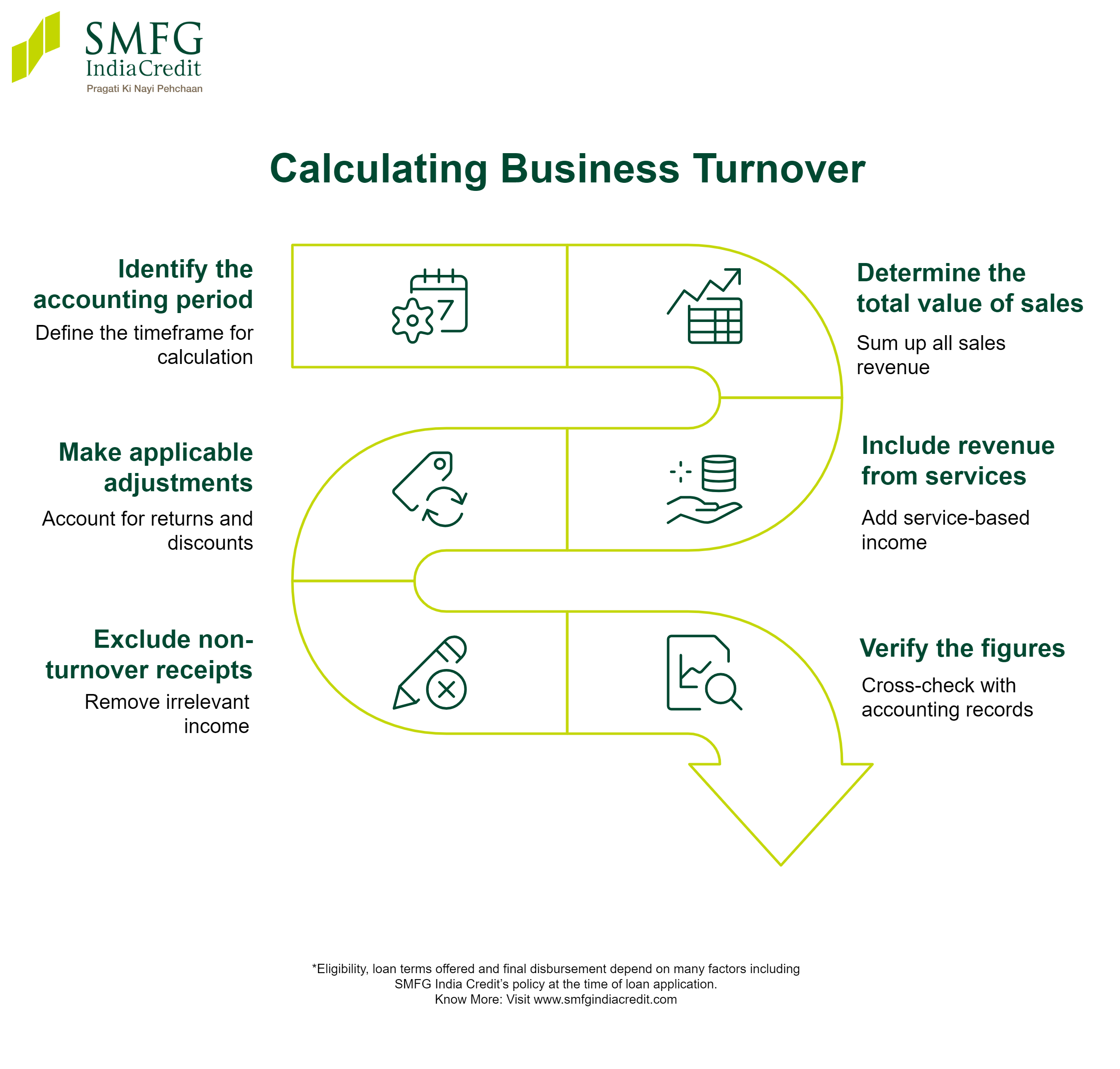
Follow these steps to calculate business turnover:
- Identify the accounting period, such as a financial year or quarter.
- Determine the total value of sales of goods during the period.
- Include revenue from services provided, where applicable.
- Make applicable adjustments for items such as sales returns, discounts, and other relevant transactions.
- Exclude receipts that do not form part of turnover under the applicable accounting or tax provisions.
- Verify the figures against accounting records, invoices, and financial statements.
The following table illustrates a simple business turnover calculation:
|
Particulars
|
Amount (Rs.)
|
|
Sales of goods
|
35,00,000
|
|
Service income
|
10,00,000
|
|
Total operating receipts
|
45,00,000
|
|
Less: Non-operating receipts
|
Nil
|
|
Business Turnover
|
45,00,000
|
Maintaining accurate accounting records throughout the year can help ensure that business turnover for income tax is determined correctly and reported in accordance with the applicable tax provisions.
Turnover figures are also reflected across key business records, including the balance sheet, financial statement, and profit and loss statement. Keeping these records accurate and up to date can also be important when preparing the business loan documents required, as lenders may review financial information to assess the business's financial position and repayment capacity.
Formula for Business Turnover
A simplified business turnover formula can be expressed as:
Business Turnover = Total Sales of Goods + Total Service Receipts
Only revenue generated from regular business activities should be included in this calculation. For example, a retail store should include all sales made during the financial year, while a consulting firm should include the fees earned from providing professional services.
If a business earns income from sources unrelated to its normal operations, such as interest income, capital contributions, or the sale of machinery, these amounts are generally not treated as business turnover for accounting purposes. However, the exact treatment may vary depending on the applicable accounting standards and tax provisions.
Using the correct formula helps businesses prepare accurate financial statements and comply with statutory reporting requirements.
Business Turnover Example
Suppose a furniture manufacturer records the following transactions during a financial year:
- Sales of furniture: Rs. 82,00,000
- Installation charges: Rs. 6,00,000
- Interest earned from a bank deposit: Rs. 80,000
- Sale of an old delivery vehicle: Rs. 2,50,000
The turnover calculation would be:
|
Particulars
|
Amount (Rs.)
|
|
Sales of furniture
|
82,00,000
|
|
Installation charges
|
6,00,000
|
|
Total operating receipts
|
88,00,000
|
|
Interest income
|
Excluded
|
|
Sale of old vehicle
|
Excluded
|
|
Business Turnover
|
88,00,000
|
Business Turnover vs Revenue vs Profit
Business turnover, revenue, and profit are often confused because they are all used to measure financial performance. However, each metric serves a different purpose.
The table below highlights the key business turnover vs profit vs revenue differences.
|
Basis
|
Business Turnover
|
Revenue
|
Profit
|
|
Meaning
|
Value of sales or operating receipts from ordinary business activities
|
Income generated from business operations; in some contexts, it may be similar to turnover
|
Amount remaining after applicable expenses and costs are deducted from revenue
|
|
Expenses deducted
|
No
|
No
|
Yes
|
|
Indicates
|
Scale of sales and business activity
|
Income generated through business operations
|
Profitability of the business
|
|
Used for
|
Certain tax thresholds, regulatory compliance, and assessment of business activity
|
Financial reporting and performance analysis
|
Evaluating profitability and overall financial performance
|
|
Can be negative?
|
Generally no
|
Generally no
|
Yes, in which case the business records a loss
|
Annual Business Turnover and Tax Implications
Annual business turnover plays an important role in determining a business's tax and regulatory obligations. Several provisions under tax laws use turnover as a threshold for deciding compliance requirements.
Depending on the applicable laws, annual turnover may affect:
- GST registration:Businesses crossing the prescribed turnover threshold may be required to obtain GST registration.
- GST return filing:Registered businesses must comply with applicable GST return filing and payment requirements.
- Income tax provisions:Turnover or gross receipts can determine eligibility for presumptive taxation schemes, such as Section 44AD of the Income Tax Act, 1961.
- Tax audit requirements:Certain businesses may become subject to audit requirements once their turnover exceeds the prescribed limits under the Income Tax Department provisions.
- Financial reporting obligations:Businesses with higher turnover may have additional accounting and disclosure requirements depending on the applicable laws.
Gross Turnover vs Net Turnover
Gross turnover in business generally refers to the total value of sales before adjustments such as sales returns and discounts, while net turnover reflects the amount remaining after these applicable adjustments. Understanding the distinction can help businesses maintain accurate accounts and report relevant figures in their Income Tax Return (ITR). Since the appropriate treatment may vary by transaction and applicable rules, businesses can consult a Chartered Accountant (CA) where necessary.
Accurate financial information can also be useful when using a business loan eligibility calculator to estimate potential borrowing capacity, based on turnover and existing obligation details.
Common Mistakes While Calculating Business Turnover
Accurately calculating business turnover is essential for financial reporting, tax compliance, and regulatory purposes. Even small errors can affect GST obligations, income tax reporting, and business planning.
Some common mistakes to avoid include:
- Including non-operating income: Interest income, dividends, capital contributions, loans, and proceeds from the sale of fixed assets are generally not part of business turnover.
- Omitting service income: Businesses that sell goods and provide services should include income from both activities where applicable.
- Double-counting sales: Recording the same invoice or transaction more than once can inflate turnover figures.
- Ignoring sales returns or credit notes: Failing to account for returns and adjustments may result in an incorrect turnover calculation.
- Using incomplete accounting records: Calculating turnover without reconciling invoices, bank statements, and financial records can lead to reporting errors.
Documents Used to Calculate Business Turnover
Businesses rely on several financial documents to calculate turnover accurately. Maintaining these records also supports tax filing, audits, and financial reporting.
Common documents used to determine business turnover include:
- Sales invoices showing goods sold or services provided.
- Purchase and sales registers maintained during the financial year.
- Profit and Loss Account prepared at the end of the accounting period.
- GST returns, where applicable, to reconcile taxable turnover.
- Bank statements to verify receipts from customers.
- Cash book and ledger accounts maintained under the accounting system.
- Accounting software reports generated from ERP or bookkeeping platforms.
- Trial balance and supporting financial records used while preparing the financial statements.
Conclusion
Business turnover is an important financial metric for assessing sales performance, maintaining accurate records, and meeting applicable tax and regulatory obligations. It reflects the value of sales or operating receipts generated during a specified period and is distinct from business income or profit.
Calculating turnover accurately can help businesses track growth, comply with applicable GST and income tax requirements, and make informed financial decisions. Maintaining proper accounting records and applying the relevant calculation rules can also support accurate reporting and effective financial management.
For businesses seeking additional funds to support working capital requirements or growth plans, SMFG India Credit offers unsecured business loans of up to Rs. 1 crore*. Use the business loan EMI calculator to estimate your potential monthly repayments and apply online.