A business cycle refers to the recurring pattern of expansion and contraction in a nation’s economic activity over time. It influences production, employment, consumer spending, and business investment. This guide explains the meaning of a business cycle, its phases, how it is measured, and why it matters for businesses and the economy.
What Is a Business Cycle?
A business cycle is the recurring rise and fall in a country's economic activity over a period of time.
The business cycle definition refers to the natural fluctuations in economic growth, employment, production, and consumer spending that occur as economies expand, slow down, contract, and recover. In a nutshell, the business cycle meaning is the movement of an economy through different stages of growth and decline.
Every economy experiences these fluctuations due to changes in demand, investment, government policies, and business confidence. During periods of growth, businesses expand operations, employment increases, and consumers spend more. During slowdowns, production declines, demand weakens, and businesses become more cautious with investments.
Understanding the business cycle helps businesses plan their finances, governments develop economic policies, and investors make informed decisions based on changing market conditions.
Business Cycle Definition
A business cycle is the pattern of expansion and contraction in economic activity that takes place over time. It represents the changes in production, employment, income, and consumer demand as an economy moves through different stages of growth and slowdown.
Why Do Business Cycles Occur?
Business cycles occur because economic conditions continuously change. Factors such as changes in aggregate demand, monetary policy, fiscal policy, inflation, interest rates, consumer confidence, and business investment influence the pace of economic activity. Global events, supply chain disruptions, technological advancements, and market expectations can also contribute to periods of economic expansion or contraction.
Phases of the Business Cycle
A business cycle moves through four main phases. Each phase reflects different levels of economic activity and affects businesses, consumers, investors, and governments differently.
The four phases include:
- Expansion: Economic activity increases as production, employment, business investment, and consumer spending continue to grow.
- Peak: The economy reaches its highest level of activity before growth begins to slow.
- Contraction (Recession): Economic output declines, businesses reduce production, consumer spending falls, and unemployment increases.
- Trough and Recovery: Economic activity stabilises before gradually improving, leading to renewed investment and growth.
Expansion
During the expansion phase of the business cycle, Gross Domestic Product (GDP) usually grows steadily, businesses increase production, employment opportunities improve, and consumer spending rises. Higher business investment and stronger demand encourage companies to expand operations, resulting in improved profitability and economic growth.
Peak
The peak represents the highest point of economic activity in the business cycle. Production, employment, and consumer spending remain strong, but inflationary pressures often increase. As growth reaches its maximum level, signs of slower economic expansion may begin to appear.
Contraction or Recession
The contraction or recession phase begins when economic activity starts to decline. Businesses reduce production due to lower consumer demand, investment slows, and unemployment may rise. GDP growth weakens, profits decline, and companies often focus on cost control until economic conditions improve.
Trough and Recovery
The trough marks the lowest point of the business cycle before recovery begins. As business confidence gradually improves, investment increases, production expands, and employment opportunities recover. Consumer spending also starts rising, helping the economy return to a phase of sustainable growth.
How Is the Business Cycle Measured?
Economists use several business cycle indicators that reflect the overall health of an economy. Instead of relying on a single measure, they analyse a combination of indicators to determine whether the economy is expanding, reaching a peak, contracting, or recovering.
|
Economic Indicator
|
What It Measures
|
Business Cycle Measurement Insight
|
|
Gross Domestic Product (GDP)
|
Total value of goods and services produced
|
Indicates overall economic growth or decline
|
|
Inflation
|
Changes in the general price level
|
Shows rising or easing price pressures
|
|
Unemployment Rate
|
Percentage of unemployed people seeking work
|
Reflects labour market conditions
|
|
Industrial Production
|
Output of factories, mines, and utilities
|
Measures manufacturing and production activity
|
|
Consumer Spending
|
Household expenditure on goods and services
|
Indicates consumer confidence and demand
|
Key Indicators of a Business Cycle
Several indicators help economists and policymakers monitor economic activity throughout the business cycle.
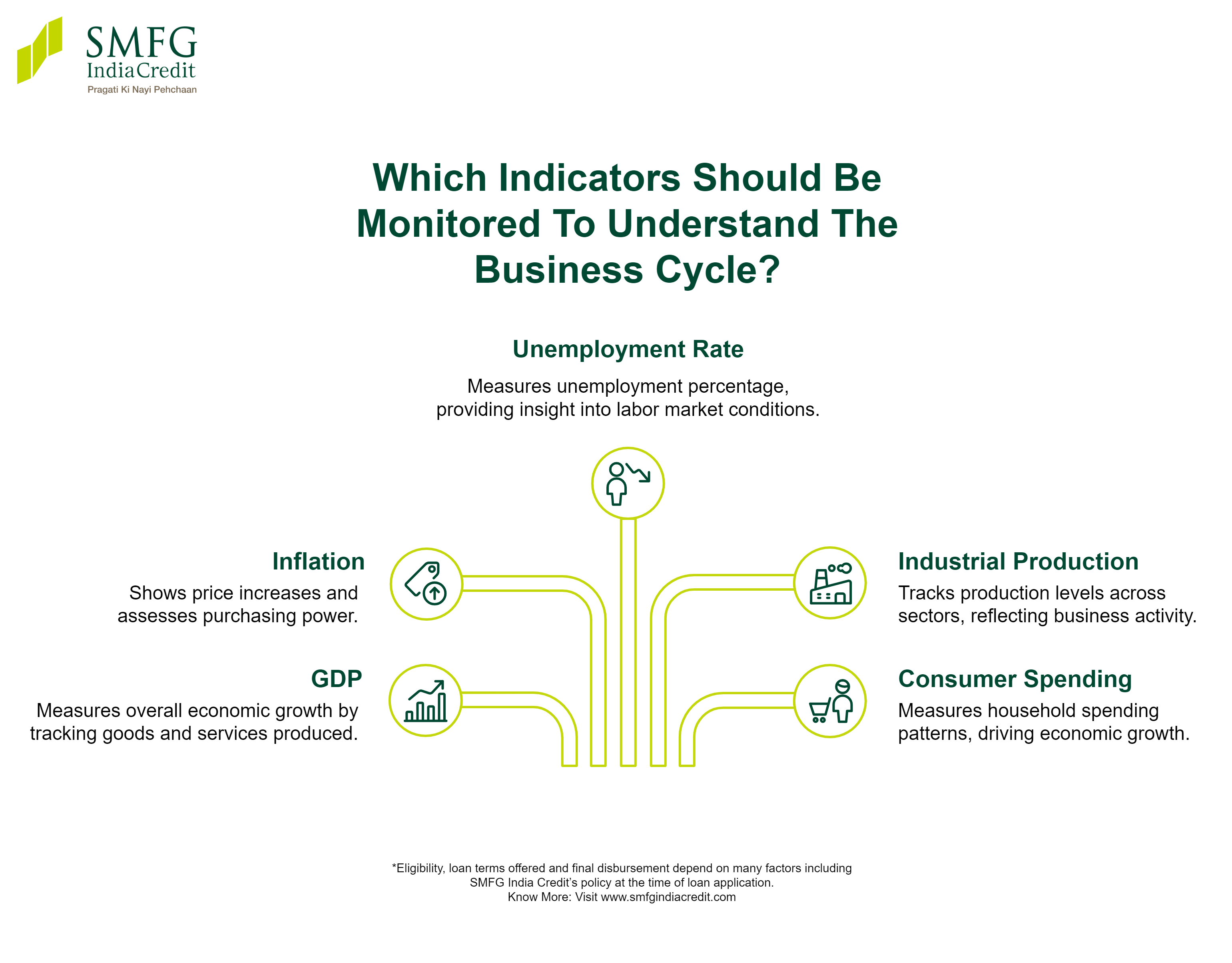
- GDP: Measures the overall growth of the economy by tracking the value of goods and services produced.
- Inflation: Shows how quickly prices are rising and helps assess purchasing power.
- Unemployment Rate: Measures the percentage of the labour force that is unemployed and actively seeking work, providing insight into labour market conditions.
- Industrial Production: Tracks production levels across manufacturing, mining, and utilities, reflecting business activity.
- Consumer Spending: Measures household spending patterns, which play a major role in driving economic growth.
Together, these indicators help identify shifts in economic activity and support informed policy and business decisions.
Importance of the Business Cycle
The business cycle provides valuable insights into growth opportunities, potential risks, and market trends.
- Businesses plan investments and manage cash flow more effectively.
- Investors evaluate market conditions before making investment decisions.
- Governments design appropriate fiscal and monetary policies.
- Consumers make informed spending and saving decisions.
- Financial institutions assess lending and credit risks.
- Organisations prepare for changes in demand, production, and employment.
Economic Cycle vs Business Cycle
The terms business cycle and economic cycle are commonly used interchangeably to describe fluctuations in overall economic activity over time. Both refer to periods in which an economy expands, reaches a peak, contracts, and eventually begins to recover.
|
Business Cycle
|
Economic Cycle
|
|
Focuses on fluctuations in business and economic activity over time.
|
Refers to the broader movement of the overall economy through expansion and contraction.
|
|
Commonly used in economics and business discussions.
|
Often used in macroeconomic analysis.
|
|
Includes expansion, peak, contraction, and recovery phases.
|
Generally refers to the same phases of economic activity.
|
Although the terminology may differ depending on the context, both terms generally describe the recurring pattern of economic growth and slowdown.
How Businesses Can Prepare for Different Business Cycle Phases
Every stage of the business cycle presents different opportunities and challenges for businesses. Preparing in advance helps you manage cash flow, maintain operational efficiency, and respond effectively to changing market conditions. Adapting your strategy to each phase can also improve financial stability and support long-term growth.
- Maintain adequate cash reserves to meet operational expenses during slower economic periods.
- Adjust inventory levels based on expected demand to avoid excess stock or shortages.
- Review expenses regularly and improve efficiency without affecting product or service quality.
- Expand products, services, or customer segments to reduce dependence on a single source of income.
- Increase production capacity, adopt new technologies, or enter new markets when economic conditions are favourable.
- Track GDP growth, inflation, unemployment, and consumer spending to anticipate changes in the business cycle.
- Arrange access to working capital or business financing before liquidity becomes a concern.
Preparing for different phases of the business cycle enables businesses to respond confidently to economic changes while maintaining operational stability.
Business Cycles Examples
Historical events demonstrate how economies move through different business cycle stages.
Although the causes of business cycles vary, each cycle follows a pattern of expansion, slowdown, contraction, and recovery.
|
Event
|
Impact on the Economy
|
Business Cycle Phase
|
|
2008 Global Financial Crisis
|
Economic activity declined sharply, credit availability tightened, unemployment increased, and businesses reduced investment.
|
Contraction followed by gradual recovery
|
|
COVID-19 Economic Slowdown (2020)
|
Lockdowns disrupted production, supply chains, and consumer spending before economies gradually recovered through policy support and reopening.
|
Sharp contraction followed by recovery
|
These examples show that business cycles are a natural part of economic activity. While the duration and intensity of each cycle may differ, economies typically move from periods of growth to slowdown and eventually return to expansion.
How Can Business Cycles Affect Enterprise Financing?
Business cycle fluctuations can influence sales, operating costs, cash flow, and investment plans. During periods of slower economic activity, businesses may face tighter cash flows, while periods of growth can create opportunities for expansion and increased investment.
In either situation, access to additional funding may help businesses respond to changing financial requirements. A business loan can support needs such as working capital, equipment purchases, inventory, or expansion. Before borrowing, businesses should consider their repayment capacity, existing obligations, and expected cash flows to avoid repayment strain.
A business loan eligibility calculator can provide an initial estimate of the loan amount an enterprise may qualify for based on relevant financial details. This can help businesses assess their borrowing capacity and apply for an amount that better aligns with their financial profile.
Conclusion
The business cycle represents the natural pattern of expansion, peak, contraction, and recovery in an economy. By understanding the business cycle measurement, phases, and importance, businesses, investors, policymakers, and consumers can make more informed decisions. Monitoring key economic indicators such as GDP, inflation, unemployment, and consumer spending also helps identify changing economic conditions early.
A clear understanding of the business cycle supports better financial planning, stronger risk management, and sustainable long-term growth.
For enterprises seeking financing support as they navigate the peaks and troughs of business cycles, SMFG India Credit offers unsecured business loans of up to Rs. 1 crore*.
Check the business loan documents required and apply online with ease.
You can also use the business loan EMI calculator to estimate potential EMIs and assess repayment requirements before applying.