The Unified Lending Interface (ULI) is changing how lenders access the information needed to assess loan applications in India. If you have ever wondered why traditional offline loan approvals can take weeks, this platform is the Reserve Bank of India's answer to that problem. This blog explains what it is, how it works, and what it means for you as a borrower.
What Is the Unified Lending Interface (ULI)?
If you are wondering about the ULI full form, it stands for Unified Lending Interface. You may also see it referred to as ULI RBI or RBI Unified Lending Interface in official communication, since the Reserve Bank of India (RBI) owns and governs the platform.
ULI is a digital platform built through the Reserve Bank Innovation Hub (RBIH) to make lending faster and more transparent. Instead of submitting the same documents to every lender, it lets you share your financial and non-financial data through one consent-based lending system.
ULI functions as an interoperable lending platform that connects lenders, including Non-Banking Financial Company (NBFC) lenders, and fintech firms to a single network of verified data sources.
The Unified Lending Interface RBI infrastructure pulls your information from sources like land ownership records, GST filings, and the Central KYC Registry, then shares it with your chosen lender once you give consent.
In short, the Unified Lending Interface is a single, secure pipe for financial data access that can speed up your loan journey.
Why Did the RBI Introduce ULI?
Traditional lending processes can involve extensive documentation, manual verification, and information spread across multiple systems. These challenges can make credit assessment slower and access to formal credit more difficult, particularly for underserved segments such as farmers and small business owners. The RBI Innovation Hub developed ULI to fix this gap and support India's wider Digital Public Infrastructure (DPI) push.
The wider RBI digital lending efforts, including this initiative, aim to bring frictionless credit to people who were previously left out of the formal banking system, improving financial inclusion across rural and urban India.
How Is ULI Different From Traditional Loan Processing?
ULI introduces API-based lending. Instead of repeated manual document submissions, your data moves digitally, with your consent, between verified sources and your lender.
|
Traditional Loan Process
|
ULI-enabled Process
|
|
Physical documents required
|
Digital loan processing with quick data retrieval
|
|
Days to weeks for approval
|
Faster loan approval process
|
|
Manual verification of land or income records
|
Quicker loan verification through APIs
|
|
Separate integration for every lender
|
One interoperable lending platform for all lenders
|
How Does the Unified Lending Interface Work?
ULI works by connecting lenders to a network of data providers through standard Application Programming Interface (API) protocols.
Step-by-Step Borrower Journey
You apply for a loan with a participating lender. You then give your consent for ULI to retrieve your data. Then the lender uses the ULI framework to send a secure API request to the relevant data repositories, such as Account Aggregator (AA) platforms and KYC databases.
The lender verifies your details and runs a credit assessment. If you qualify, the lender approves and disburses the loan.
Data Sources Connected Through ULI
ULI draws on a wide network of sources, including GSTN records, the Central KYC Registry for Know Your Customer (KYC) checks, Account Aggregator (AA) platforms, land records, and credit bureau data. This mix of sources strengthens the digital credit ecosystem and gives lenders a fuller picture of your creditworthiness without asking you for repeated paperwork.
Role of Borrower Consent in ULI
Nothing moves through ULI without your permission. Borrower consent sits at the centre of the platform, and every instance of borrower data sharing is logged and tied to your explicit approval. This consent-based lending model is designed to protect your privacy while still speeding up loan verification.
What Does ULI Mean for Borrowers?
For you, ULI means less repeated paperwork and a potentially quicker path from application to disbursement. If you are applying for credit products such as a business loan, ULI can help reduce the number of documents you need to submit and shorten your wait for a decision.
It should be noted that the ULI platform is meant to speed up the data verification process. The final approval and processing timelines remain subject to the lender's policies.
Key Benefits of ULI
ULI can give you faster access to credit with a less document-intensive process and a more consistent loan approval process across lenders. Because your data moves through verified digital public infrastructure rather than physical files, there is less room for delays caused by missing paperwork.
Who Is Likely to Benefit the Most?
ULI can be especially useful if you are a farmer, an MSME owner, or a self-employed borrower who previously struggled to demonstrate creditworthiness through conventional means. Rural borrowers with limited documentation stand to gain the most from ULI, since the platform can draw on alternative data such as land records to establish eligibility.
Types of Loans That Can Benefit from ULI
ULI supports several loan categories, including:
- Personal loans or home loans
- Business loans or working capital loans
- MSME loans
- Other forms of secured and unsecured credit
ULI vs UPI: Understanding the Difference
People often compare ULI to UPI because both are part of India's digital public infrastructure, but they solve different problems.
|
Unified Payments Interface (UPI)
|
Unified Lending Interface (ULI)
|
|
Facilitates money transfers between bank accounts
|
Facilitates access to data required for lending
|
|
Used for payments and fund transfers
|
Used to support credit assessment and loan processing
|
|
Enables real-time payment transactions
|
Enables consent-based access to relevant data; it does not transfer loan funds
|
|
Built as digital payment infrastructure
|
Built as digital lending infrastructure
|
Is the Unified Lending Interface Safe?
ULI follows a consent-based lending model, so no lender can access your information without your explicit approval. The Reserve Bank of India oversees the platform, and data is shared through secure, standardised API channels instead of open networks.
However, as with any digital lending process, borrowers should take basic precautions when sharing personal and financial information.
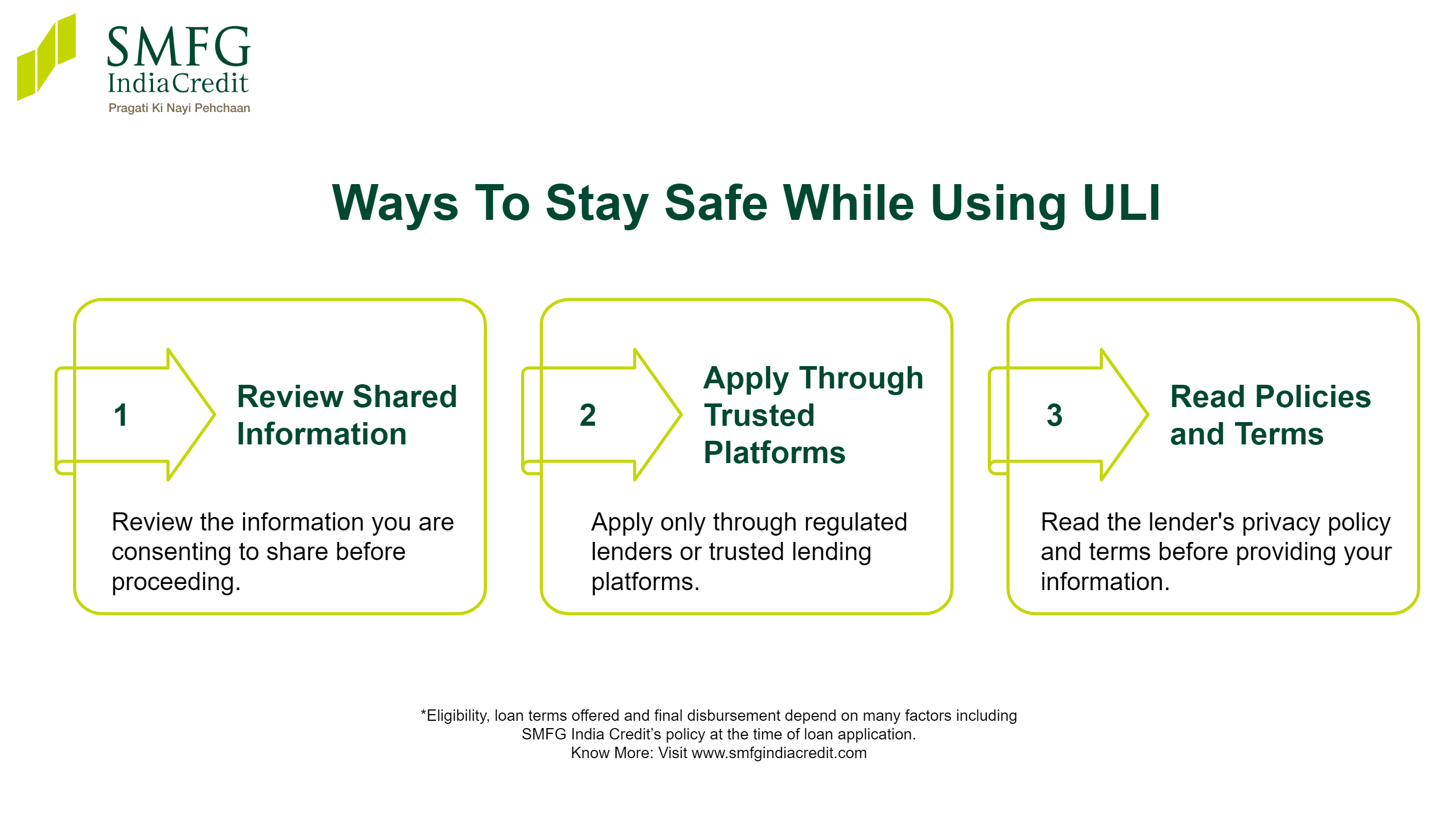
Here are a few ways to stay safe while using ULI:
- Review the information you are consenting to share before proceeding.
- Apply only through regulated lenders or trusted lending platforms.
- Read the lender's privacy policy and terms before providing your information.
Common Myths About ULI
Many people have misconceptions about how ULI works. Here are some of the most common myths:
- ULI automatically approves loans: ULI only enables faster data sharing and verification. The lender still decides whether to approve or reject your application.
- ULI and UPI are the same: ULI and UPI serve different purposes. UPI facilitates digital payments, while ULI streamlines the lending process.
- Your data is shared without permission: Every data request requires your explicit consent before any information is accessed.
- ULI replaces lenders and NBFCs: ULI does not replace lenders. It simply helps lenders and NBFCs access verified information more efficiently to process loan applications faster.
Challenges and Future of ULI
ULI still faces hurdles around data quality, system integration, and borrower awareness. Not every lender has completed its technical integration with the platform, and building trust in borrower data sharing will take time.
As of December 2025, 64 lenders (including 41 banks and 23 NBFCs) have been onboarded to the platform, with lenders accessing 136+ data services.
Looking ahead, ULI is expected to expand its data sources and loan journeys further, deepening its role within India's digital public infrastructure alongside UPI and Aadhaar.
What Can Borrowers Do to Prepare for a ULI-enabled Loan?
Let’s consider that you are applying for a business loan. ULI can help speed up data access and verification, but the final approval and loan terms still depend on the strength of your application and the lender’s criteria. You can use a business loan EMI calculator to estimate EMIs and apply for a loan amount and tenure that suit your repayment capacity, increasing the chances of approval.
You should also check the business loan documents required by your lender and keep them accurate and up to date. Maintaining a healthy credit profile, providing consistent financial information, and submitting a complete application can help strengthen your case for approval.
Conclusion
This Unified Lending Interface has the potential to make credit assessment more efficient in India. By combining consent-based lending, verified data sources, and standardised APIs, ULI can cut down the paperwork and waiting time that once defined traditional loan applications. However, final loan approval, terms, and processing timelines continue to depend on the lender’s policies and the strength of the borrower’s application.
If you’re exploring enterprise finance solutions, SMFG India Credit offers unsecured funds of up to Rs. 1 crore* at competitive business loan interest rates.
Estimate your borrowing capacity using our business loan eligibility calculator and apply online today!