The gross receipts meaning refers to the total amount a business receives from its activities before deducting any expenses. Tracking these business receipts helps organisations understand their overall revenue, maintain accurate accounting records, and meet tax reporting requirements.
This article explains what gross receipts are, how they are calculated, where they are used, and how they differ from other commonly used financial terms, helping you interpret total receipts more accurately in a business context.
What Are Gross Receipts?
The gross receipts definition refers to the total amount of money or value a business receives from sales, services, and other sources of income before any deductions, expenses, cost of goods sold, or taxes are subtracted. In simple terms, the gross receipts meaning reflects the business's complete inflow of funds during a given period rather than its profit or net earnings. Understanding gross receipts helps businesses measure total revenue, maintain accurate financial records, and support informed financial and tax-related decisions.
The Importance of Gross Receipts
Understanding why gross receipts matter can help businesses monitor financial performance and meet various regulatory and operational requirements. Accurate gross receipts for a business provide a clearer picture of overall earnings before deductions and support better financial planning.
- Support tax filing by providing the information required for tax calculations and reporting.
- Help assess eligibility when applying for a business loan.
- Enable effective revenue tracking to monitor business growth over time.
- Assist in determining business size for certain regulatory or programme requirements.
- Contribute to preparing accurate financial statements.
- Offer insights into cash flow patterns and support ongoing compliance with financial and tax obligations.
Maintaining accurate gross receipts records can help business owners make better financial decisions and stay prepared for reporting, funding, and operational needs.
What Is Included in Gross Receipts?
Gross receipts examples typically include the money or value a business receives from its normal operations and certain other sources before deductions. Depending on the applicable accounting and tax rules, gross receipts income sources may include:
- Sales revenue from goods sold
- Service income earned from providing services
- Rental income received from leased property
- Interest income from deposits or investments
- Royalties from intellectual property or licensing
- Commissions earned on transactions
- Grants and certain other business-related receipts, where applicable
The treatment of some receipts may vary depending on the relevant accounting standards, tax provisions, or jurisdiction.
Gross Receipts Examples
|
Receipt Type
|
Example
|
Included in Gross Receipts?
|
|
Product sales
|
Sale of goods worth Rs. 2 lakhs
|
Yes
|
|
Service fees
|
Consulting charges received from clients
|
Yes
|
|
Rent
|
Income from leasing business premises
|
Generally yes
|
|
Interest
|
Interest earned on business deposits
|
Generally yes
|
|
Royalties
|
Licensing income from intellectual property
|
Generally yes
|
|
Commissions
|
Commission earned on completed sales
|
Generally yes
|
Gross Receipts Formula
The formula for gross receipts adds together all amounts received by a business before any deductions are made. When considering how to calculate gross receipts, include sales revenue, service income, other income, and non-operating receipts received during the relevant period. Do not subtract COGS, salaries, operating costs, taxes, or any other deductions, as gross receipts represent the total inflow before such adjustments.
Gross Receipts Formula = Sales Revenue + Service Income + Other Income + Non-operating Receipts (before deductions)
How to Calculate Gross Receipts
To calculate gross receipts, begin by identifying every source of money received during the relevant accounting period. Review your invoices, bank statements, and other accounting records to capture all inflows accurately. Add the sales revenue earned from goods, the service income received from clients, and any other eligible receipts. Do not subtract operating expenses, salaries, taxes, or cost of goods sold at this stage. A complete gross receipts calculation should reflect the total amount received before deductions.
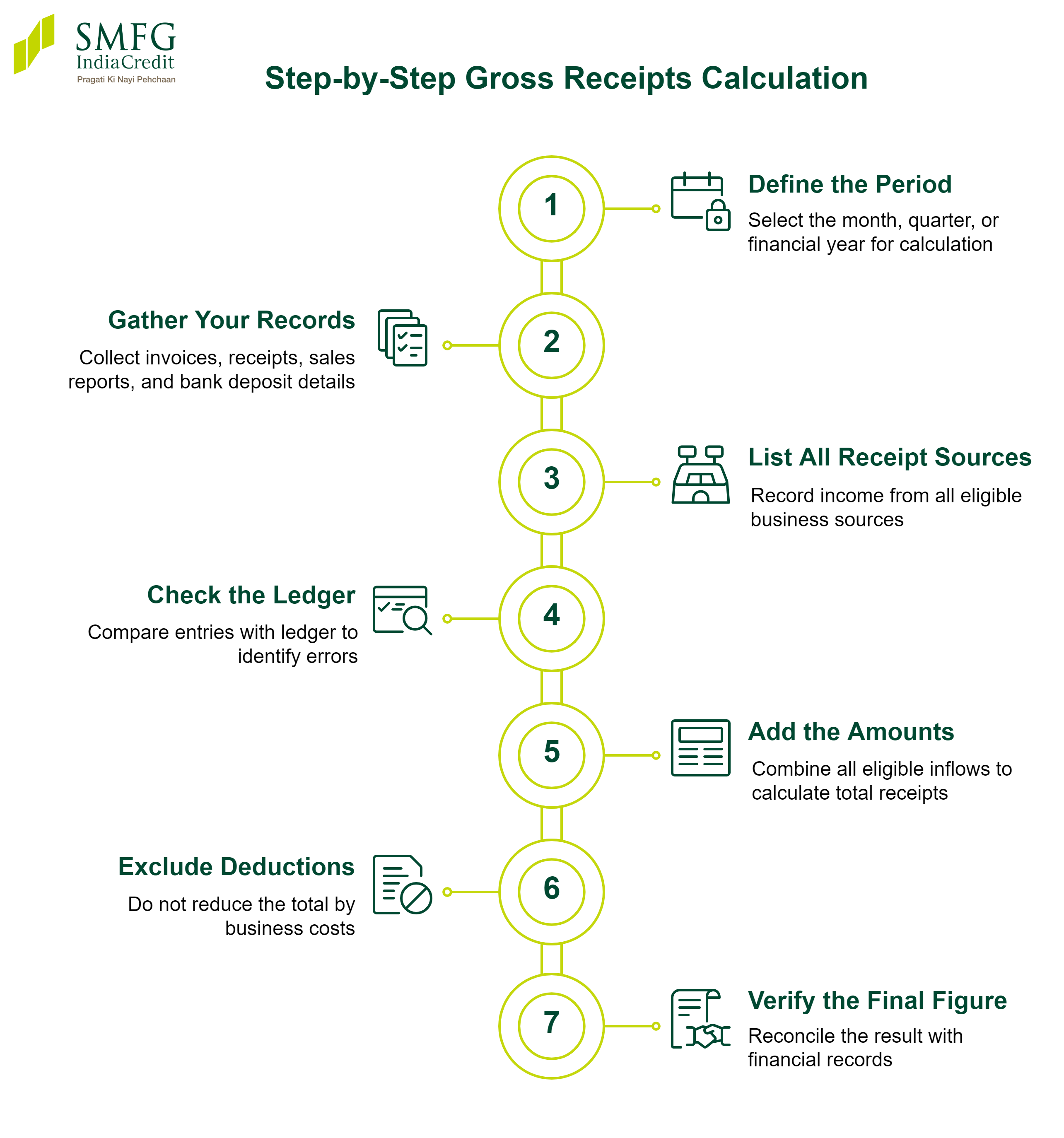
Step-by-Step Gross Receipts Calculation
- Define the Period: Select the month, quarter, or financial year for which the total will be calculated.
- Gather Your Records: Collect invoice records, payment receipts, sales reports, and details of bank deposits.
- List All Receipt Sources: Record income from product sales, services, rent, interest, commissions, or other eligible business sources.
- Check the Ledger: Compare each entry with your ledger to identify missing, duplicated, or incorrectly recorded transactions.
- Add the Amounts: Combine all eligible inflows to calculate total receipts for the selected period.
- Exclude Deductions: Do not reduce the total by business costs or other outgoings.
- Verify the Final Figure: Reconcile the result with your financial records. Using accounting software, where available, can simplify the business receipts calculation and support consistent record-keeping.
Gross Receipts Calculation Example
The following gross receipts example shows how different sources of business income are combined to determine the total amount received before any expenses are deducted. Assume a business earns sales income of Rs. 5,00,000, service income of Rs. 1,50,000, rent income of Rs. 50,000, and interest income of Rs. 10,000 during a financial period.
Gross Receipts = Rs. 5,00,000 + Rs. 1,50,000 + Rs. 50,000 + Rs. 10,000 = Rs. 7,10,000
The total receipts for the period are Rs. 7,10,000. No business expenses or other deductions are subtracted while calculating gross receipts.
Gross Receipts and Taxation
Gross receipts for tax purposes are often used to support tax reporting, determine eligibility for certain tax provisions, and assess applicable thresholds. Depending on the jurisdiction, the definition of taxable receipts may vary, so businesses should refer to the relevant local regulations. In some regions, a gross receipts tax may apply to the total amount received by a business before expenses are deducted. Understanding how gross receipts are treated can help businesses maintain accurate records and support ongoing compliance with applicable income tax and other tax requirements.
What Is Gross Receipts Tax?
The gross receipts tax meaning refers to a tax imposed on a business's total receipts rather than its net profit. As part of the gross receipts tax calculation, business expenses are generally not deducted when determining the tax base. Unlike income tax, which is typically based on taxable profits, or sales tax, which is collected on certain transactions, gross receipts tax is calculated on the total qualifying receipts, subject to the rules applicable in the relevant jurisdiction.
Gross Receipts in Business Loans
Lenders may review a business's gross receipts to understand its scale of operations, revenue, and overall financial activity. The relationship between gross receipts and business loan eligibility is only one aspect of the assessment, as lenders also consider several other factors before making a lending decision. These typically include:
- Gross receipts for business loan assessment as an indicator of business activity
- Existing financial obligations and overall repayment capacity
- Business cash flow and profitability
- The applicant's credit profile and repayment history
Tip: If you are planning to apply for financing, a business loan eligibility calculator can provide an estimate of the loan amount you may qualify for based on your enterprise’s key financial details.
Gross Receipts for Small Business Eligibility
Gross receipts for a small business are often used to determine whether a business meets the eligibility criteria for certain government schemes, contracts, or regulatory provisions. In many cases, a gross receipts threshold forms part of the business classification process, although the applicable limits and tax rules vary depending on the relevant programme or jurisdiction.
Maintaining accurate small business gross receipts and supporting financial records helps businesses demonstrate compliance and respond more efficiently when applying for benefits or meeting reporting requirements.
Gross Receipts for Freelancers and Professionals
Gross receipts for freelancers and other self-employed professionals include all client payments received before deducting business expenses. Similarly, professional gross receipts and gross receipts for consultants should be calculated using the total amount reflected in invoices and other business records. Depending on the applicable tax provisions, these receipts may also be relevant for sales gross receipts of a business in ITR-3, presumptive taxation, or reporting professional income in an ITR. As tax treatment can vary, it is advisable to seek professional guidance where required.
Gross Receipts in Accounting Records
Maintaining accurate gross receipts in accounting helps businesses prepare reliable financial records and support reporting requirements. If you are wondering where to find gross receipts, the information is typically available across multiple business receipts records, making periodic reconciliation important. Common sources include:
- Invoices issued to customers
- Sales register maintained for business transactions
- Bank statement entries showing payments received
- Ledger records used for bookkeeping
- Payment gateway reports for online collections
- Reports generated through accounting software and the profit and loss statement
Common Mistakes While Calculating Gross Receipts
Several gross receipts calculation mistakes can result in inaccurate financial reporting and affect tax filings or business assessments. Understanding these common errors in gross receipts can help businesses maintain reliable records and avoid unnecessary corrections later.
- Deducting Expenses Too Early: Gross receipts should be calculated before subtracting any expenses.
- Confusing Revenue With Profit: Gross receipts represent total inflows and should not be mistaken for profit.
- Leaving Out Non-Sales Income: Include eligible non-sales income, such as rent, interest, royalties, or commissions, where applicable.
- Including Personal Transfers: Exclude personal deposits or transfers that are unrelated to business activities.
- Skipping Bank Reconciliation: Regular bank reconciliation helps identify missing or duplicated transactions.
- Ignoring Refunds and Returns: Record refunds and returns in accordance with the applicable accounting and tax requirements rather than omitting or adjusting them incorrectly.
Reviewing your records periodically and maintaining supporting documentation can reduce errors and improve reporting accuracy. Understanding how to report gross receipts correctly also helps ensure your financial records remain consistent and aligned with applicable accounting and tax requirements.
Conclusion
Understanding gross receipts helps businesses measure their total receipts before deducting expenses, providing a clearer view of overall revenue generated during a given period. Knowing how to calculate gross receipts accurately supports effective tax reporting, financial analysis, and business assessments. Maintaining complete business records also makes it easier to demonstrate gross receipts for business when required for compliance, financing, or other operational purposes.
If your enterprise requires additional funds for expansion, inventory, equipment, or working capital, SMFG India Credit offers unsecured financing of up to Rs. 1 crore* at competitive business loan interest rates.
Check your eligibility, use the business loan EMI calculator to estimate your monthly obligations, and apply online with minimal documentation.
* Please note that this article is for your knowledge only. Loans are disbursed at the sole discretion of SMFG India Credit. Final approval, loan terms, disbursal process, foreclosure charges and foreclosure process will be subject to SMFG India Credit's policy at the time of loan application. If you wish to know more about our products and services, please contact us