Profit margin measures how much profit a business retains from its revenue after accounting for its expenses. Understanding the profit margin's meaning helps business owners evaluate the profitability of their operations, make informed pricing decisions, and monitor overall financial performance. Whether you run a start-up or an established enterprise, tracking your business profit margin can support better planning and sustainable growth. This guide explains the different types of profit margins, how they are calculated, practical examples, and ways to improve them over time.
What Is Profit Margin?
The profit margin definition refers to the percentage of revenue that remains as profit after deducting all relevant costs and expenses. In simple terms, the profit margin’s meaning is how much a business earns from every rupee of sales after covering its operating and production costs.
It is an important indicator of profitability, showing how efficiently a business manages its income and spending. Tracking profit margin helps businesses evaluate financial health, improve pricing decisions, and identify opportunities to increase overall efficiency.
Since the profit margin definition stays consistent across industries, it makes your business's profit margin easy to benchmark against others.
Importance of Profit Margin
Understanding why profit margin matters can help businesses make better financial and operational decisions. A healthy profit margin in business shows that the company is generating sufficient earnings after covering its costs, making it easier to plan for growth and manage risks.
- Supports a sustainable pricing strategy by helping businesses price products or services appropriately.
- Highlights opportunities for better cost control and improved operational efficiency.
- Reflects overall financial health, making it easier to assess business performance over time.
- Builds confidence among investors by demonstrating the business's ability to generate returns.
- Helps lenders evaluate business loan eligibility alongside factors such as turnover, repayment capacity, and credit profile.
- Improves cash flow planning by helping businesses understand the relationship between income and operating costs.
- Enables meaningful comparisons with industry benchmarks to identify areas for improvement.
Regularly monitoring profit margin helps business owners make informed decisions that support long-term stability and growth.
Profit Margin Formula
The basic formula for profit margin is:
Profit Margin = (Profit ÷ Revenue) × 100
This profit margin formula applies to every type of profit: gross, operating, and net. You simply divide the relevant profit figure by revenue and multiply by 100 to get a percentage. Each profit margin formula variant uses a different profit figure, depending on which costs you've already deducted.
How to Calculate Profit Margin
To calculate profit margin, first determine your total revenue for the chosen period. Next, calculate your total costs by adding the cost of goods sold, operating expenses, and other business expenses. Subtract the total costs from revenue to find your profit. Then apply the profit margin formula: divide the profit by the total revenue and multiply the result by 100. This profit margin calculation shows how much profit your business retains from each rupee of sales.
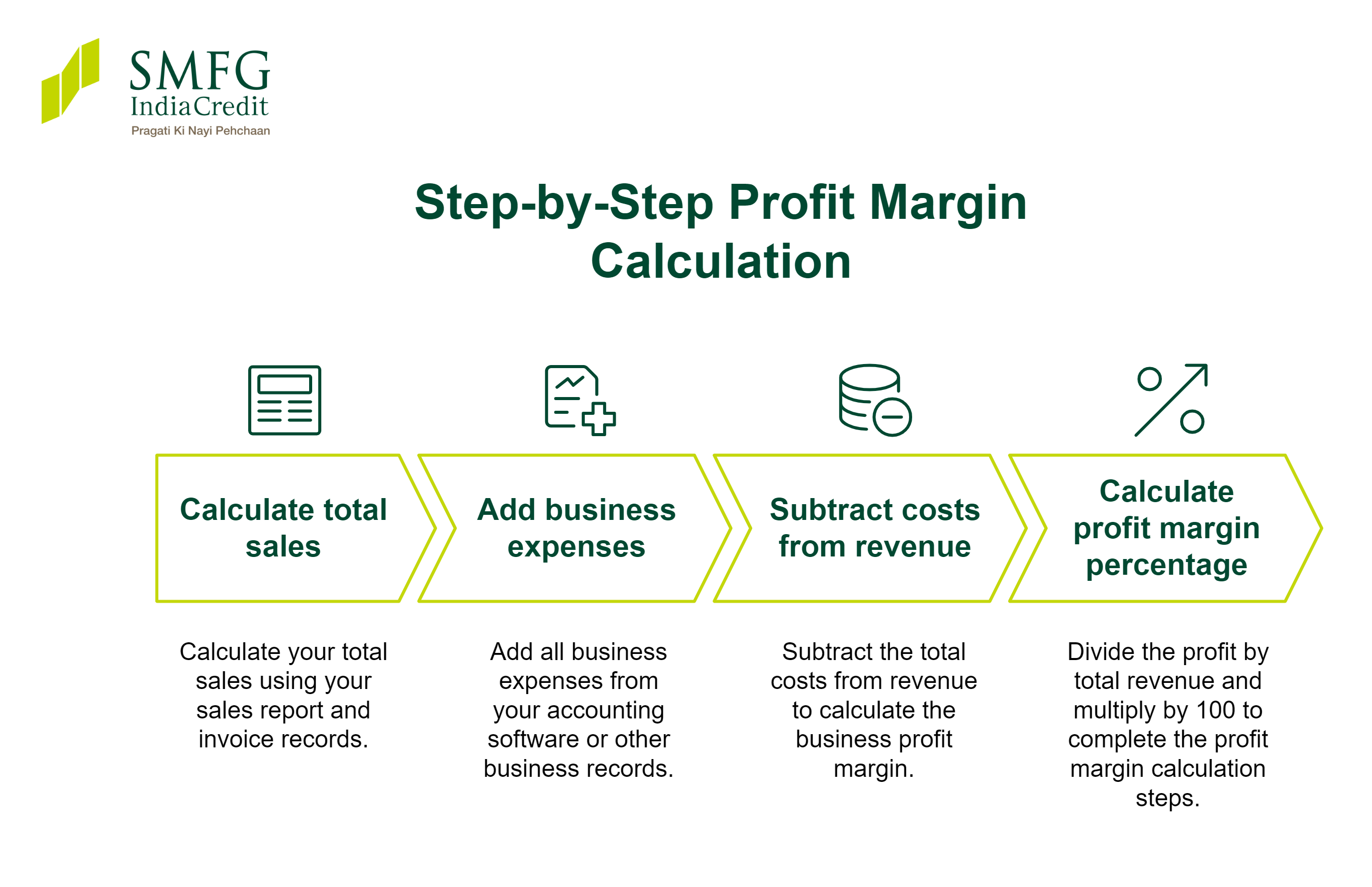
Step-by-Step Profit Margin Calculation
- Calculate your total sales using your sales report and invoice records.
- Add all business expenses from your accounting software or other business records.
- Subtract the total costs from revenue to calculate the business profit margin.
- Divide the profit by total revenue and multiply by 100 to complete the profit margin calculation steps.
Profit Margin Example
A profit margin calculation example: if your revenue is Rs. 10,00,000 and your total cost is Rs. 7,50,000, your profit is Rs. 2,50,000. The calculation is:
Profit Margin = (Rs. 2,50,000 ÷ Rs. 10,00,000) × 100 = 25%
In this business profit margin example, the percentage shows that the business retains Rs. 25 as profit for every Rs. 100 of revenue earned.
This example of profit margin applies the same formula used for gross, operating, and net calculations.
Types of Profit Margin
There are three main types of profit margin, and each measures profitability after deducting a different set of costs. Looking at all three helps businesses understand where they are earning money and where costs are affecting returns. Together, these business margin types provide a more complete picture of financial performance.
- Gross Profit Margin: Measures profit after deducting the COGS (cost of goods sold). It shows how efficiently a business produces or delivers its products or services.
- Operating Profit Margin: Measures profit after deducting COGS and operating expenses, indicating how efficiently the core business is managed.
- Net Profit Margin: Measures the profit remaining after deducting all business expenses, including operating costs, interest, and taxes.
Understanding gross, operating, and net profit margins helps businesses evaluate performance at different stages of their operations and identify opportunities to improve profitability.
Gross Profit Margin
The gross margin meaning refers to the percentage of revenue remaining after deducting the direct cost of producing or delivering goods or services, also known as the COGS (Cost of Goods Sold). The resulting gross profit shows how efficiently a business manages its production costs and whether its pricing strategy is sufficient to cover direct expenses. A higher gross profit margin generally indicates that the business retains more money from sales to meet other operating costs and generate profits.
Gross Profit Margin Formula and Example
The gross profit margin formula is:
Gross Profit Margin = (Gross Profit ÷ Revenue) × 100
or
Gross Profit Margin = [(Revenue − COGS) ÷ Revenue] × 100
For example, if a business has revenue of Rs. 5,00,000 and COGS of Rs. 3,00,000, the gross profit is Rs. 2,00,000. Applying the formula:
Gross Profit Margin = (Rs. 2,00,000 ÷ Rs. 5,00,000) × 100 = 40%
This gross profit margin example shows that the business retains 40% of its sales after covering its direct production costs.
Operating Profit Margin
The operating margin meaning refers to the percentage of revenue that remains after deducting the cost of goods sold and operating expenses, but before interest and taxes. Operating expenses typically include rent, salaries, utilities, and other day-to-day business costs. This margin helps businesses evaluate how efficiently their core operations generate profits, without considering financing costs or taxes. A higher operating profit margin generally indicates better operational efficiency and cost management.
Operating Profit Margin Formula and Example
The operating profit margin formula is:
Operating Profit Margin = (Operating Profit ÷ Revenue) × 100
For example, if a business has revenue of Rs. 10,00,000 and an operating profit of Rs. 1,80,000, the calculation is:
Operating Profit Margin = (Rs. 1,80,000 ÷ Rs. 10,00,000) × 100 = 18%
This operating margin example shows that the business retains 18% of its revenue after covering its operating costs and other eligible expenses, before accounting for interest and taxes.
Net Profit Margin
The net margin meaning refers to the percentage of revenue that remains as net profit after deducting all business costs, including the cost of goods sold, operating expenses, interest, taxes, and other total expenses. It is often considered the most comprehensive measure of profitability because it reflects the business's bottom line after accounting for all major costs. A higher net profit margin generally indicates stronger financial performance and more efficient cost management.
Net Profit Margin Formula and Example
The net profit margin formula is:
Net Profit Margin = (Net Profit ÷ Revenue) × 100
For example, if a business has revenue of Rs. 12,00,000 and a net profit of Rs. 1,20,000, the calculation is:
Net Profit Margin = (Rs. 1,20,000 ÷ Rs. 12,00,000) × 100 = 10%
This net profit margin example shows that the business retains 10% of its revenue as final profit after accounting for interest, tax, and all other eligible business expenses.
A healthy net profit margin can also strengthen a business's overall financial profile when applying for credit. Although lenders evaluate several factors, net profit is commonly considered while assessing repayment capacity alongside cash flow, turnover, and existing obligations. You can also use a business loan eligibility calculator to get an estimate of your borrowing capacity before you apply.
Gross vs Operating vs Net Profit Margin
Understanding gross vs operating vs net profit margin helps businesses evaluate profitability at different stages of their operations. Each margin deducts a different set of costs, providing a different perspective on financial performance. Such a types of profit margin comparison helps identify whether costs related to production, day-to-day operations, or overall business activities are affecting profitability.
|
Margin Type
|
Costs Deducted
|
What It Measures
|
Best Used For
|
|
Gross Margin
|
COGS
|
Profit after direct production or service costs
|
Evaluating pricing and production efficiency
|
|
Operating Margin
|
COGS + operating expenses
|
Profit from core business operations before interest and taxes
|
Assessing operational efficiency
|
|
Net Margin
|
All business costs, including COGS, operating expenses, interest, and taxes
|
Overall profitability after all expenses
|
Evaluating the business's overall financial performance
|
Use gross margin to assess production efficiency, operating margin to evaluate day-to-day business performance, and net margin to understand the overall profitability of the business after accounting for all expenses.
Tip: Maintaining accurate records of your revenue, costs, and profit margins can also make it easier to prepare the business loan documents required when applying for financing.
What Is a Good Profit Margin?
There is no single good profit margin that applies to every business. The ideal margin depends on factors such as the business model, cost structure, product or service offered, pricing power, and the level of competition in the market.
A healthy profit margin in one industry may be considered average or even low in another. For example, a net margin of around 10% may be viewed as healthy in some sectors, but comparing your performance against the relevant industry benchmark provides a more meaningful assessment of your business's profitability.
Industry-Wise Examples of Profit Margin
The industry profit margin can vary significantly depending on operating costs, pricing, and the nature of the business. The table below provides the average profit margin by industry across different sectors.
|
Industry
|
Illustrative Net Profit Margin Range
|
|
Retail
|
2%–8%
|
|
Manufacturing
|
5%–15%
|
|
SaaS/Software
|
15%–30%+
|
|
Food Business
|
3%–10%
|
|
Service Business
|
10%–25%
|
|
Finance Business
|
15%–35%+
|
*These profit margin examples by business are indicative only. Actual margins vary based on the business model, scale of operations, market conditions, and operational efficiency.
Factors That Affect Profit Margin
Several factors affecting profit margin influence how much profit a business retains from its sales. Understanding what affects profit margin can help businesses identify opportunities to improve efficiency and increase returns. Some of the key profit margin drivers include:
- Pricing: Selling prices directly affect the amount of profit earned on each sale.
- Raw Materials: Changes in the cost of raw materials can increase production costs.
- Labour Cost: Employee wages and related expenses influence overall operating costs.
- Rent: Higher rental expenses can reduce profitability, particularly for businesses with physical locations.
- Marketing Cost: Advertising and promotional spending should generate sufficient returns to justify the investment.
- Competition: Competitive pricing may affect profit margins and pricing flexibility.
- Operational Efficiency: Efficient processes can reduce costs and improve profitability.
- Product Mix: Products with higher margins can improve overall business performance.
- Discounts and Wastage: Excessive discounts or avoidable wastage can reduce profits.
- Tax: Applicable taxes also influence the final profit retained by the business.
Regularly reviewing these factors can help businesses make informed decisions to improve profitability while maintaining sustainable growth.
How to Improve Profit Margin in Business
If you are wondering how to improve profit margin, focus on making sustainable changes that increase efficiency without compromising quality. The following strategies can help you improve your business profit margin over time:
- Review your pricing regularly to reflect changes in costs and market conditions.
- Reduce direct costs through better sourcing and effective vendor negotiation.
- Strengthen cost control by monitoring day-to-day business expenses and eliminating unnecessary spending.
- Improve productivity by streamlining processes and making better use of available resources.
- Reduce wastage through efficient inventory and production management.
- Build customer retention by encouraging repeat purchases and delivering consistent value.
- Optimise your product mix by focusing on products or services with stronger margins.
- Review overheads periodically to identify opportunities for long-term savings.
A balanced approach to revenue growth and cost management can help increase profit margin while supporting sustainable business growth. Avoid cutting essential quality or customer service solely to reduce costs, as this can affect long-term profitability.
Profit Margin vs Markup
Profit margin vs markup is a common point of confusion. Margin is profit as a percentage of your selling price, while markup is profit as a percentage of your cost price. The difference between margin and markup matters because a 50% markup and a 50% margin are not the same figure; mixing them up can lead to under-pricing your products.
How to Improve Profit Margin
If you're looking at how to improve profit margin, a few practical steps tend to make the biggest difference:
- Reduce direct and operating costs without cutting quality.
- Review and optimise your pricing regularly.
- Focus on higher-margin products or services.
- Negotiate better rates with suppliers.
- Reduce waste and improve overall efficiency.
- Build repeat business, which lowers acquisition costs over time.
Conclusion
Profit margin shows how efficiently a business converts revenue into profit after accounting for expenses. Regularly applying the profit margin formula and monitoring gross margin, operating margin, and net margin can help improve pricing decisions, cost management, and overall business profitability. Tracking these metrics consistently supports better financial planning and long-term business growth.
If you need financial support to strengthen your enterprise operations, SMFG India Credit offers unsecured funds of up to Rs. 1 crore* at competitive business loan interest rates.
Estimate your monthly repayments using our business loan EMI calculator and apply online today.