Quick Summary
- Taxable income is the portion of your total income on which you actually pay tax after claiming eligible deductions and exemptions.
- In India, it includes income from salary, house property, capital gains, business or profession, and other eligible sources.
- For FY 2025–26, income tax slabs apply to your net taxable income after accounting for eligible deductions, such as those under Section 80C (up to Rs. 1.5 lakh), Section 80D (health insurance), and the standard deduction, wherever applicable.
- The New Tax Regime is now the default regime, but you can still opt for the Old Tax Regime if your deductions make it more beneficial.
Understanding the taxable income meaning, and how taxable income is calculated is essential for anyone earning money in India. Whether you are a salaried employee, a freelancer, or a business owner, your tax liability is not based on everything you earn. Instead, it is based on what remains after claiming the deductions and exemptions allowed under the law. Getting this right ensures that you pay only the tax you legally owe, no more and no less.
What Is Taxable Income in India?
Taxable income is the portion of your total income that the Income Tax Department taxes after allowing eligible deductions and exemptions under the Income Tax Act. It is not the same as your gross salary or total revenue. For income tax calculation, you first determine your total income from all eligible sources and then subtract the deductions and exemptions available under the applicable tax regime. The remaining amount is your taxable income, on which tax is calculated according to the applicable slab rates.
Why Understanding Taxable Income Matters
Income tax planning begins with understanding what is taxable and what is not. When you know which deductions apply to you, you can make tax-saving investments at the right time, avoid paying excess tax, and stay compliant with tax laws.
It also helps you gain a clearer understanding of your finances, making it easier to plan your investments or explore credit products such as a personal loan.
Optimising eligible deductions and maximising income tax savings can improve your disposable income and strengthen your overall financial profile. This, along with other factors like good creditworthiness, may support personal loan eligibility by demonstrating a stronger repayment capacity.
Components of Taxable Income
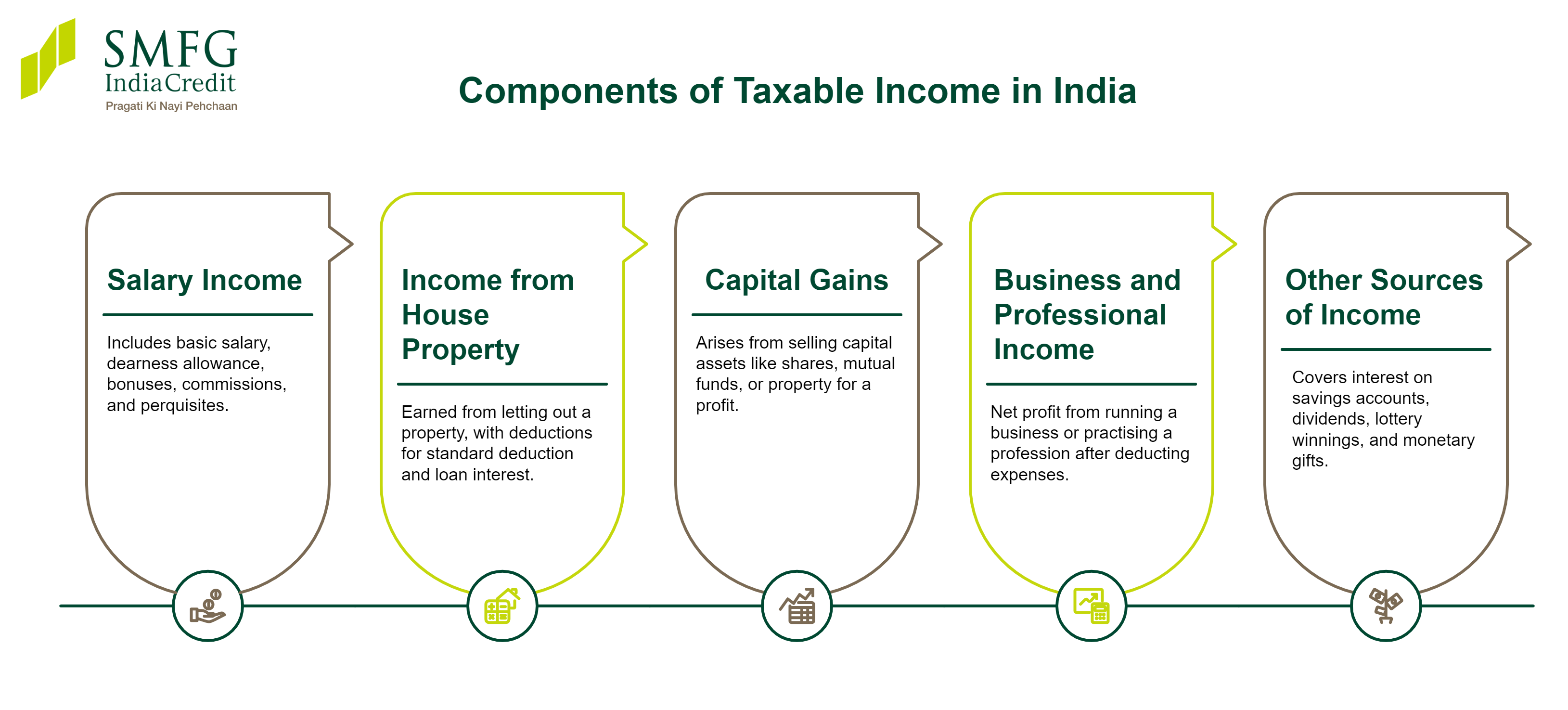
The Income Tax Act divides income into five heads. Together, these form the sources of taxable income in India.
Here are the five main taxable income components:
Salary Income
Salary taxable income includes your basic salary, dearness allowance, bonuses, commissions, and perquisites such as a company car or rent-free accommodation. The standard deduction of Rs. 50,000 (or Rs. 75,000 under the New Tax Regime) is deducted from gross salary before arriving at taxable salary in India. Allowances like HRA and LTA may be partially exempt depending on actual usage and receipts under the Old Tax Regime.
Income from House Property
House property taxable income includes income earned from letting out a property. Any rental income tax liability is calculated under the provisions of the Income Tax Act. Under Section 24(a), a standard deduction of 30% of the net annual value is allowed. If you have taken a loan for the property, the interest paid on that loan may also be claimed as a deduction under Section 24(b), subject to the applicable conditions.
Capital Gains
Capital gains taxable income arises when you sell a capital asset, such as shares, mutual funds, or property, for a profit. The resulting investment income tax liability depends on factors such as the type of asset and the holding period. In general, short-term capital gains and long-term capital gains are taxed differently, with the applicable tax rates and exemptions varying according to the asset and the provisions of the Income Tax Act.
Business and Professional Income
If you run a business or practise a profession, such as law, medicine, or consulting, your business's taxable income is generally the net profit remaining after deducting allowable business expenses. Expenses such as rent, employee salaries, office supplies, and depreciation on eligible assets can be claimed as deductions before arriving at the taxable profits used for professional income tax purposes.
Other Sources of Income
This head covers other taxable income sources, such as interest earned on savings accounts, fixed deposits, dividends, lottery winnings, and monetary gifts exceeding Rs. 50,000 in a financial year from non-relatives.
How to Calculate Taxable Income?
The taxable income formula follows a structured process. Here is how to calculate taxable income in India correctly.
Step 1: Calculate Gross Total Income
The gross total income is the sum of income from all five heads before any deductions under Chapter VI-A are applied.
Gross Total Income Calculation = Salary + House Property Income + Business/Professional Income + Capital Gains + Other Sources
This is the starting point for your taxable income calculation.
Step 2: Deduct Exemptions
Some income is exempt from taxable income even before Chapter VI-A deductions apply. These are covered primarily under Section 10 of the Income Tax Act. Common examples of tax exemptions include House Rent Allowance (HRA), Leave Travel Allowance (LTA), gratuity, and agricultural income, subject to the prescribed conditions and limits. The availability of some exemptions depends on the tax regime you choose.
Step 3: Subtract Eligible Deductions
This is where income tax deductions are applied. Under the Old Tax Regime, you can claim deductions under:
- Section 80C: Up to Rs. 1.5 lakh for investments in PPF, ELSS, life insurance premiums, NSC, and 5-year tax-saving FDs
- Section 80D: Premium paid on health insurance for self, family, and parents
- National Pension System (NPS): Additional deduction of up to Rs. 50,000 under Section 80CCD(1B) over and above the 80C limit
- Section 24(b): Interest on home loan up to Rs. 2 lakhs for a self-occupied property
Step 4: Arrive at Net Taxable Income
Subtract all eligible deductions and exemptions from your gross total income to determine the final taxable income calculation.
Net Taxable Income = Gross Total Income – Exemptions – Deductions
The figure you arrive at is your net taxable income meaning in practice. Tax is calculated on this final number as per the applicable slab rates.
Taxable Income Calculation Example
Here is a simple taxable income example for a salaried individual under the Old Tax Regime for FY 2025–26:
|
Income/Deduction
|
Amount (Rs.)
|
|
Gross Salary
|
12,00,000
|
|
Less: Standard Deduction
|
50,000
|
|
Less: HRA Exemption
|
1,20,000
|
|
Gross Total Income
|
10,30,000
|
|
Less: Section 80C
|
1,50,000
|
|
Less: Section 80D (Health Insurance)
|
25,000
|
|
Less: NPS Section 80CCD(1B)
|
50,000
|
|
Net/ Total Taxable Income
|
8,05,000
|
What Is the Core Difference Between Taxable Income and Gross Income?
Understanding gross income vs taxable income is fundamental before you start planning your taxes.
|
Factor
|
Gross Income
|
Taxable Income
|
|
Definition
|
Total earnings before any deductions
|
Income after deductions and exemptions
|
|
Includes
|
All salary, rent, interest, capital gains
|
Only the portion subject to tax
|
|
Deductions applied
|
No
|
Yes, under Chapter VI-A
|
|
Used for
|
Initial income assessment
|
Actual tax calculation
|
|
Tax applied on
|
No
|
Yes
|
Your yearly taxable income is always lower than your gross income, provided you have claimed the deductions you are entitled to.
Common Deductions That Reduce Taxable Income
One of the most effective ways to reduce taxable income legally is through the tax deductions allowed.
Here are some of the most common tax-saving deductions:
Section 80C Deductions
Tax deductions under 80C allow you to claim up to Rs. 1.5 lakh per year on eligible investments. These include PPF contributions, ELSS mutual funds, life insurance premiums, repayment of home loan principal, NSC, and certain other eligible investments. Investing consistently in these instruments is one of the most widely used smart tax-saving ways in India.
Section 80D Deductions
Section 80D allows you to claim deductions for premiums paid towards health insurance policies. Depending on the age of the insured persons and whether the policy covers yourself, your spouse, dependent children, or parents, you may be eligible to claim deductions ranging from Rs. 25,000 to Rs. 1,00,000. These medical insurance tax benefits help lower your tax liability while providing financial protection against healthcare expenses.
Home Loan Tax Benefits
If you have taken a home loan, the interest paid (up to Rs. 2 lakhs per financial year for a self-occupied property, subject to applicable conditions) is deductible under Section 24(b). The principal repayment is eligible for deduction under Section 80C, within the overall limit of Rs. 1.5 lakh. These housing loan deduction benefits are available under the Old Tax Regime and make a home loan one of the most tax-efficient financial products for eligible taxpayers.
Tips to Reduce Taxable Income Efficiently
Here are some practical tax optimisation tips to help reduce your total taxable income and lower tax liability, wherever eligible:
- Maximise your Section 80C investments early in the financial year rather than at the last minute.
- Invest in NPS for the extra Rs. 50,000 deduction under 80CCD(1B).
- Pay health insurance premiums for yourself and your parents to claim the full Section 80D benefit.
- If you have opted for the Old Tax Regime and have a home loan, ensure you claim both the eligible principal repayment and interest deductions.
- Submit investment proofs to your employer on time so that TDS is deducted correctly.
Old vs New Tax Regime Comparison
|
Factor
|
Old Tax Regime
|
New Tax Regime
|
|
Deductions allowed
|
Yes (80C, 80D, HRA, NPS, etc.)
|
No (most deductions not available)
|
|
Standard deduction
|
Rs. 50,000
|
Rs. 75,000
|
|
Tax rates
|
Higher rates, more slabs
|
Lower rates, simplified slabs
|
|
Best suited for
|
Those with high deductions
|
Those with few deductions
|
|
Default regime
|
No
|
Yes (from FY 2023–24 onwards)
|
Compare your taxable income in India under both tax regimes before deciding which one to opt for. The regime that results in a lower tax liability will depend on your income, eligible deductions, and overall financial situation.
Taxable Income for Business Owners
For business owners, taxable income in India is calculated after deducting all legitimate business expenses from total revenue. These include rent, staff salaries, depreciation, utility bills, and professional fees.
The net profit after these deductions is the taxable income. Business owners can also claim applicable deductions under Chapter VI-A to further reduce tax liability. Maintaining accurate books of accounts and filing Income Tax Returns (ITRs) on time are essential for ensuring compliance with tax laws and reducing the likelihood of scrutiny by the Income Tax Department.
Taxable Income for Salaried Individuals
Taxable income on salary for salaried individuals begins with the gross salary and is then adjusted for eligible exemptions and deductions. Under the Old Tax Regime, exemptions such as HRA and LTA, along with the standard deduction, help determine the taxable salary in India before eligible deductions under Chapter VI-A are applied. The exact benefits available depend on the tax regime you choose.
A salaried employee tax calculation is typically carried out by the employer through the Tax Deducted at Source (TDS) mechanism. However, you should still verify the details using your Form 16 and file your ITR to ensure the tax deducted and your taxable income have been computed correctly.
Tip: If you plan to borrow in the future, use tools such as a personal loan eligibility calculator to estimate how much you may qualify for based on your net monthly income, existing financial obligations, and other key factors.
Taxable Income for Self-Employed Professionals
Self-employed taxable income is computed differently from salaried income. Freelancers and professionals can deduct business-related expenses before arriving at their net taxable figure. Additionally, eligible professionals with gross receipts of up to Rs. 1 crore* and eligible businesses with turnover of up to Rs. 3 crores may opt for the presumptive taxation scheme under Sections 44ADA and 44AD, respectively, subject to the prescribed conditions. This simplifies the taxable income calculation by reducing the need to maintain detailed books of accounts.
If your income fluctuates seasonally, it is important to plan your deductions, advance tax payments, and borrowing carefully. If you need short-term financial support during lean periods, tools such as a personal loan EMI calculator can help you estimate repayments and plan them in line with your expected cash flow.
Conclusion
Taxable income is not simply what you earn. It is the portion of your income that remains after claiming eligible deductions and exemptions, where applicable. Understanding the net taxable income meaning, the formula, the five heads of income, and the available deductions puts you in better control of your tax liability.
Whether you are salaried, self-employed, or a business owner, computing your yearly taxable income correctly and making the right investment choices can lead to significant savings.
If you need financial support for planned or unexpected expenses while managing taxes, regular expenses, and long-term investments, SMFG India Credit offers personal loans of up to Rs. 10 Lakhs* to meet your financial needs. Check your eligibility and apply online to benefit from competitive personal loan interest rates and flexible repayment tenures of up to 60 months.