An income tax notice, often called an IT notice, is an official communication sent to a taxpayer when there is a mismatch, query, or compliance issue in their tax records. The Income Tax Department of India issues it under the Income Tax Act of 1961, based on guidelines from the Central Board of Direct Taxes (CBDT). Receiving an income tax notice in India does not always mean wrongdoing. In many cases, it is simply a request for clarification or additional information.
This article explains the implications of a notice from the Income Tax Department, the possible triggers, and how you should respond.
Understanding an Income Tax Notice
So, what is an income tax notice, and why do you receive it? An IT notice is sent when the department needs clarification, verification, or correction related to your Income Tax Return (ITR) for a specific Assessment Year or Financial Year. It may be triggered due to data mismatches, non-filing of ITR, scrutiny selection, or high-value transactions.
If you are wondering why an income tax notice is issued, it is usually to ensure compliance and accurate tax reporting for a financial year.
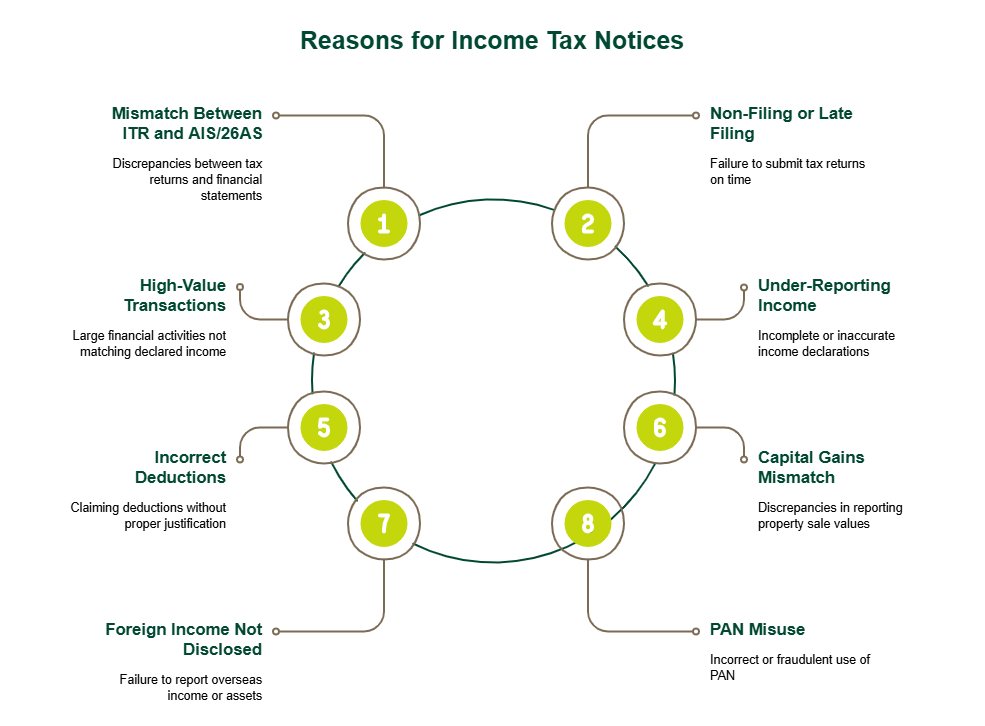
8 Reasons You Can Receive an Income Tax Notice
There are several reasons for the income tax notice being issued. Below are the most common income tax notice reasons:
- Mismatch between ITR and AIS/Form 26AS
- Non-filing of ITR or late filing
- High-value financial transactions
- Under-reported income
- Incorrect deductions
- Capital gains mismatch
- Foreign income not disclosed
- PAN misuse
Reason 1: Mismatch Between ITR and AIS/26AS
One of the most common income tax notice reasons is a mismatch between your Income Tax Return (ITR), Annual Information Statement (AIS), and Form 26AS.
The AIS reflects detailed financial transactions linked to your PAN. Form 26AS shows your Tax Deducted at Source (TDS), advance tax, and self-assessment tax. If the figures you declare in your ITR do not match AIS or Form 26AS, the Income Tax Department of India may issue an income tax notice under Section 143(1)(a).
For example:
- Interest income from fixed deposits appears in AIS but not in your ITR
- TDS claimed does not match Form 26AS
- Salary reported by your employer differs from your declaration
Even a small inconsistency can trigger an automated income tax notice under Section 143(1)(a) because the system compares your return with data submitted by banks, employers, mutual funds, and other reporting entities.
To avoid this:
- Check your AIS thoroughly before filing
- Reconcile Form 26AS with TDS certificates (form 16/16A)
- Ensure your PAN is quoted correctly across all investments and financial accounts
- File a revised return promptly if you identify errors after filing
If you receive a Section 143(1) notice, read it carefully. It generally informs you about adjustments made during processing. It may also be a tax refund notice or a demand notice, depending on the situation.
Reason 2: Non-Filing or Late Filing of ITR
Non-filing of ITR is another major reason for an income tax notice. If you miss the tax filing deadline under Section 139(1), the department can issue a notice under Section 142(1) asking you to file your return.
If you delay filing beyond the due date, you may file a belated return under Section 139(4). However, penalties and interest may apply. Continuous non-filing of ITR may result in an income tax scrutiny notice or further action under Section 148 for reassessment.
Reason 3: High-Value Financial Transactions
The Income Tax Department of India tracks large financial transactions through reporting mechanisms. If these do not match your declared income, a tax notice issued alert may follow.
|
Transaction Type
|
Reporting Threshold
|
|
Cash deposits in a savings account
|
₹10 lakh or more in a year
|
|
Property purchase/sale
|
₹30 lakh or more
|
|
Credit card purchases
|
₹2 lakh or more
|
|
Mutual fund investment
|
₹2 lakh or more
|
|
Bonds/debentures purchases
|
₹5 lakh or more in a year
|
These transactions are linked to your PAN and appear in AIS. If not reported correctly in your Income Tax Return (ITR), you may receive an income tax notice in India for verification.
Reason 4: Under-Reporting of Income
If you miss reporting salary, interest, rental income, or capital gains, it may lead to an income tax notice. Under-reporting generally means income is partially declared, while misreporting refers to incorrect claims made intentionally.
The Income Tax Department of India compares your ITR with third-party data. If suppressed income or under-reported income is detected, notice may be issued under Section 148 for reassessment.
Reason 5: Incorrect Deductions or Exemptions
Claiming deductions without proper proof can trigger an income tax notice. Common mistakes include:
- Fake HRA receipts
- Excess claim under Section 80C
- Unsupported medical insurance claim under Section 80D
- Invalid donations under Section 80G
If discrepancies are found, you may receive a Section 143(1) notice or even a demand notice under Section 156 asking for tax payment.
Reason 6: Property & Capital Gains Mismatch
When you sell property, capital gains must be reported accurately. If the declared sale value differs from the stamp duty valuation, adjustments may apply under Section 50C.
Failure to report capital gains tax properly can result in an income tax notice under Section 148. Property purchases are also tracked via PAN, so unexplained investments can attract scrutiny.
Reason 7: Foreign Income or Assets Not Disclosed
If you hold overseas bank accounts, RSUs, or foreign investments, you must disclose them in Schedule FA of your ITR. Non-disclosure of foreign income can result in serious compliance action.
Under the Income Tax Act, 1961, foreign income disclosure is mandatory. The department receives data through global information-sharing frameworks.
Reason 8: PAN Misuse or Identity Issues
Incorrect PAN quoting, duplicate PAN usage, or identity theft can also lead to an income tax notice.
Ensure your pan card is linked correctly and quoted in all financial transactions. Incorrect TDS entries due to wrong PAN reporting often trigger income tax notice cases.
Income Tax Notice Types & Sections
Below are common income tax notice types under the Income Tax Act, 1961:
|
Section
|
Purpose
|
|
Section 143(1)
|
Intimation after return processing
|
|
Section 142(1)
|
Request for information
|
|
Section 148
|
Reassessment notice
|
|
Section 156
|
Demand notice for tax due
|
|
Section 139(9)
|
Defective return notice
|
Each income tax notice must mention the relevant section and Assessment Year.
How to Check If an Income Tax Notice Is Genuine
You can do an income tax notice check online through the official e-filing portal of the Income Tax Department of India.
Steps:
- Log in to the e-filing portal using your PAN and password.
- Go to the ‘e-Proceedings’ or relevant ‘View Notices/Orders’ section.
- Open the notice and verify the Document Identification Number (DIN) mentioned.
- Cross-check the Assessment Year (AY), your PAN, and name on the notice.
The Income Tax Department of India issues most notices digitally through the portal and via registered email. Always verify the notice on the portal before responding, sharing information, or making any payment.
How to Respond to an Income Tax Notice
If you are unsure how to respond to an income tax notice, follow these steps:
- Read the notice carefully. Check the section, reason, and instructions.
- Identify the section and issue. Understand whether it relates to a mismatch, verification, reassessment, or a defective return.
- Download AIS and Form 26AS. Compare all reported transactions and tax credits with your filed ITR.
- Prepare supporting documents. Keep salary slips, bank statements, investment proofs, Form 16, or any relevant records ready.
- File a revised return if required. If errors are found, submit a corrected ITR under the applicable provision.
- Submit your response online. Respond through the ‘e-Proceedings’ section on the official portal of the Income Tax Department of India.
Always respond within the deadline mentioned in the notice to avoid further action, penalties, or escalations.
What Happens If You Ignore an Income Tax Notice?
Ignoring an income tax notice can lead to penalties, interest under Sections 234A/B/C, or best judgment assessment under Section 144. A demand notice may follow.
Serious non-compliance can result in prosecution under the Income Tax Act, 1961.
Common Mistakes While Responding to an IT Notice
Many taxpayers make avoidable errors while responding to a notice issued by the Income Tax Department of India. These mistakes can lead to delays, additional scrutiny, or unnecessary tax demands.
Common mistakes include:
- Missing the response deadline, which may trigger penalties or further action.
- Ignoring AIS/Form 26AS mismatches, leading to unresolved discrepancies.
- Submitting incomplete or incorrect documents, causing rejection or follow-up notices.
- Not filing a revised return even when errors in the original ITR are identified.
- Skipping professional help, especially when the notice involves reassessment, scrutiny, or complex transactions.
Conclusion
An income tax notice is generally a compliance check, not a penalty. Most IT notices in India arise due to mismatches in financial data, non-filing of ITR, or incorrect deduction claims. When you understand the reason and respond correctly, the issue is usually resolved without difficulty.
Always verify your AIS, Form 26AS, and Income Tax Return (ITR) before filing. Keeping your documents organised and ensuring accurate reporting significantly reduces the chances of receiving an income tax notice.
Tax compliance also plays an important role in personal finance. ITRs are a standard part of credit assessment, forming an essential component of personal loan documents and other loan products, and helping lenders evaluate repayment capacity. Maintaining accurate records can strengthen your personal loan eligibility.
If you’re looking for additional financial support as you manage your monthly commitments, SMFG India Credit offers personal loans of up to Rs. 10 Lakhs* at competitive interest rates. Use the personal loan eligibility calculator and EMI calculator to plan your borrowing and apply online.
* Please note that this article is for your knowledge only. Loans are disbursed at the sole discretion of SMFG India Credit. Final approval, loan terms, disbursal process, foreclosure charges and foreclosure process will be subject to SMFG India Credit's policy at the time of loan application. If you wish to know more about our products and services, please contact us