Quick Summary
- The RBI CIBIL score rules continue to strengthen India's credit reporting framework, making credit information more timely and transparent.
- From July 1, 2026, lenders must report your loan and credit card data to credit bureaus on four fixed dates every month.
- As a result, your credit profile can reflect repayments, new loans, and defaults more quickly under the new CIBIL score update rules.
- Credit bureaus must resolve disputes within 30 days, and lenders must provide a clear, specific reason for a loan or credit card rejection.
- RBI also advises all credit bureaus to send real-time alerts whenever your credit information is accessed.
- As per the RBI CIBIL rule updates, all lenders, including NBFCs, must join all four credit bureaus and share data in a standardised format.
RBI's new CIBIL score rules 2026 are reshaping how credit information is collected, updated, and shared across India. The CIBIL score update cycle is becoming shorter, dispute resolution processes are becoming more robust, and lenders now have greater responsibilities towards borrowers. Whether you already have an active loan or are planning to apply for a financial product, these credit score rules in India can directly influence how your credit profile is managed and assessed.
What Are RBI's New CIBIL Score Rules?
The RBI CIBIL score rules refer to a set of updated credit reporting and borrower protection guidelines issued by the Reserve Bank of India. The primary objective is to make credit score regulation in India more transparent, accurate, and fair. Under the revised RBI CIBIL rules, all regulated lenders and credit card issuers must follow a uniform format for reporting data to credit bureaus such as CIBIL, Experian, Equifax, and CRIF. Let us take a closer look at the other major updates you should know.
Key Changes in RBI's CIBIL Score Rules 2026
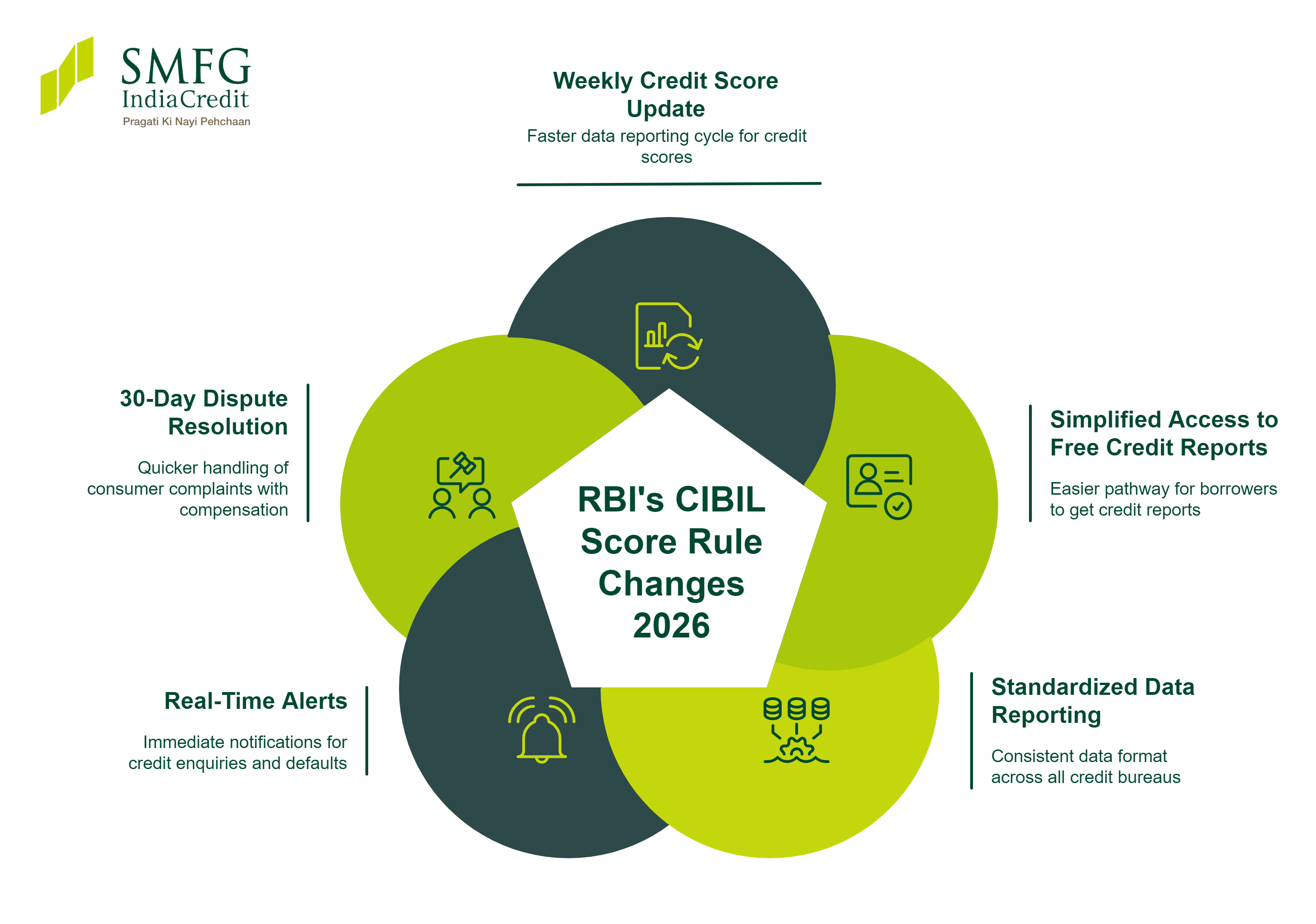
1. Weekly Credit Score Update
One of the most significant RBI credit score changes is that, starting July 1, 2026, lenders must submit incremental borrower credit data on four fixed dates every month: the 9th, the 16th, the 23rd, and the last day of the month.
Under the previous system, lenders reported data fortnightly, and before that, every 30–45 days. This means monthly credit score updates are being replaced by a faster reporting cycle.
2. Simplified Access to Free Credit Reports
RBI had already mandated that every individual is entitled to one free credit report per year from each credit bureau. However, under the RBI CIBIL rule updates, credit bureaus have been advised to offer a clear, visible pathway for borrowers to access their credit reports without unnecessary friction. Credit score monitoring is no longer something borrowers have to struggle with.
3. Lenders Must Report to All Credit Bureaus in a Standard Format
Previously, not all lenders necessarily submitted data in a consistent format or to all credit bureaus, which sometimes resulted in discrepancies across reports. Under the RBI CIBIL rules 2026, every regulated lender must be a member of all four RBI-recognised credit bureaus and submit data in a single standardised format. This can help reduce errors caused by inconsistencies in data reported across credit bureaus.
4. Real-Time Alerts for Credit Enquiries and Payment Defaults
Whenever a lender accesses your credit report, the credit bureau must promptly notify you through SMS or email. This is a major borrower protection rules upgrade. You will know as soon as a hard enquiry is made on your credit profile, allowing you to quickly identify any unauthorised enquiries and take timely action.
Additionally, lenders must also notify you before reporting a default to a credit bureau, giving you a chance to clear the dues or address the issue before it affects your credit history.
5. 30-Day Dispute Resolution and Rejection Reasons Mandate
One of the key RBI credit score changes is the way consumer complaints are handled. Earlier, credit bureaus could classify submissions as requests, queries, or general communications. Now, lenders can no longer reclassify grievances into other categories, and every grievance must be treated as a user complaint. If your complaint is not resolved within 30 days, the credit bureau must pay compensation of Rs. 100 for each day of delay.
As part of the strengthened credit report dispute resolution framework, RBI has directed lenders to provide any required, complete information to credit bureaus within 21 days of receiving a request. If a lender fails to do so, they are also liable to pay compensation of Rs. 100 for every day of delay.
Additionally, lenders must now provide a clear and specific reason when rejecting a loan or credit card application. Generic explanations such as "internal policy" can no longer be used as the sole reason for rejecting a credit application.
Old Rules Versus New Rules
|
Comparison Factor
|
Before 2026
|
After 2026
|
|
Lending Decision Criteria
|
Based largely on historical credit records
|
Greater focus on the recent 30–60 day repayment behaviour
|
|
Credit Score Refresh Time
|
Typically updated within 30–60 days
|
Within 7–10 days
|
|
Credit Reporting Frequency
|
Monthly or every 15 days
|
Every week (on fixed dates mandated by the RBI)
|
|
Recovery After Credit Damage
|
Noticeable improvement generally took 6–12 months
|
Improvements may become visible within weeks
|
|
Effect of a Missed EMI
|
Reflected after a delay
|
Reflected much sooner
|
Top 5 Things You Should Do Right Now
The new CIBIL score update rules can work in your favour if you maintain healthy credit behaviour. Here is what you should do immediately:
- Check your credit reports across all four credit bureaus for errors or outdated entries.
- Clear any overdue EMIs before they are reported under the faster reporting cycle.
- Set up auto-debit for all active loans to avoid accidentally missing a payment.
- Keep your credit card utilisation below 30% of your total credit limit.
- Avoid applying for multiple loans within a short period, as each hard enquiry can temporarily lower your credit score.
If you are planning to apply for a personal loan in the coming months, your credit profile may now be evaluated using much more recent data than before.
Maintaining a strong repayment record over the last 30 to 60 days can make a meaningful difference to your personal loan eligibility and CIBIL score.
Common Mistakes That Can Hurt Your Credit Score
The RBI CIBIL score rules can make it easier to see improvements in your credit score more quickly, but they also mean that credit score mistakes may be reflected sooner. Watch out for these common reasons CIBIL score drops:
- Missed or Delayed EMIs: Under the new reporting cycle, even a single missed payment may be reflected in your credit report within days.
- High Credit Card Utilisation: Using more than 30% of your available credit limit may signal financial stress to lenders.
- Multiple Loan Applications at Once: Each loan application results in a hard enquiry, and multiple enquiries within a short period can lower your credit score.
- Ignoring Errors on Your Credit Report: Under the new RBI CIBIL rule updates, disputes are expected to be resolved within 30 days. However, this only helps if you regularly review your credit report and report inaccuracies promptly.
- Closing Old Credit Accounts Unnecessarily: This shortens your credit history and may reduce your credit score.
A strong credit score and a clean credit report can improve your chances of securing loan approval on favourable terms, such as a lower personal loan interest rate.
Conclusion
The RBI CIBIL score rules 2026 represent a significant step forward for borrowers. Faster updates, mandatory dispute resolution timelines, real-time enquiry alerts, and greater transparency around loan rejections give borrowers more control over their credit profiles. However, faster reporting also means there is less room for error. A missed payment or a spike in credit utilisation can now appear on your credit report much sooner than before.
The best way to benefit from the RBI credit score changes is to start improving your credit profile today.
If you’re planning ahead for borrowing, SMFG India Credit offers personal loans of up to Rs. 10 Lakhs* to support varied financial needs. Estimate your borrowing capacity using our personal loan eligibility calculator and apply online with minimal documentation.
You may also use our personal loan EMI calculator to plan your repayments before you apply.