Section 16 of the Income Tax Act provides certain deductions from salary that may reduce the taxable income of eligible salaried employees and pensioners, subject to the applicable provisions of the Income Tax Act. These Section 16 deductions form an important part of salary tax computation and can influence an individual's overall tax liability.
This article explains the purpose of salary income deductions under Section 16, the deductions it covers, how they are applied, practical examples, and some common misconceptions.
Key Takeaways on Section 16
Section 16 deductions allow eligible taxpayers to claim specified deductions from salary while computing taxable income. The provisions apply only in specific situations, making it useful to understand which deductions are available and who can claim them.
- Section 16(ia) provides the standard deduction under Section 16 for eligible salaried taxpayers and certain pensioners.
- The standard deduction is available to salaried employees under both tax regimes, although the deduction amount differs under the old and new regimes, subject to the applicable provisions.
- Section 16(ii) allows a deduction for entertainment allowance, subject to prescribed conditions and primarily for eligible government employees.
- Section 16(iii) covers the professional tax deduction for professional tax paid during the relevant financial year.
- No investment proof is required to claim the standard deduction, as it is not linked to eligible investments or specified expenditures.
What Is Section 16 of the Income Tax Act, 1961?
The Section 16 meaning refers to the provisions that allow certain deductions from income chargeable under the head "Salaries" before arriving at the taxable salary of an employee. Section 16 of the Income Tax Act applies to eligible individuals earning salary income and specifies the deductions that may be claimed, subject to the applicable conditions. By permitting these deductions, the provision helps reduce the salary amount on which income tax is calculated, resulting in a lower taxable income where the eligibility requirements are met.
Purpose of Section 16
The objective of Section 16 salary deduction is to provide eligible taxpayers with specified deductions from salary income while computing taxable income. It offers tax relief by permitting certain deductions that are specifically allowed under the Income Tax Act, rather than requiring employees to claim individual work-related expenses. These provisions simplify the computation of salary income and ensure eligible taxpayers can claim the applicable deductions.
- Standard deduction for eligible salaried taxpayers and certain pensioners, subject to the applicable provisions.
- Deduction for entertainment allowance, where permitted under the Act.
- Deduction for professional tax paid during the relevant financial year.
By reducing taxable salary, these deductions may increase disposable income, which can support budgeting, savings, and financial planning. They may also influence borrowing decisions for products such as a personal loan.
Maintaining strong finances, together with meeting the lender's overall eligibility criteria, may improve your chances of securing approval with a favourable personal loan interest rate.
Deductions Available Under Section 16
The deductions under Section 16 of the Income Tax Act comprise three specific deductions that may be claimed while computing salary income, subject to the conditions prescribed under the Income Tax Act. These Section 16 income tax deductions do not apply uniformly to every taxpayer, as each deduction has its own eligibility criteria. The following salary deductions under Section 16 help determine the final taxable income from salary.
- Standard deduction available to eligible salaried employees and certain pensioners.
- Entertainment allowance deduction, available under specified conditions.
- Professional tax deduction for professional tax paid during the relevant financial year.
Standard Deduction Under Section 16(ia)
Section 16(ia) provides the eligible standard deduction for salaried employees and pensioners, reducing taxable salary without requiring proof of actual expenses or investments. For AY 2026-27, the deduction is Rs. 50,000 under the Old Tax Regime and up to Rs. 75,000 under the New Tax Regime, subject to the applicable provisions. Since this is a fixed deduction, eligible taxpayers can claim it automatically if they satisfy the prescribed conditions, without maintaining or submitting supporting bills or investment documents.
Standard Deduction Limits
|
Tax Regime
|
Standard Deduction Limit
|
Who Can Claim
|
Proof Required
|
|
Standard deduction, Old Tax Regime
|
Rs. 50,000 or the salary amount, whichever is lower
|
Eligible salaried employees and pensioners
|
No
|
|
Standard deduction, New Tax Regime
|
Up to Rs. 75,000 or the salary amount, whichever is lower
|
Eligible salaried employees and pensioners
|
No
|
Entertainment Allowance Deduction Under Section 16(ii)
The entertainment allowance under Section 16 of the Income Tax Act is available primarily to eligible government employees and is not generally available to private-sector employees. Under Section 16(ii) of the Income Tax Act, the entertainment allowance deduction is restricted to the lowest of the following amounts:
- The actual entertainment allowance received
- 20% of salary (based on basic salary)
- Rs. 5,000
As the deduction is subject to these prescribed limits, receiving an entertainment allowance does not automatically mean the entire amount is deductible. This is a common misconception among taxpayers.
Professional Tax Deduction Under Section 16(iii)
The professional tax deduction under Section 16 of the Income Tax Act allows eligible employees to claim a deduction for professional tax from salary that has been paid during the relevant financial year. Section 16(iii) applies to professional tax levied by the state government under the applicable state laws. The levy, also referred to as employment tax, is generally subject to the maximum limit prescribed under Article 276(2) of the Constitution of India. Where the employer deducts and pays the professional tax on the employee's behalf, the amount paid can generally be claimed as a deduction while computing salary income, subject to the applicable provisions of the Income Tax Act.
Section 16 Deduction Summary
The following Section 16 summary provides a quick overview of the deductions under Section 16 and their key eligibility conditions. While Section 16(ia), Section 16(ii), and Section 16(iii) each provide a deduction from salary income, the eligibility criteria, deduction limits, and proof requirements differ depending on the nature of the deduction.
Deductions Under Section 16 of the Income Tax Act
|
Deduction
|
Section
|
Who Can Claim
|
Maximum Amount/Limit
|
|
Standard deduction
|
Section 16(ia)
|
Eligible salaried employees and pensioners
|
Rs. 50,000 under the old regime or up to Rs. 75,000 under the new regime, subject to the applicable provisions
|
|
Entertainment allowance
|
Section 16(ii)
|
Eligible government employees
|
Lowest of actual allowance received, 20% of basic salary, or Rs. 5,000
|
|
Professional tax
|
Section 16(iii)
|
Employees who have paid professional tax
|
Actual amount of professional tax paid during the relevant financial year
|
Section 16 for Pensioners
Section 16 for pensioners is relevant where a pension received from a former employer is taxed under the head "Salaries". In such cases, eligible individuals may claim the standard deduction for pensioners, subject to the applicable provisions of the Income Tax Act. Since this deduction is a fixed amount, it is available without the need to submit proof of investments or actual expenses. However, not all pension income is treated the same for tax purposes. The availability of the deduction depends on whether the pension salary income is taxable under the head "Salaries", making it important to determine the nature of the pension before claiming the deduction.
Who Can Claim Deductions Under Section 16?
Section 16 eligibility depends on the nature of the deduction being claimed and the taxpayer's source of income. While certain deductions are available to most salaried taxpayers, others apply only in specific situations. Understanding the eligibility criteria can help ensure the correct deduction is claimed while computing taxable salary.
- Eligible salaried employee deduction benefits include the standard deduction, subject to the applicable provisions.
- Pensioners receiving a pension from a former employer that is taxable under the head "Salaries" may also claim the standard deduction.
- The deduction for entertainment allowance is generally available only to eligible government employees and is not ordinarily available to private employees.
- The deduction for professional tax may be claimed where such a tax has been paid during the relevant financial year, subject to the applicable provisions.
Since each deduction has different eligibility conditions, taxpayers should verify the applicable requirements before claiming them in their income tax return.
Section 16 Under Old Tax Regime vs New Tax Regime
The treatment of deductions under Section 16 differs depending on the tax regime selected. Under the Section 16 Old Tax Regime, eligible taxpayers can claim the standard deduction as well as certain other deductions, subject to the applicable conditions. Under the Section 16 New Tax Regime governed by Section 115BAC, the standard deduction in the New Tax Regime is also available, although the deduction limit differs under the latest provisions. However, the availability of deductions such as professional tax and entertainment allowance depends on the applicable provisions of the chosen regime. These differences can affect the computation of taxable income.
|
Particulars
|
Old Tax Regime
|
New Tax Regime
|
|
Standard deduction
|
Available (up to Rs. 50,000, subject to the applicable provisions)
|
Available (up to Rs. 75,000, subject to the applicable provisions)
|
|
Entertainment allowance deduction
|
Available to eligible government employees, subject to the prescribed conditions
|
Not available under the applicable provisions
|
|
Professional tax deduction
|
Available where applicable
|
Not available under the applicable provisions
|
How Section 16 Reduces Taxable Salary
The Section 16 calculation helps determine the portion of salary on which income tax is payable by reducing eligible deductions from gross salary. As part of the taxable salary calculation, deductions such as the standard deduction, professional tax, and entertainment allowance (where applicable) are considered in accordance with the provisions of the Income Tax Act. This salary deduction calculation forms an important step in arriving at the final taxable salary.
Taxable Salary = Gross Salary – Deductions under Section 16 – Other Eligible Exemptions/Deductions, If Applicable
Documents Required to Claim Section 16 Deductions
The standard deduction is a fixed deduction and generally does not require any supporting documents. However, for other claims, maintaining the relevant documents for Section 16 deduction can help substantiate your eligibility. Information relating to deductions is usually available in salary records issued by your employer.
- Form 16 salary deduction details, where applicable
- Monthly payslip showing salary components and professional tax deductions
- Salary certificate, if required, to verify salary particulars
- Details of entertainment allowance, where applicable, as reflected in the salary structure or related records
Keeping these records readily available can help verify Section 16 proof requirements, wherever applicable, while filing your income tax return.
Where to Check Section 16 Deductions in Form 16
Section 16 in Form 16 is generally reflected in the section relating to income chargeable under the head "Salaries" and the corresponding deductions. Before filing your ITR, review these details carefully to ensure the deductions reported by your employer match your salary records. This can help confirm that the Form 16 standard deduction and other eligible deductions have been correctly considered while arriving at your taxable salary.
- Check the salary and deduction details in Form 16.
- Verify the salary deduction in Form 16, including the standard deduction, where applicable.
- Confirm that any professional tax deducted during the financial year has been correctly reflected.
- Compare the figures in Form 16 with your ITR before submitting your return to identify and resolve any discrepancies.
How to Claim Section 16 Deduction While Filing ITR
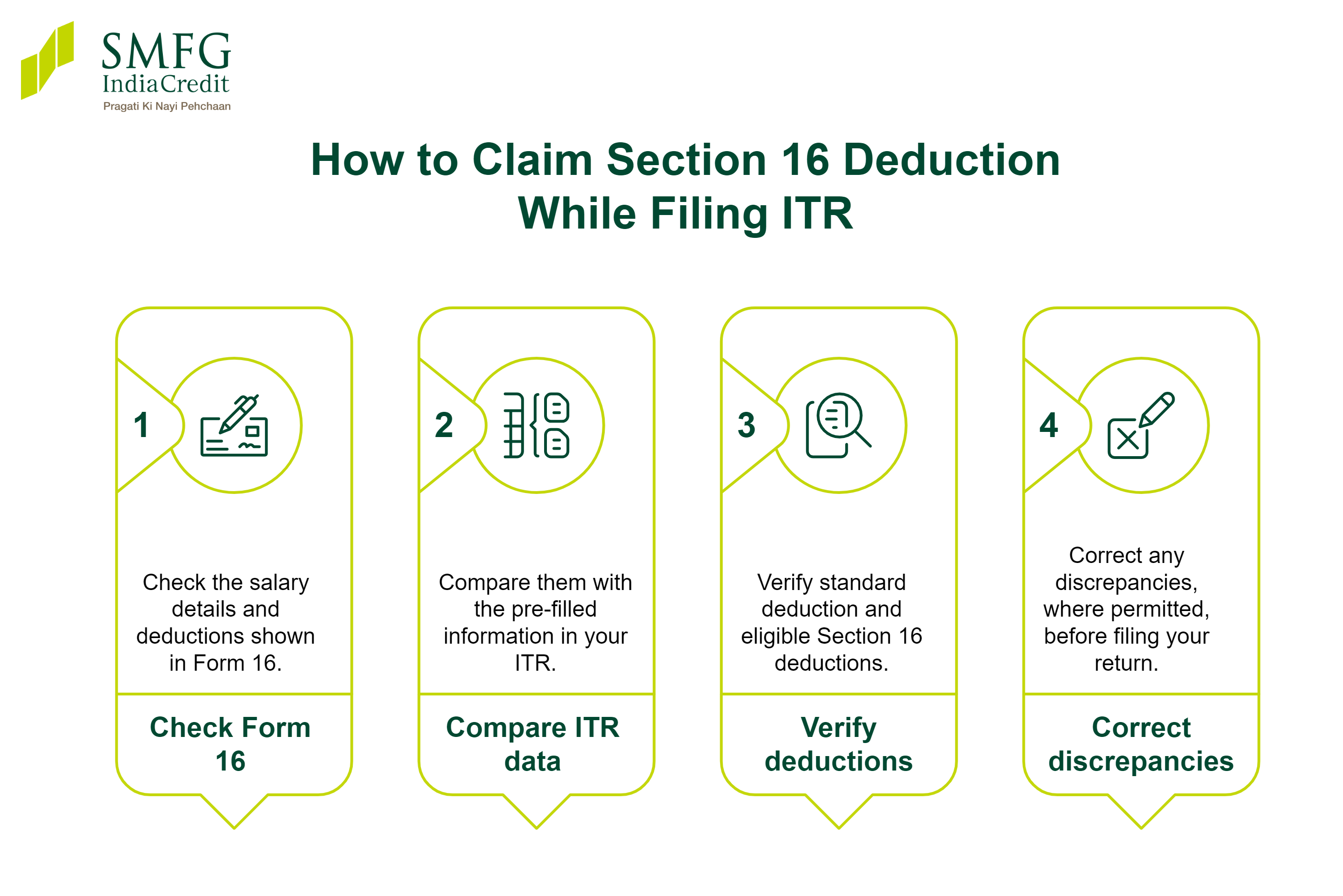
Claiming deductions under income tax Section 16 is generally straightforward for salaried taxpayers, as the relevant details are usually reflected in Form 16 and the pre-filled ITR. However, you should verify that the information is accurate before submitting your return. While the standard deduction is generally considered in the salary computation, it is advisable to review the figures and ensure any eligible exemption under Section 16 or deduction has been correctly reflected, wherever applicable.
- Check the salary details and deductions shown in Form 16.
- Compare them with the pre-filled information in your ITR.
- Verify that the standard deduction and other eligible Section 16 deductions have been correctly reflected.
- If you identify any discrepancies, review the relevant details and make corrections, where permitted, before filing your return.
Conclusion
Section 16 of the Income Tax Act provides specified deductions that can reduce taxable salary for eligible taxpayers, subject to the applicable provisions. Knowing which deductions are available, who can claim them, and how they are reflected in Section 16 in ITR can help ensure accurate tax filing and salary income computation. Reviewing your salary records and Form 16 before filing your return can also help minimise errors and support compliance with the applicable tax requirements.
If you are planning a major expense alongside managing your tax obligations and regular expenses, SMFG India Credit offers unsecured funds of up to Rs. 10 lakhs* with straightforward personal loan eligibility and competitive interest rates.
Use our personal loan eligibility calculator to estimate your borrowing capacity and submit your application online.
You can also use the personal loan EMI calculator to estimate your monthly repayments and compare different loan amounts and repayment tenures before making a borrowing decision.
* Please note that this article is for your knowledge only. Loans are disbursed at the sole discretion of SMFG India Credit. Final approval, loan terms, disbursal process, foreclosure charges and foreclosure process will be subject to SMFG India Credit's policy at the time of loan application. If you wish to know more about our products and services, please contact us