Many borrowers notice an additional interest charge before their regular EMI payments begin and are unsure why it has been applied. This amount is known as broken period interest, or BPI in a loan, and usually arises when there is a gap between the loan disbursement date and the first EMI date. Since a lender starts charging loan interest before the first EMI from the date the funds are disbursed, it is important for every borrower to understand how this charge works. This article explains its meaning, calculation, applicability, and key considerations.
What Is Broken Period Interest?
The broken period interest meaning refers to the interest charged for the period between the loan disbursement date and the beginning of the regular first EMI cycle. Simply put, BPI meaning in loan is the interest that accrues before the scheduled EMI repayments commence. Since the outstanding loan amount starts attracting interest as soon as it is disbursed, the lender charges this amount at the applicable interest rate for the intervening period before the first EMI becomes due.
Why Is Broken Period Interest Charged?
The reason for BPI in a loan is that interest begins to accrue from the day the disbursed amount is credited to the borrower, even if the regular EMI cycle starts later. Since the borrower can use the funds immediately after disbursement, the lender charges interest before EMI starts only for the intervening period. This ensures that the interest payable accurately reflects the actual loan usage period, in accordance with the applicable lender policy.
- Interest starts accruing from the loan disbursement date.
- The first EMI may be scheduled several days later.
- BPI covers the interest for this interim period only.
- The charge is calculated proportionately based on the applicable interest rate and the resulting interest cost for the period.
When Does Broken Period Interest Apply?
BPI applicability depends on the timing of the loan disbursement and the scheduled EMI commencement. Broken period interest in loans is commonly charged when there is a gap between the date on which the funds are released and the first EMI date.
- Mid-month disbursement, where the loan is released after the usual EMI cycle has begun.
- A fixed first EMI date falling in the following month.
- Home loan disbursements, including partial disbursements during property construction.
- Personal loan disbursed before the scheduled EMI cycle begins.
- Balance transfer cases where the new loan is disbursed before EMI payments commence with the new lender.
The exact BPI treatment may vary depending on the terms of the loan account and the lender's policy.
How Does Broken Period Interest Work in Loans?
The typical BPI loan process begins once the loan disbursement is completed and the lender confirms the regular EMI due date. The number of broken period days between these two dates is then identified, and interest is charged only for this interim period.
- The approved loan amount is disbursed to the borrower.
- The lender fixes the first EMI cycle and due date.
- The days before the regular cycle begins are counted.
- Loan interest calculation before EMI is carried out on the disbursed amount using the contracted ROI.
- The resulting amount may be collected upfront or added to the first instalment, depending on the repayment schedule.
Broken Period Interest Formula
The broken period interest formula calculates the interest payable for the period between loan disbursement and the start of the regular EMI cycle. A simple BPI formula used for loan broken period interest calculation is shown below. While the formula generally uses 365 days, some lenders may calculate interest using a 360-day basis, depending on the applicable lender policy or loan agreement.
BPI = Loan Amount × Annual Interest Rate × Broken Period Days ÷ 365
How to Calculate Broken Period Interest
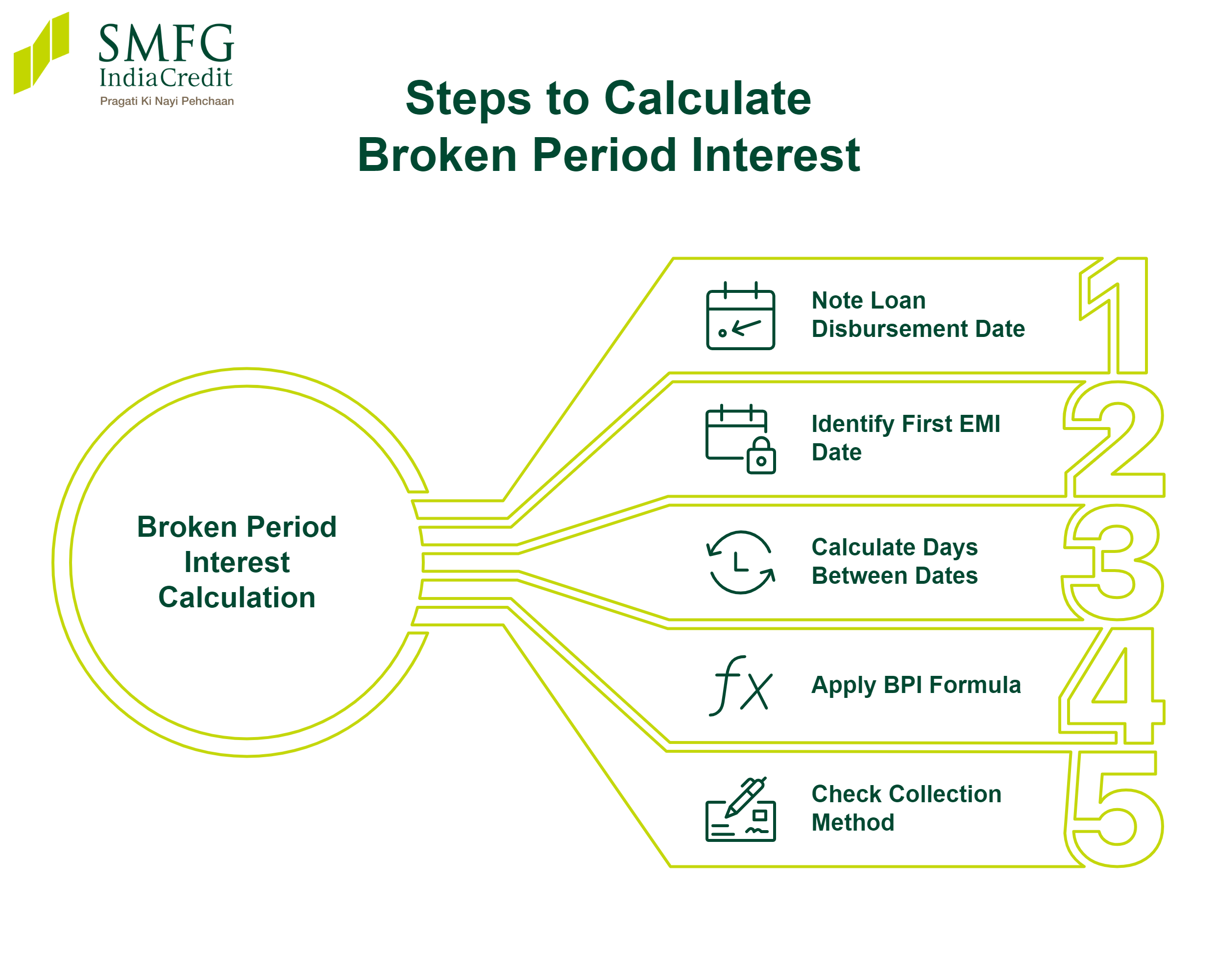
The broken period interest calculation is based on the time between the disbursement date and the first EMI date. To calculate BPI in a loan, identify the relevant dates, determine the applicable interest rate, and apply the prescribed formula. You should also review the loan agreement to understand how the lender collects the charge.
- Note the loan disbursement date.
- Identify the scheduled first EMI date.
- Calculate the number of days between these dates.
- Apply the applicable annual interest rate using the BPI formula.
- Check whether the amount is deducted at disbursement or collected separately with the first EMI, as specified in the loan statement or agreement.
Broken Period Interest Calculation Example
The following broken period interest example shows how interest is calculated for the period between loan disbursement and the start of the regular EMI cycle. Assume the loan amount is Rs. 5,00,000, the annual interest rate is 12%, and the broken period days total 10.
BPI = Rs. 5,00,000 × 12% × 10 ÷ 365 = ~ Rs. 1,644
This BPI calculation example results in a BPI amount of approximately Rs. 1,644. The actual amount may vary depending on the lender's day-count convention and the terms of the loan agreement.
Broken Period Interest Example Summary
|
Loan Amount
|
Interest Rate
|
Broken Period Days
|
Approx. BPI
|
|
Rs. 5,00,000
|
12% p.a. (annual rate)
|
10
|
Rs. 1,644 (approx.)
|
Broken Period Interest in Personal Loans
Broken period interest in personal loan transactions may apply when there is a gap between the loan disbursement date and the first EMI date. Since the lender begins charging loan interest before the first EMI from the date the loan amount is disbursed, interest may accrue for the intervening period before the regular repayment cycle begins.
This personal loan BPI charge is calculated separately from the regular EMIs and may either be collected upfront or along with the first instalment, depending on the lender's policy and loan terms. Borrowers should review the sanction letter or loan agreement to understand how the applicable personal loan interest rate is used to calculate this amount.
Broken Period Interest in Vehicle Loans
Broken period interest in car loans and other vehicle finance products may apply when the loan is disbursed before the regular EMI cycle begins. If there is a gap between the disbursement date and the scheduled EMI due date, the lender may charge interest for this interim period.
This vehicle loan BPI is separate from the regular EMI interest calculation and may either be collected before the repayment cycle starts or along with the first instalment, depending on the loan terms. The same principle generally applies to bike loan broken period interest, although the method of collection and calculation may vary across lenders and the terms of the relevant loan account.
Common Misconceptions About Broken Period Interest
Several broken period interest misconceptions arise because borrowers often encounter this charge before paying their first EMI. Understanding these common BPI myths can help distinguish a legitimate interest charge from other loan-related costs and avoid confusion during the repayment process.
- BPI is a penalty: No. It is an interest charge for the period between loan disbursement and the first EMI.
- BPI is a processing fee: No. A processing fee is a separate charge for processing the loan application.
- BPI is always hidden: No. It is generally disclosed in the loan agreement or sanction terms.
- BPI is the same as an EMI: No. It is charged separately for the interim period before regular EMI payments begin. It is charged separately for the interim period before regular EMI payments begin.
- BPI means paying extra interest beyond the loan usage period: No. It applies only to the actual loan usage period before the regular repayment cycle starts.
- BPI is always avoidable: No. Whether BPI applies depends on the loan disbursement date, the EMI schedule, and the lender's policy.
Conclusion
Broken period interest is a proportionate interest charge that applies for the period between loan disbursement and the start of the regular EMI cycle. Since the broken period loan interest due depends on factors such as the disbursement date, applicable interest rate, and the broken period interest calculation method followed by the lender, borrowers should review these details carefully.
If anything is unclear, refer to the loan agreement, Key Fact Statement (KFS), and repayment schedule, or request a detailed interest break-up from your lender before proceeding.
If you are considering borrowing in the near future, SMFG India Credit offers personal loans of up to Rs. 10 lakhs*.
Applicants meeting personal loan eligibility can avail of competitive interest rates starting from 12.5%* per annum and flexible tenures of up to 60 months.
Use our personal loan EMI calculator to estimate your monthly outflow and apply online with minimal documentation.
You may also use our personal loan eligibility calculator to assess how much you may be able to borrow and make informed financial decisions.
* Please note that this article is for your knowledge only. Loans are disbursed at the sole discretion of SMFG India Credit. Final approval, loan terms, disbursal process, foreclosure charges and foreclosure process will be subject to SMFG India Credit's policy at the time of loan application. If you wish to know more about our products and services, please contact us