Quick Summary
- The ITR late filing penalty can be up to Rs. 5,000 if your total income exceeds Rs. 5 lakhs, or Rs. 1,000 if it does not.
- But the consequences of not filing the ITR can go well beyond a fine. You may lose the ability to carry forward certain losses, incur interest under Section 234A at 1% per month on unpaid tax, receive an income tax notice, and experience delays in receiving eligible refunds.
- For FY 2025–26 (AY 2026–27), the due date for filing an ITR depends on the category of taxpayer. For example, for ITR-1 and ITR-2 filers, the deadline is 31 July 2026. If you miss the applicable due date, you can generally file a belated return by 31 December 2026, subject to the applicable late fee and interest.
Many people assume they do not need to file an Income Tax Return (ITR) if tax has already been deducted through TDS or if they have no additional tax liability. However, what happens if you do not file an ITR can be more serious than many taxpayers realise. You may still incur late fees, lose certain tax benefits, and receive notices from the Income Tax Department.
This article explains the consequences of not filing ITR and the steps you can take to remain compliant.
What Is ITR, and Who Should File ITR?
An Income Tax Return (ITR) is a form filed with the Income Tax Department to report your income, deductions, and tax paid for a financial year. Under the Income Tax Act, an income tax return filing should be done in cases such as the following:
- Your gross income exceeds the basic exemption limit (Rs. 2.5 lakh under the old regime; Rs. 4 lakhs under the new regime for FY 2025–26)
- You are a company or firm, regardless of profit or loss
- You want to claim a tax refund on the excess TDS deducted
- You have foreign assets or signing authority in a foreign account
- Your gross total receipts, received from your profession, exceed Rs. 10 lakhs
- You have deposited Rs. 1 crore or more in a current account
Even if your employer has deducted TDS and issued Form 16, you must file your ITR separately through the Income Tax Portal.
What Happens If You Do Not File ITR?
Non-filing of ITR carries both immediate and long-term consequences. Whether the missed ITR filing deadline was accidental or deliberate, here is a breakdown of what follows.
Late Filing Fees Under Section 234F
The Section 234F penalty is one of the most direct consequences of delayed income tax filing. It applies when you file your return after the due date within the permitted belated return filing window.
|
Income Level
|
ITR Late Filing Penalty
|
|
Total income up to Rs. 5 lakhs
|
Rs. 1,000
|
|
Total income above Rs. 5 lakhs
|
Rs. 5,000
|
|
Income below the basic exemption limit
|
Nil
|
Interest on Unpaid Tax Under Section 234A
If you have any unpaid tax and file late, Section 234A interest applies at 1% per month (or part of a month) on the outstanding amount, calculated from the original due date until you actually file the return. This income tax return penalty can increase your overall tax liability significantly.
Loss of Carry Forward of Losses
Failing to file your ITR within the due date can prevent you from claiming the carry-forward loss ITR benefit for certain business and capital losses. As a result, you may not be able to use those losses for future ITR loss adjustment, leading to a tax benefit loss in subsequent financial years. However, certain losses, such as losses from house property, may still be carried forward subject to the applicable provisions of the Income Tax Act.
Notice from the Income Tax Department
The ITR non-filing consequences may include receiving an ITR notice from the Income Tax Department. The department can use information from TDS records, GST filings, high-value transactions, and PAN card-linked financial activity to identify non-filers. An income tax notice for non-filing may begin as a compliance reminder, but ignoring it can lead to income tax scrutiny and an assessment of your income based on the information available to the department.
Legal Consequences of Not Filing ITR
In cases of wilful non-filing of ITR with significant tax dues, prosecution under Section 276CC of the Income Tax Act may follow. The penalty ranges from three months to seven years of imprisonment, depending on the tax amount involved. While prosecution for non-filing of ITR is generally reserved for serious cases, the risk is real for taxpayers with substantial undisclosed incomes who repeatedly fail to file their returns.
Financial Consequences Beyond Penalties
The financial impact of not filing ITR extends beyond late fees and interest. Delayed filing can slow down refund processing, affect visa applications where income proof is required, and reduce your financial credibility with lending institutions. Maintaining a consistent ITR record helps when applying for financial products, such as a personal loan, as it demonstrates financial discipline and supports the income assessment process.
Impact on Loan Applications
Most lenders ask for the last two to three years' ITRs as proof of income and repayment capacity while assessing applications for credit products such as a personal loan, business loan, or home loan. Providing ITR for loan approval helps verify your financial profile, while the absence of recent returns may require additional documentation or even contribute to loan rejection due to no ITR, depending on the lender's assessment criteria.
As a result, ITR and personal loan eligibility are closely linked, as regular ITR filing supports income verification and helps lenders assess your repayment capacity. The same principle also applies to several other financial products.
Clear and consistent ITR records, along with strong creditworthiness and overall eligibility, can support a smoother loan application process and improve your chances of securing favourable terms, such as a lower personal loan interest rate.
Impact on Tax Refund Claims
Claiming a tax refund without an ITR is generally not possible, as filing your return is the mechanism through which excess tax paid is claimed. Missing the filing deadline can delay the processing of eligible refunds, and prolonged non-filing may result in a missed refund.
How to Check if ITR Is Filed or Not?
You can verify your income tax compliance status directly on the Income Tax Portal:
- Log in using your PAN or Aadhaar-linked credentials.
- Go to "e-File" and then "Income Tax Returns".
- Select "View Filed Returns".
- You will see the status of all returns filed for each assessment year.
How to Avoid ITR Penalties
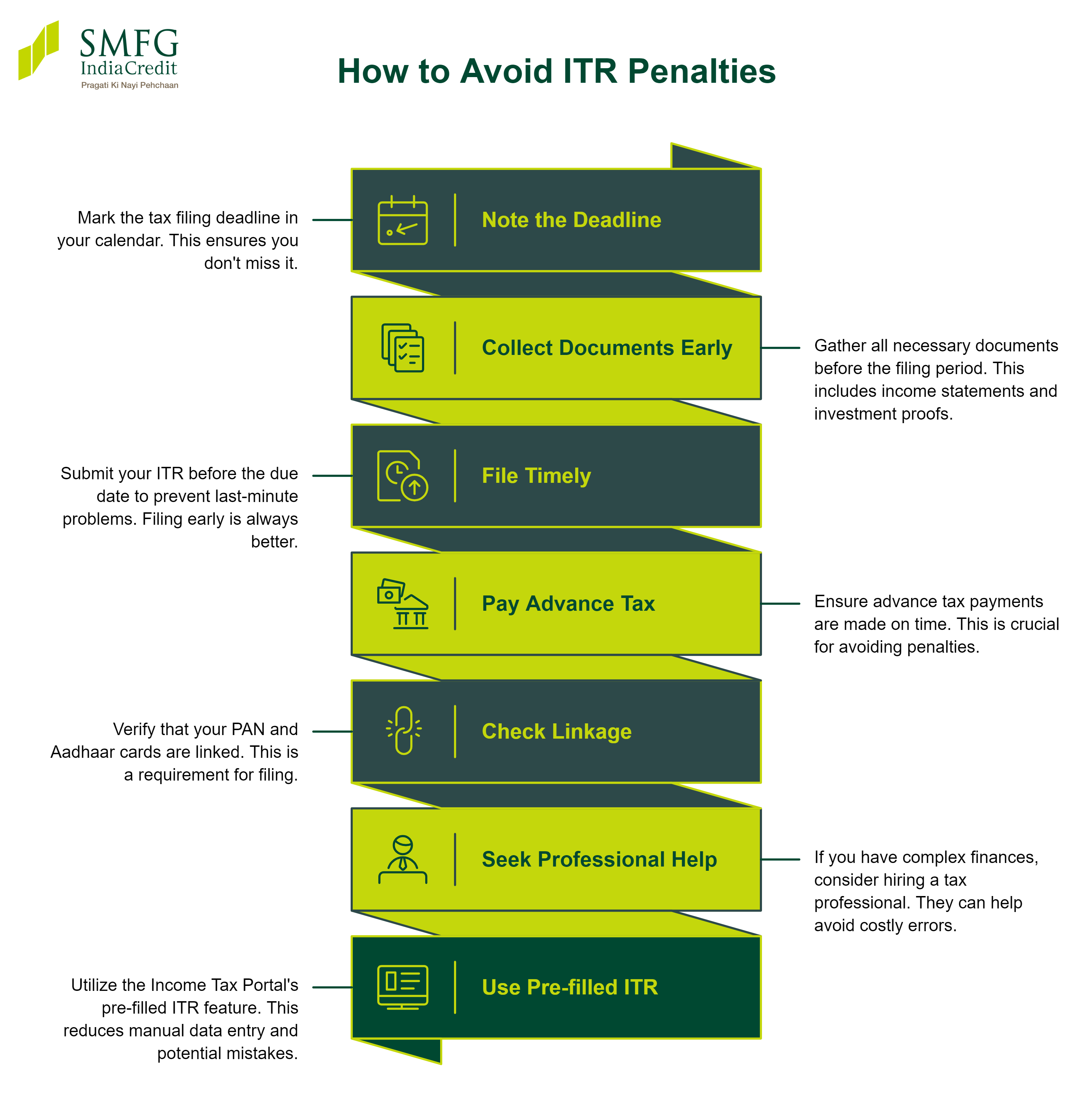
Avoiding the ITR late filing penalty is straightforward with basic planning:
- Note the tax filing deadline for your category well in advance (31 July 2026 for most individual taxpayers for AY 2026–27).
- Collect all documents early: Form 16, interest certificates, investment proofs, and capital gains statements.
- Timely tax filing is important. File before the due date, not on it, to avoid last-minute portal issues.
- Pay advance tax on time, wherever applicable.
- Check your PAN card and Aadhaar card linkage status on the Income Tax Portal before filing.
- If you have investments or multiple income sources, consider professional help to avoid errors that may require revision.
- Use the Income Tax Portal’s pre-filled ITR feature to reduce manual data entry errors.
Conclusion
The penalty for not filing the ITR is only the beginning. The full impact can include interest charges, the loss of carry-forward benefits, tax refund delays, loan complications, and, in serious cases, legal action. Fortunately, the consequences of not filing ITR can often be avoided by filing your return on time. For FY 2025–26 (AY 2026–27), the due date for most individual taxpayers is 31 July 2026. If you miss the deadline, file a belated return by 31 December 2026 to minimise the consequences.
If you need financial assistance while managing your tax obligations, regular expenses, and long-term goals, consider a personal loan of up to Rs. 10 Lakhs* from SMFG India Credit. Use our personal loan EMI calculator to estimate your monthly repayments and begin your online application.
We also recommend using the personal loan eligibility calculator to assess your borrowing capacity based on factors such as your monthly income and existing financial obligations.