After completing the repayment of a loan, obtaining a No Dues Certificate is an important final step.
The loan No Dues Certificate serves as a vital loan closure document confirming that the borrower has cleared all outstanding dues in the loan account and that the lender has no further financial claims relating to the loan. This article explains the NDC's meaning in a loan, why it is important, how to obtain it, and the role it plays after a loan has been successfully closed.
What Is a No Dues Certificate?
The NDC full form is No Dues Certificate.
The No Dues Certificate meaning refers to an official document issued by a lender confirming that a borrower has fully repaid a loan and that no further amount is payable.
It certifies that all financial obligations relating to the loan, including the principal amount, interest, EMI, and any applicable penalty charges, have been settled. As an official record of loan closure, a No Dues Certificate serves as important financial proof and may be useful for future borrowing, record-keeping, and resolving any queries relating to the closed loan account.
What Is the NDC Full Form?
The NDC full form is No Dues Certificate. In the context of borrowing, the NDC meaning in loan refers to a document confirming that all dues relating to a loan have been cleared, and no further amount is payable by the borrower. Depending on the financial institution, it may also be referred to as a loan closure certificate or a loan closure letter. It is commonly issued after a loan has been fully repaid and the lender has completed the loan closure process.
Why Is a No Dues Certificate Important for Loans?
The importance of a No Dues Certificate extends beyond confirming that a loan has been repaid. It provides documentary evidence that the borrower has fulfilled all repayment obligations and helps avoid disputes after the loan is closed. Why a No Dues Certificate is important becomes particularly clear in the following situations:
- Serves as loan repayment proof issued by the lender.
- Helps protect your credit record by confirming that no dues remain.
- Supports smoother processing of a future loan application, where required.
- Facilitates the release of collateral or original documents in the case of secured loans.
Retaining a No Dues Certificate or NDC with your loan records is a good practice, even after the account has been closed.
Key Benefits of a No Dues Certificate
|
Benefit
|
Why It Matters
|
|
Repayment Proof
|
Provides official repayment proof confirming that no EMI, interest, or other dues remain payable.
|
|
Protects Credit Profile
|
Supports an accurate credit profile by evidencing that the loan has been closed successfully.
|
|
Reduces Future Disputes
|
Helps minimise potential disputes relating to outstanding dues or the loan closure status.
|
|
Collateral Release
|
Assists with collateral release and the return of original documents for secured loans, where applicable.
|
|
Supports Future Loan Application
|
May be useful during a loan application as evidence that previous borrowing obligations have been fully settled.
|
These No Dues Certificate benefits make it worthwhile to retain the certificate even after your loan has been closed.
When Is a No Dues Certificate Required?
A loan NDC requirement can arise in several situations, even after you have completed loan closure. Keeping a No Dues Certificate safely preserved can help simplify future financial and legal processes. It is commonly required in the following situations:
- To confirm no dues after loan closure.
- While submitting a new loan application with another lender.
- Before a property sale involving a previously financed asset.
- Before a vehicle sale, if the vehicle was purchased using a loan.
- When refinancing an existing loan or transferring it to another lender.
- To facilitate the release of original documents or security, where applicable.
- To resolve discrepancies in your credit report or credit score, if any.
Retaining a copy of your No Dues Certificate can help you respond quickly whenever proof of loan closure is required.
Who Issues a Loan No Dues Certificate?
A lender No Dues Certificate is issued by the lending institution after verifying that the borrower has repaid all amounts due and the loan account has been successfully closed. Depending on the type of loan, the certificate may be issued by:
- An NBFC or a Housing Finance Company
- A vehicle finance company
- Another eligible financial institution, including digital lenders.
The certificate is typically issued after the lender verifies the repayment records, either automatically or upon the borrower's request, depending on the institution’s internal process.
Types of Loans Where NDC is Required
A No Dues Certificate may be issued after the successful closure of various types of loans. While the process may vary between lenders, it is commonly applicable to the following loan categories:
- No Dues Certificate for
- No Dues Certificate for home loan
- No Dues Certificate for vehicle loan
- No Dues Certificate for Loan Against Property
- No Dues Certificate for
- No Dues Certificate for education loan
- No Dues Certificate for consumer durable loan
No Dues Certificate for a Personal Loan
A personal loan No Dues Certificate, or an NDC for a personal loan, confirms that the unsecured loan has been fully repaid, including all EMI payments and any applicable charges. It serves as official proof of loan closure and can help maintain an accurate credit profile for future reference.
If you apply for a similar financing option in the future, retaining this document can support your personal loan eligibility by demonstrating a good repayment history to the lender.
No Dues Certificate for a Home Loan
A home loan No Dues Certificate, or an NDC for a home loan, confirms that the loan has been fully repaid. It also supports the release of property documents, removal of any lien or charge over the collateral, where applicable, and can be important when selling, refinancing, or otherwise engaging in a property transaction.
No Dues Certificate for Vehicle Loan
Obtaining a vehicle loan No Dues Certificate helps complete the remaining post-closure formalities. Along with a car loan NOC or bike loan NOC, it may be required for the removal of hypothecation from the vehicle records, completing formalities with the RTO, and facilitating the transfer of vehicle ownership.
Details Mentioned in a No Dues Certificate
While the exact loan No Dues Certificate format may vary between lenders, the document should contain all the essential information required to confirm that the loan has been closed successfully. Reviewing the details in the No Dues Certificate before accepting it can help avoid discrepancies and simplify any future verification.
A typical No Dues Certificate format generally includes:
- Borrower name
- Loan account number
- Loan type
- Lender name
- Loan closure date
- A declaration confirming that no outstanding dues remain payable
- Name and signature of the authorised signatory, along with the lender's seal, where applicable
- Date of issue of the certificate
Before storing the certificate, verify that all the details are accurate and match your loan records. Any errors should be reported to the lender promptly so that a corrected No Dues Certificate can be issued.
No Dues Certificate Format
Although there is no single standard No Dues Certificate format, most lenders follow a similar structure.
The exact NDC format for a loan may vary depending on the institution, but it should include the key information needed to confirm successful loan closure. The list below outlines a No Dues Certificate sample with the commonly included details:
- Header: Title of the certificate and certificate number, where applicable
- Borrower Information: Borrower details, including the borrower's name
- Loan Information: Loan account, loan type, and lender reference details
- Declaration: Statement confirming that no dues remain outstanding
- Loan Closure: Date of loan closure and date of issue
- Lender Details: Branch or lender information, lender seal, and authorised signature
Sample Loan NDC Format
This table illustrates the information commonly included in a No Dues Certificate sample format.
|
Field
|
What It Should Mention
|
|
Borrower Name
|
Full borrower name as per the loan records
|
|
Loan Account Number
|
Unique loan account number or reference linked to the borrower
|
|
Loan Closure Date
|
Closure date confirming successful loan repayment
|
|
Outstanding Amount
|
Confirmation that the outstanding amount is nil
|
|
Authorisation
|
Signature of the authorised signatory, along with the lender's seal, where applicable
|
How to Get a No Dues Certificate Online
Many lenders and NBFCs allow borrowers to download a No Dues Certificate online after the loan has been successfully closed.
If you are searching for how to get a No Dues Certificate online, the exact process may vary by lender, but it generally follows these steps:
- Confirm that your closed loan has been processed by the lender.
- Log in to the customer portal or mobile app using your credentials or by verifying your identity through your registered mobile number and OTP, where applicable.
- Select the closed loan account.
- Open the document section or the service request section.
- Locate the option for loan NDC download.
- Download and save the No Dues Certificate for your records.
If the certificate is not yet available, contact your lender to check its issuance status or raise a service request through the available channels.
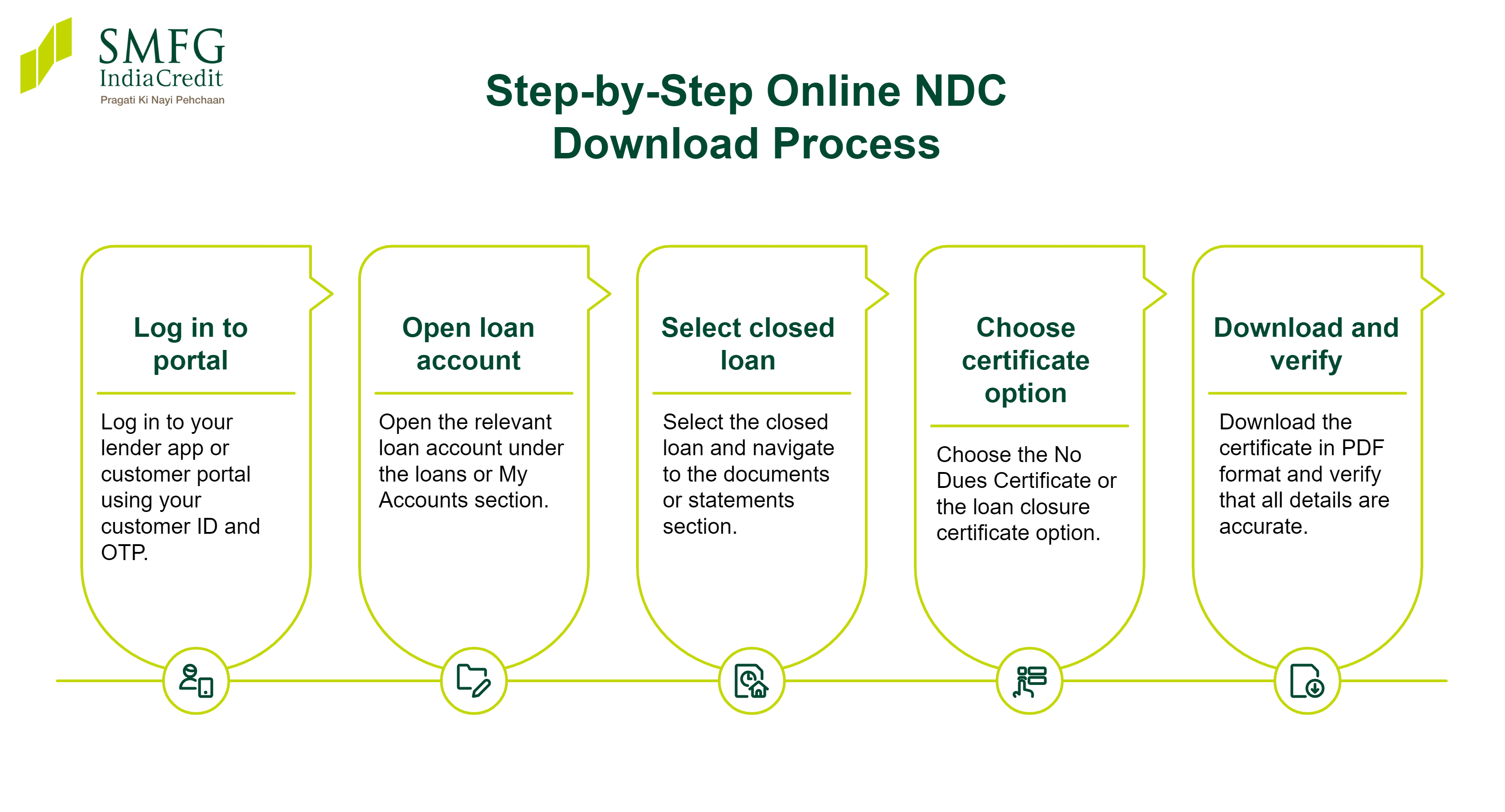
Step-by-Step Online NDC Download Process
- Log in to your lender app or customer portal using your customer ID and OTP, where applicable.
- Open the relevant loan account under the loans or My Accounts section.
- Select the closed loan and navigate to the documents or statements section.
- Choose the No Dues Certificate or the loan closure certificate option.
- Download the No Dues Certificate or the loan closure certificate in PDF format and verify that all the details are accurate before saving it.
How to Get a No Dues Certificate Offline
If you are unable to obtain your certificate online, you can get a No Dues Certificate offline by visiting the relevant lender branch after your loan has been closed. Many lenders accept a lender No Dues Certificate request in person and issue the certificate after verifying the repayment status of your loan. The exact procedure may vary between lenders, but it generally involves the following steps:
- Visit the branch where your loan is serviced or any branch authorised by the lender.
- Request and complete the required application form, if applicable.
- Submit the request along with valid ID proof and your loan account number or other relevant loan details.
- If required, meet the branch manager or the designated loan officer for further assistance.
- The lender will complete the necessary verification to confirm that all dues have been cleared and the loan account has been closed.
- Once the verification is complete, collect your loan NDC offline from the branch or enquire whether it can also be shared through email or made available on the customer portal.
Before leaving the branch, review the No Dues Certificate carefully to ensure that all details, including your name, loan account number, and loan closure status, are accurate.
Documents Required to Get a No Dues Certificate
The documents required for a No Dues Certificate may vary depending on the lender and the type of loan. For online requests, you may only need access to your loan account through the customer portal or mobile app. For branch visits, however, you may be asked to submit certain NDC documents to help the lender verify your identity and loan closure. Common loan closure documents include:
- Loan account number
- Valid identity proof
- Registered mobile number linked to the loan account
- Latest EMI receipt, where applicable
- Foreclosure receipt, if the loan was prepaid
- Repayment statement or other proof of loan repayment, if requested
- A written application letter requesting the issuance of a No Dues Certificate
Some lenders may ask for additional documents based on their internal verification process. It is advisable to confirm the exact documentation requirements with your lender before submitting the request.
Sample Application for a No Dues Certificate
If your lender requires a written request, you can submit a No Dues Certificate application after your loan has been fully repaid.
A simple No Dues Certificate request letter should clearly mention your loan details and request the issuance of the certificate. The exact format may vary between lenders, but the following sample can be used as a reference for a loan NDC application.
To
The Branch Manager
[Name of the Lender]
[Branch Address]
Subject: Request for Issuance of No Dues Certificate
Dear Sir/Madam,
I, [Borrower Name], have successfully completed the repayment of my loan bearing Loan Account Number [XXXXXXXXXX]. The loan was closed on [Loan Closure Date], and I request you to kindly issue a No Dues Certificate confirming that no outstanding amount remains payable on the loan account.
I would appreciate it if the certificate could be shared with me through my registered email ID or made available for collection as a physical copy. For any clarification, you may contact me on my registered mobile number [XXXXXXXXXX].
Thank you for your assistance.
Yours faithfully,
[Borrower Name]
Date: __________
Place: __________
Processing Time for a No Dues Certificate
The No Dues Certificate processing time varies depending on the lender, the loan type, and the completion of lender verification. In many cases, the loan closure certificate time is shorter for service requests submitted through a customer portal. Offline requests made at a branch may take a few working days, particularly if additional verification is required before the certificate is issued.
Charges for a No Dues Certificate
Many lenders issue an NDC without any No Dues Certificate charges once the loan has been successfully closed.
However, NDC charges, a loan closure certificate fee, or other service charges may apply for a duplicate certificate, a physical copy, or certain branch-based requests, depending on the lender's policy. Before submitting your request, it is advisable to review the applicable schedule of charges.
What to Check After Receiving a No Dues Certificate
After receiving your NDC, take a few minutes to check the No Dues Certificate details carefully. Reviewing the document can help you verify loan NDC accuracy and avoid complications in future financial or legal transactions. Use the following checklist:
- Correct spelling of the borrower's name
- Accurate loan account number
- Correct closure date
- Confirmation of zero outstanding dues
- Correct loan type
- Authorised signature and lender seal, where applicable
- Confirmation of collateral release or return of original documents, if applicable
If you notice any discrepancy in the No Dues Certificate details, contact your lender promptly and request a corrected certificate.
What to Do If a No Dues Certificate Has Wrong Details
If you notice wrong details in the No Dues Certificate, report the issue without delay. To request an NDC correction or a loan certificate correction:
- Contact the lender's customer care or visit the nearest branch.
- Raise a service request quoting your loan account details.
- Submit the required proof supporting the correction.
- Collect the corrected certificate after the lender completes the verification process.
Does a No Dues Certificate Improve Credit Score?
A credit score is not directly affected simply because the No Dues Certificate is issued. However, successful loan closure and accurate reporting of the account can support a healthy credit report by reflecting a positive repayment history and the correct closed status. If you notice any discrepancy after closure, raise it with the lender or the relevant credit bureau for correction.
No Dues Certificate and Credit Report Update
After repaying your loan, verify that the closed loan is reflected correctly in your credit report. Check whether the lender has completed lender reporting to the credit bureau, and the account shows the appropriate loan closed in the credit report or CIBIL loan closure status. If not, raise a credit report dispute using your No Dues Certificate and other repayment proof to support the correction request.
No Dues Certificate for Secured Loans
Obtaining a No Dues Certificate for secured loans is particularly important because the loan is backed by an asset offered as collateral. Besides confirming that the loan has been repaid, the certificate also supports the completion of post-closure formalities, including:
- NDC for home loan to facilitate the return of original documents.
- NDC for vehicle loan to support the removal of hypothecation, where applicable.
- Release of a mortgage or lien created against the secured asset, in accordance with the lender's process.
Retaining the No Dues Certificate helps ensure that all security-related formalities have been completed after the loan is closed.
No Dues Certificate for Unsecured Loans
A No Dues Certificate for unsecured loans serves as official confirmation that the debt has been repaid in full. Whether you need a personal loan NDC, a business loan No Dues Certificate, or a certificate relating to a consumer durable loan, its primary purpose is to confirm successful loan closure. Since there is no asset pledged as security, the certificate mainly serves as repayment proof and can help resolve any future queries or disputes relating to the closed loan account.
Common Mistakes to Avoid After Loan Closure
Even after successful repayment, certain loan closure mistakes can lead to unnecessary inconvenience later. Avoiding these No Dues Certificate mistakes can help ensure that all post-closure formalities are completed properly. After receiving your NDC after loan closure, remember to:
- Download and Save the No Dues Certificate: Keep both digital and physical copies for future reference.
- Check Your Credit Report: Confirm that the loan is reported as closed.
- Clear Any Outstanding Charges: Verify that no outstanding charges remain payable.
- Collect Original Documents: Retrieve original documents for secured loans, where applicable.
- Remove Vehicle Hypothecation: Complete hypothecation removal and obtain the required NOC for financed vehicles, if applicable.
Conclusion
A No Dues Certificate for a loan is an important document that confirms all repayment obligations have been fulfilled and the loan has been successfully closed. Whether you receive it online or through your lender, keep this loan closure certificate as reliable repayment proof. Every borrower should also verify the certificate details and check that the loan is correctly reflected in the credit report after closure.
If you are planning your next borrowing requirement, SMFG India Credit offers unsecured funds of up to Rs. 10 Lakhs* at competitive personal loan interest rates.
Before applying, use the personal loan eligibility calculator to estimate your borrowing potential.
We also recommend using our personal loan EMI calculator to plan your monthly repayments in advance and make informed financial decisions.