Many business owners and individuals search for the GST meaning in India when they want clarity about the taxes they pay or collect. GST in India changed the way indirect tax works across the country. Instead of dealing with multiple taxes, you now deal with one structured system.
To understand what GST in India is, you need to look at how it applies to goods and services, who must register, and how compliance works. This guide explains the goods and services tax clearly so you can understand your responsibilities.
What Is GST?
The full form of GST is Goods and Services Tax. GST in India replaced several indirect taxes that were previously charged separately by the central and state governments. It applies to most goods and services unless specifically exempted.
The Goods and Services Tax is a single indirect tax applied to the supply of goods and services across India. In simple terms, it is a destination-based tax that you pay at the point of consumption.
The GST definition in India focuses on value addition. Every time value is added in the supply chain, GST is charged. However, businesses can claim credit for the tax already paid. That is how the system avoids double taxation.
History & Background of GST in India
To understand the history of GST in India properly, you need to look at what existed earlier. Before the Goods and Services Tax, the indirect tax system in India included VAT, service tax, excise duty, central sales tax, and several state-level levies. This created duplication and confusion.
The history of GST began when the concept was first proposed in 2000. After years of discussion between the Centre and states, the Constitution (101st Amendment) Act was passed in 2016. GST in India was officially implemented on 1 July 2017.
The answer to why GST was introduced lies in its objectives. The aim was to replace multiple indirect taxes with one unified tax system, improve transparency, reduce the cascading effect of taxes, and simplify compliance through a technology-driven, online framework.
Today, GST in India is governed by the gst council, which decides rates, exemptions, and policy changes.
Key Features and Objective of GST
The Goods and Services Tax was built to fix long-standing gaps in India’s indirect tax system by bringing multiple taxes under one framework and making tax collection simpler, fairer, and more transparent for everyone involved.
Key Features of GST
- GST follows a single indirect tax system across India, replacing multiple central and state taxes and creating a unified national market.
- It is a destination-based tax, which means the tax revenue is collected by the state where the goods or services are finally consumed.
- The GST input tax credit mechanism allows businesses to claim credit for taxes already paid, helping eliminate the cascading effect of taxation.
- GST enables online registration, return filing, and tax payments, which improves compliance and reduces paperwork for businesses.
- It applies a more uniform tax structure to goods and services, bringing consistency and clarity to tax rates across sectors.
Objective of GST
The main objective of GST was to simplify the indirect tax system in India. Another purpose is to remove the cascading effect of tax. You should not pay tax on tax. The system allows credit so that tax is charged only on value addition.
GST also aims to improve compliance and widen the tax base. By bringing businesses into a formal, technology-driven system, the government sought to build a more transparent and efficient tax administration framework.
Types of GST in India
When you want to understand the GST meaning, you also need to know its types. GST in India is divided into four main categories:
- CGST (Central GST): Central GST is collected by the central government on transactions that occur within the same state.
- SGST (State GST): State GST is collected by the respective state government on intra-state transactions.
- UTGST (Union Territory GST): Union Territory GST is applicable to transactions in Union Territories that do not have their own legislatures.
- IGST (Integrated GST): Integrated GST is charged on inter-state transactions as well as on the import of goods and services.
For example, if you sell within your state, CGST and SGST apply. If you sell to another state, IGST applies. This GST tax structure ensures revenue sharing between the Centre and the states. It is important to understand CGST vs SGST vs IGST for accurate tax calculation and compliance.
GST Rates in India
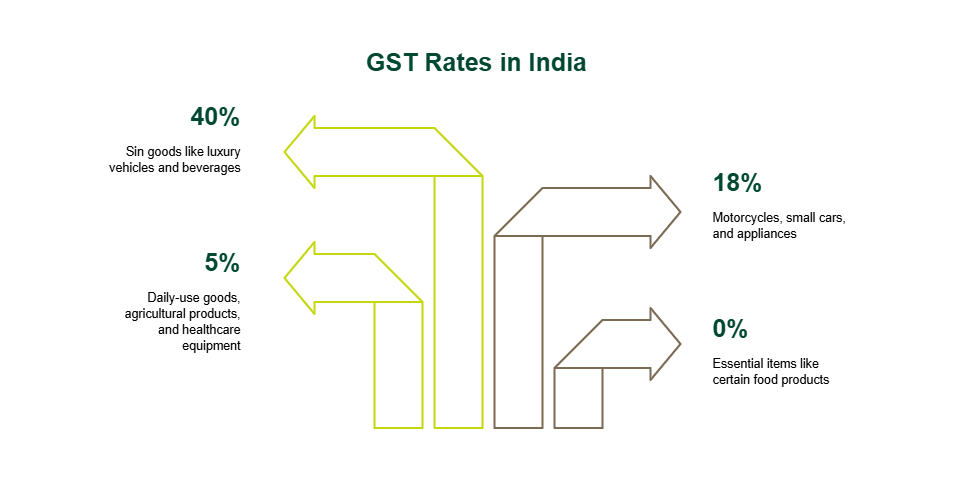
GST in India follows multiple tax slabs. The applicable rate depends on the category of goods or services.
The main GST rate slabs in India are:
- 0%: Essential items such as certain food products
- 5%: Daily-use goods, agricultural products, and healthcare equipment
- 18%: Motorcycles, small cars, appliances
- 40%: Sin goods like luxury vehicles, aerated and caffeinated beverages
The GST Council reviews these rates periodically. Rates may change based on policy decisions, so you should always check the latest notifications before applying a rate.
Benefits of GST for Businesses & Consumers
If you run a business, GST in India affects you directly.
GST impact on businesses:
- You deal with one structured tax system.
- You can claim input tax credit.
- Interstate trade becomes easier.
- Compliance is handled online.
Benefits of GST for consumers:
- Prices are more transparent.
- The tax structure is uniform across states.
GST in India aimed to create a common national market. While compliance requires discipline, the system is clearer compared to the earlier multi-tax structure.
Input Tax Credit Under GST
Input Tax Credit (ITC) is a key part of GST in India. It allows you to reduce your tax liability.
If you pay GST on purchases for your business, you can claim that amount as a credit against the GST you collect on sales. This prevents tax cascading.
To claim ITC under GST for a small business:
- You must be registered under GST.
- You must have a valid tax invoice.
- The supplier must have filed their return.
- You must file your return on time.
If conditions are not met, you cannot claim GST Input Tax Credit. So proper compliance is crucial.
GST vs. VAT, Service Tax
Before GST in India, businesses dealt with VAT, service tax, excise duty, and other state taxes. Each had separate rules and filings.
Under the old system:
- Multiple registrations were required.
- Tax credit was not always seamless.
- Interstate trade involved a central sales tax.
Under GST Network:
- There is one unified system.
- Credit flows more smoothly.
- Returns are filed online through a central portal.
This shift reduced duplication, though compliance remains structured and time-bound.
Who Must Register for GST?
You must register under the GST Council if your aggregate turnover exceeds the prescribed threshold.
As of the current rules, the Goods and Services Tax thresholds are as follows:
- ₹40 lakh for goods (in most states)
- ₹20 lakh for services (in most states)
- Lower GST registration eligibility thresholds apply in special category states like Meghalaya, Mizoram, and Tripura
You must also register if:
- You supply goods interstate
- You sell through e-commerce platforms
- You are required to deduct or collect tax at source
If you are unsure about who needs GST registration, check the latest notifications because thresholds may change.
How to Register for GST
Here is how to apply for GST, step-by-step:
- Visit the official GST portal.
- Click on ‘Register’ on the home page and select ‘New Registration’.
- Fill in basic details and generate a Temporary Reference Number (TRN).
- Log in using the TRN and complete Part B of the application form by providing detailed business information.
- Upload required documents.
- Submit using OTP verification or a digital signature.
After verification, you receive a GSTIN (GST Identification Number).
Documents Required for GST Registration Process
You will typically need:
- PAN card of the business or applicant
- Aadhaar card
- Business address proof
- Bank account details
- Photograph of the applicant
- Incorporation certificate (for companies or LLPs)
Additional GST application documents may be required depending on the type of entity or the nature of the business.
GST Compliance & Return Filing
Once registered, you must follow GST compliance requirements. You are required to:
- Issue proper tax invoices that contain all mandatory details such as GSTIN, invoice number, tax breakup, and place of supply.
- File periodic GST returns, including GSTR-1 for reporting outward supplies and GSTR-3B for summarising tax liability and input tax credit.
- Pay the applicable GST amount within the prescribed due dates to avoid interest and late fees.
- Maintain accurate and updated records of sales, purchases, input tax credit, and tax payments as required under the GST Council law.
Late filing on the GST portal attracts interest and penalties. So you should maintain a calendar and track deadlines carefully.
Common GST Mistakes to Avoid
You can avoid unnecessary issues by paying attention to common errors:
- Applying the wrong GST rate to goods or services can lead to underpayment or overpayment of tax and may attract notices from tax authorities.
- Missing GST bill deadlines can result in late fees, interest charges, and disruptions in your compliance record.
- Claiming incorrect input tax credit without proper documentation can cause mismatches and may lead to the reversal of credit, along with penalties.
- Failing to reconcile purchase data with filed returns can create discrepancies that trigger compliance issues later.
- Using an incorrect GSTIN on invoices or returns can delay filings, create confusion in records, and affect input tax credit claims.
Small mistakes can lead to notices, so review your filings before submission.
Conclusion: Understanding GST for Better Compliance
When you understand what the GST Network is in India, compliance becomes easier. GST in India is designed to create a more uniform indirect tax system, reduce the cascading effect of tax, and improve transparency in tax administration.
If you run a business, it is important to stay updated with the GST overview, latest rates, return deadlines, and eligibility rules. Regulations may change, and the GST Council periodically reviews and revises policies.
If you require financial support while managing GST-related obligations along with routine operational expenses, you may consider an business loan from SMFG India Credit. With straightforward eligibility criteria and competitive business loan interest rates, we aim to make your borrowing journey seamless.
Apply online for funds of up to Rs. 1 crore* with minimal business loan documentation. You can also use our business loan EMI calculator and eligibility calculator to plan your finances effectively before submitting your application.