The latest GST rates in India in 2026 reflect the government’s ongoing push towards simplification under GST 2.0. The introduction of updated GST tax slabs and a more streamlined structure aims to reduce compliance pressure while improving transparency. As discussions around new GST rates continue, both consumers and businesses are expected to see clearer tax treatment across essential goods and services. This updated system is designed to promote efficiency and support smoother transactions under the Goods and Services Tax framework.
What Are GST Rates in India?
GST rates in India refer to the tax percentages applied to goods and services under the country’s indirect tax system. These rates are grouped into different GST tax slabs, forming the core of the GST structure in India.
The purpose of these new GST slabs is to create a uniform and transparent system that replaces multiple earlier taxes and ensures consistent treatment across states. Periodically, the GST Council can review these slabs and introduce new GST rates in India to address revenue needs, economic conditions, and sector-specific concerns. As part of ongoing GST reforms, the government aims to simplify compliance, reduce disputes, and make taxation easier for both businesses and consumers. Overall, GST rates help determine how products and services are taxed while maintaining a streamlined nationwide framework.
GST Structure in India: Before vs After GST 2.0
|
Category
|
Earlier GST Slabs
|
New Slabs under GST 2.0
|
|
Nil-rated or Essential Goods
|
0%
|
0%
|
|
Mass Consumption Goods
|
5%
|
5%
|
|
Standard Rate
|
12% & 18%
|
18%
|
|
Luxury / Sin Goods
|
28%
|
40%
|
The introduction of GST 2.0 in September 2025 has led to significant GST rationalisation, replacing the earlier five-tier system with a simpler structure. These GST 2.0 reforms aim to improve efficiency, reduce classification disputes, and provide a clearer updated GST rate list for businesses.
With the GST rate changes of September 2025, the earlier 12% category was merged into a broader 18% slab, and luxury items were shifted to a higher 40% band. Overall, the new GST rates and structures offer a more streamlined set of GST slab rates in India, supporting better compliance and transparency.
Updated GST Tax Slabs in India 2026
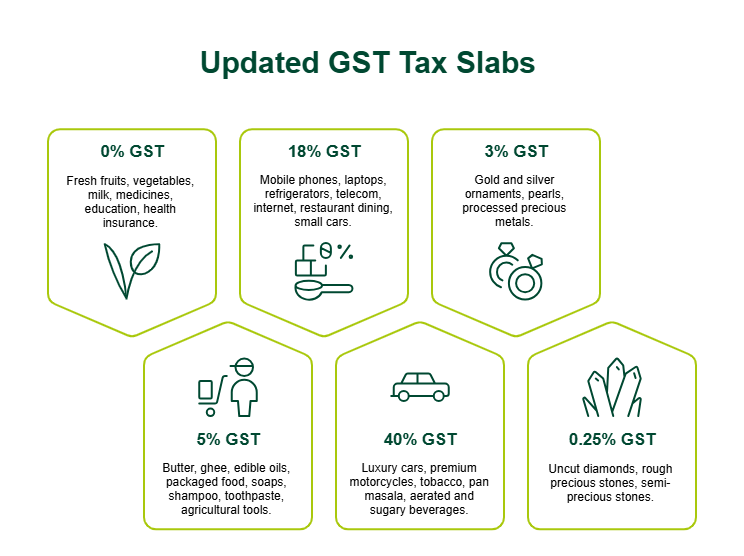
The latest GST rates in 2026 follow the revised slab structure introduced through ongoing GST reforms. The new GST rate list is designed to simplify compliance, reduce disputes, and create a more predictable framework for taxpayers. Going forward, the GST Council may continue to adjust rates depending on economic conditions and revenue needs. Under the updated structure, goods and services fall into zero-rated, concessional, standard-rate, and higher-rate categories, with Compensation Cess applied to select goods where required.
0% GST Rate (Exempted Goods & Services)
The 0% GST rate applies to essential goods and services that form part of the GST exemption list. These GST-exempt items are kept outside the tax structure to reduce the burden on households and ensure access to basic needs. Many zero-GST goods fall under food, healthcare, and education, as they are considered vital for daily living. Common examples include:
- Fresh fruits and vegetables
- Milk, bread, and other unprocessed food items
- Life-saving medicines and medical supplies
- Educational services
- Health insurance for specific categories
By keeping these categories under the exempt/0% GST rate, the GST Council aims to support affordability and promote widespread access to essential services.
5% GST Rate (Lower/Merit Slab)
The 5% GST rate applies to goods considered essential for daily use. This lower or merit category helps keep prices reasonable for households, farmers, and small businesses. Many products under this slab are basic necessities or items that support essential sectors such as agriculture, food supply, and healthcare. Common examples of 5% GST slab items include:
- Butter, ghee, and edible oils
- Packaged foods
- Soaps, shampoo, and toothpaste
- Packaged cereals and flours
- Basic agricultural equipment, including solar units
By keeping these under the GST rates on essentials, the system ensures affordability while supporting key economic activities.
18% GST Rate (Standard Slab)
The 18% GST rate is the standard slab applied to a wide range of commonly used products and services. Most 18% GST slab goods and services fall under consumer electronics, household appliances, and everyday service sectors. This slab forms a major part of India’s GST system and covers items that are neither essential nor luxury in nature. Typical 18% GST items include:
- Mobile phones and laptops
- Refrigerators and other home appliances
- Telecom and internet services
- Restaurant services (non-AC or general dining)
- Small passenger cars
- Watches and clocks
By placing these categories under the standard slab, the new GST rates and structures ensure balanced taxation across mid-range goods and services.
40% GST Rate (Luxury & Sin Goods)
The 40% GST rate applies to luxury and sin goods that fall under the highest GST slab in India. This category is designed to discourage consumption of products considered non-essential or potentially harmful, while also generating additional revenue for the government. Common 40% GST items include:
- Luxury cars and premium bikes
- Tobacco and related products
- Pan masala and similar items
- Aerated and sugary drinks
By applying a higher rate to these goods, the new GST rate structure supports responsible consumption and strengthens revenue collection.
Key GST Rate Changes in 2025–2026
Several important GST rate changes in 2025 were introduced to simplify classifications and align taxes with current industry needs. These revisions form part of the new GST rate list, affecting a mix of essential, industrial, and consumer products. Some of the notable updates include:
- Railway parts and components shifted to clearer classifications to improve consistency for manufacturers and contractors.
- Renewable energy equipment, including solar devices, received adjustments to support growth in clean energy.
- Namkeens and savoury snacks were rationalised to remove classification disputes.
- Dishwashers and select home appliances saw updates to reflect their growing consumer demand.
- Aerated drinks moved into a higher category due to health considerations and revenue needs.
Why GST Slabs Were Rationalised
The rationalisation of rate slabs under GST 2.0 was introduced to create a clearer, more predictable tax framework for businesses and consumers. One of the key goals of this GST simplification effort was to reduce confusion caused by overlapping categories and frequent classification disputes. By merging slabs and revising rates, the system now supports easier compliance and lowers administrative burden for taxpayers.
These adjustments are also part of broader GST reforms aimed at improving revenue stability while keeping inflation in check. The GST Council reviewed sectors where minor rate differences created unnecessary complexity and streamlined them into broader, more practical categories. Overall, the rationalised slabs help enhance transparency, reduce litigation, and make the GST system more efficient for the long term.
Impact of New GST Rates on Consumers
The impact of new GST rates on consumers can be seen in everyday spending, especially for households managing rising living costs. With rationalised slabs, several daily-use items may see stable or lower prices, offering some relief from inflation. Certain revisions in GST rates on electronics also influence how families budget for devices such as phones and appliances. Changes in GST rates on automobiles affect major purchase decisions, particularly for entry-level vehicles. At the same time, clearer rules around GST rates on healthcare help consumers better understand medical expenses.
Key effects include:
- Lower prices on select daily-use items due to rationalised rates
- More predictable pricing for electronics such as smartphones and appliances
- Stable costs for small and mid-range automobiles based on revised slabs
- Improved clarity on healthcare services falling under lower tax categories
- Reduced disputes and smoother billing for consumers in retail and service sectors
Impact of GST Rates on Businesses & MSMEs
The GST reform impact on businesses can be visible across compliance, pricing, and day-to-day operations, especially for MSMEs. With a more streamlined structure, companies now spend less time managing rate classifications and can focus more on core activities. The rationalised slabs also influence how businesses plan their pricing strategy, as clearer tax treatment helps them calculate costs and adjust margins more accurately. For MSMEs, predictable GST rules can reduce uncertainty and support smoother cash-flow planning. Key effects include:
- Lower compliance burden due to simplified slab structures
- Improved accuracy in pricing and quotation processes
- Better visibility of input tax credits and margin planning
- Reduced disputes arising from ambiguous classifications
- More stability in procurement and vendor negotiations
GST Rates for Common Goods & Services
To help you understand how different products and services fall under various GST categories, here is a handy table covering commonly used items and their applicable rates:
|
GST Percentage
|
Category Type
|
Examples of Goods & Services
|
|
0% (Nil)
|
Essential exempt items
|
Fresh fruits and vegetables, milk, life-saving medicines, educational services, health insurance
|
|
5%
|
Lower / merit-rated items
|
Butter, ghee, edible oils, packaged food items, soaps, shampoo, toothpaste, basic agricultural tools
|
|
18%
|
Standard-rated items
|
Mobile phones, laptops, refrigerators, telecom services, internet services, restaurant dining, small cars
|
|
40%
|
Luxury or sin-category items
|
Luxury cars, premium motorcycles, tobacco products, pan masala, aerated and sugary beverages
|
|
3%
|
Niche rates – precious metals, jewellery, and gemstones
|
Gold and silver ornaments, pearls, processed precious metals
|
|
0.25%
|
Niche rates – diamonds, precious stones
|
Uncut diamonds, rough precious stones, semi-precious stones
|
How to Check GST Rate for Any Product
Understanding how to check the GST rate for any product is easier when you know the right tools to use. Most goods are classified through HSN & SAC codes, which help identify the correct tax category. Whether you want to verify GST on cars and bikes or confirm the applicable GST on luxury goods, the process remains the same across categories.
Follow these steps:
- Visit the official GST portal and access the search HSN code section.
- Enter the product name or its HSN or SAC code in the search bar.
- Review the GST rate, category, and any linked details shown on the screen.
- For complete accuracy, check for the latest GST rate notifications available on the portal.
Conclusion
The new GST rates introduced for 2026 and beyond create a clearer and more streamlined tax structure under GST 2.0. With simplified slabs and improved categorisation, both consumers and businesses benefit from greater transparency and easier compliance. Ongoing reviews by the GST Council ensure that the system stays aligned with changing economic needs while reducing classification disputes.
As households adjust to the updated framework, thoughtful financial planning becomes even more important. If you need support to manage expenses or upcoming requirements, you may consider a personal loan of up to Rs. 10 Lakhs* from SMFG India Credit. Eligible applicants can avail of competitive personal loan interest rates and flexible tenures of up to 60 months. Use our personal loan EMI calculator and eligibility calculators, check the required documents, and apply online with ease.