The Reserve Bank of India has recently cautioned the public against misleading campaigns that falsely promise loan waiver assistance. This RBI warning on loan waiver scams highlights how fraudsters use fake loan waiver offers to target borrowers, often demanding upfront “service charges” or “legal fees” under the guise of arranging debt relief. Falling victim to a loan waiver offer scam can result in financial loss and expose borrowers to credit profile damage. This article explains the common fake loan waiver claim warning signs and practical steps you can take to protect yourself.
What Did RBI Say About Fake Loan Waiver Offers?
The RBI loan waiver warning cautions borrowers against unauthorised campaigns run by individuals or entities claiming they can arrange the waiver of dues owed to financial institutions and NBFCs. These fake loan waiver claims may involve issuing a bogus debt waiver certificate or demanding upfront service charges and legal charges in exchange for promised debt relief.
Such claims have no basis in the formal banking system and can expose borrowers to financial loss, legal complications, and disruption of their repayment obligations.
Legitimate loan waivers and restructuring are governed by strict regulatory guidelines. They may only be authorised by an RBI-approved financial institution in accordance with the applicable rules. Therefore, borrowers should rely only on official communication from their lenders or authorised institutions regarding any loan relief or restructuring measures.
What Is a Loan Waiver Scam?
The loan waiver scam meaning refers to a fraudulent scheme in which a scammer falsely claims that a borrower can have their loan written off without following the lender's official procedures.
In this form of a fake debt relief scam, victims are promised relief from their outstanding dues in exchange for an upfront fee.
In reality, genuine loan waivers or restructuring are subject to regulatory requirements and can only be approved through authorised processes. Falling for such upfront fee loan scams can result in financial losses, legal complications, and continued liability for the original loan.
How Do Fake Loan Waiver Scams Work?
Understanding how the loan waiver scam works can help borrowers recognise warning signs before they suffer financial losses. A typical fake loan waiver process usually follows a similar pattern designed to create urgency and convince borrowers to pay money. Common tactics for credit products, such as a personal loan, include:
- Promotional messages circulated through WhatsApp or social media.
- Contact from fake agents claiming they can arrange a loan waiver quickly.
- False assurances that outstanding loans can be written off without following the lender's official process.
- Issuing a fake certificate as proof that the waiver has been approved.
- Demanding an upfront fee as a processing, legal, or administrative charge.
- Using pressure tactics to persuade borrowers to act immediately.
This form of debt waiver fraud often leaves borrowers out of pocket while their loan obligations remain unchanged, and may also expose borrower data to misuse.
5 Ways Borrowers Can Protect Themselves from Loan Waiver Scams
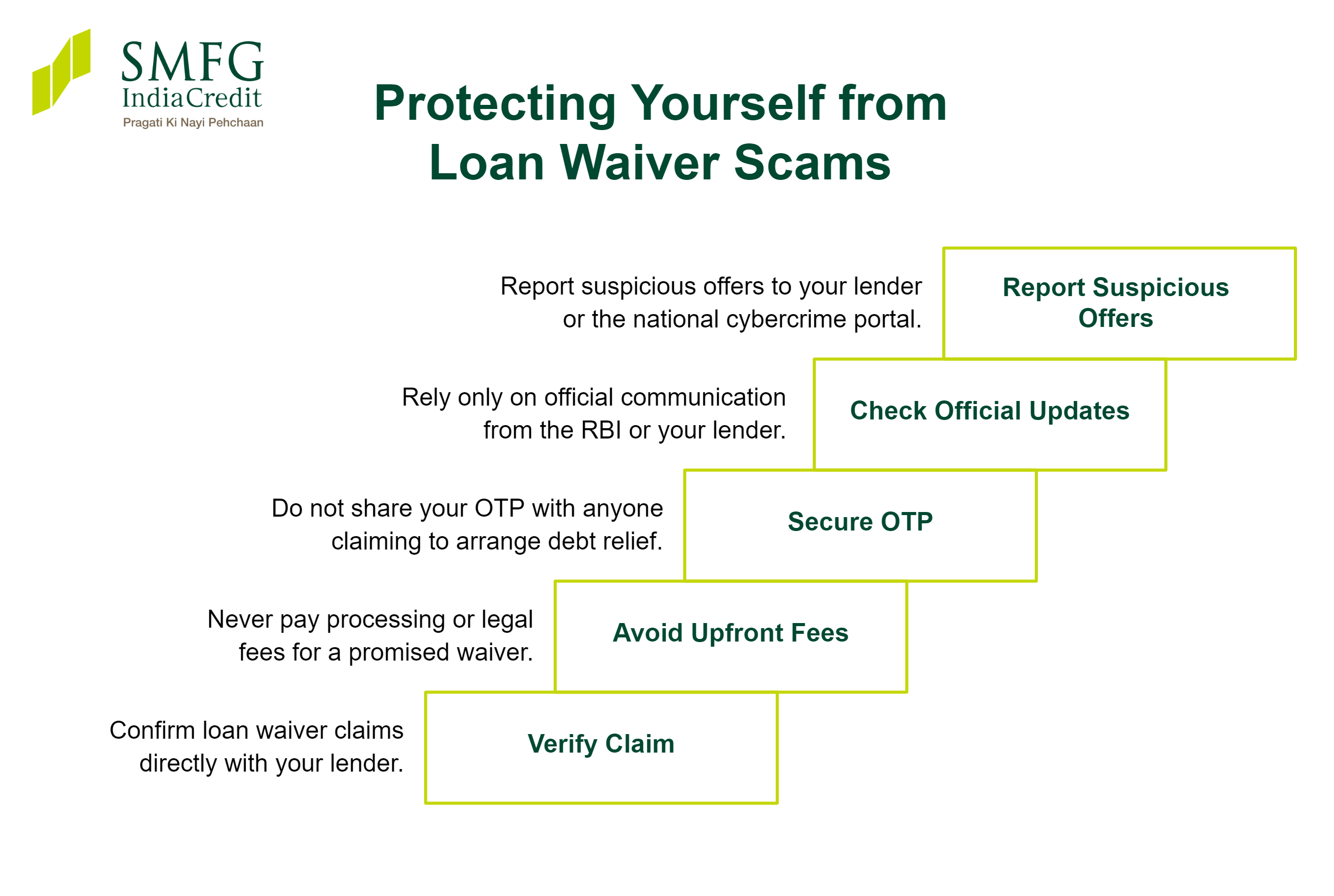
Knowing how to protect from loan waiver scam attempts starts with following a few basic precautions. These loan scam protection tips can help reduce the risk of financial fraud and improve awareness.
- Verify any loan waiver claim directly with your lender.
- Never pay an upfront processing or legal fee for a promised loan waiver.
- Do not share your OTP with anyone claiming to arrange debt relief.
- Check updates only through official communication from the RBI or your lender.
- Report suspicious offers to your lender branch, customer care, or the national cybercrime portal.
Staying alert, following borrower safety tips, and relying only on authorised channels can help you avoid fraudulent loan waiver schemes.
1. Verify Loan Waiver Claims Directly with Your Lender or NBFC
Always verify loan waiver claims through your lender's official channels before taking any action. Genuine loan restructuring, settlement, or waiver requests follow established procedures and are communicated only by the lending institution.
Contact your nearest branch, use the official website, mobile app, or customer care to confirm the status of your loan account. If your loan is with an NBFC, complete an waiver check through its authorised channels. Never rely solely on messages or calls claiming to offer loan waiver confirmation.
2. Do Not Pay Upfront Fees for Loan Waiver Certificates
A common debt waiver certificate scam involves a scammer demanding a service fee, legal fee, or certificate charge in exchange for arranging a loan waiver. The RBI has warned that debt waiver certificate fraud often relies on collecting money through an upfront fee loan scam, even though no genuine relief is provided. A borrower should never make such payments, as legitimate loan waivers or restructuring are not approved through unauthorised fee collection.
3. Never Share OTP, Passwords or Sensitive KYC Details
Protecting your personal information is an important part of loan fraud protection. No genuine lender will ask you to share an OTP, password, UPI PIN, or sensitive KYC details such as your Aadhaar, PAN, or bank account information through calls, messages, or social media to process a loan waiver. Sharing these details can expose you to loan scam OTP fraud, or a KYC scam. Always communicate only through your lender's authorised channels if you need assistance.
4. Check Whether the Offer Comes from an Official Source
Always verify that any seemingly official loan waiver notice comes from an authorised source before taking action. Genuine communications are typically issued through an official website, a recognised SMS header, a financial institution app, a branch notice, or formally signed correspondence. Be cautious of a fake lending institution message, a fake letterhead, or offers circulated through WhatsApp forwards and unofficial social media pages. A loan scam on WhatsApp often relies on such unauthorised channels to appear legitimate.
5. Report Suspicious Loan Waiver Offers Immediately
If you suspect fraud, report loan waiver scam attempts without delay. You can raise a loan fraud complaint through your lender's or NBFC's lender grievance mechanism. If the offer involves an unauthorised entity, you may also submit a fraud report through the RBI Sachet Portal, where applicable. Cases involving a cybercrime loan scam should be reported on the National Cyber Crime Portal, while any financial loss should also be reported by filing a police complaint.
Genuine Loan Settlement vs Fake Loan Waiver Scam
Understanding official loan settlement vs loan waiver scam is important because the two are very different. A genuine loan settlement or loan restructuring is initiated or approved by the lender through an official process and may affect your credit report and . In contrast, a fake loan waiver is typically promoted by unauthorised individuals or entities with no authority to offer debt relief. Always rely on official communication and obtain lender approval before acting on any loan-related proposal.
Quick Comparison: Genuine Loan Settlement vs Scam
This loan waiver scam comparison highlights how a genuine loan settlement differs from a fraudulent waiver offer.
|
Parameter
|
Genuine Loan Settlement
|
Fake Loan Waiver Scam
|
|
Source
|
Lender or NBFC through an official channel
|
Unknown agent, social media, or messaging platforms
|
|
Approval
|
Formal approval under the lender's process
|
False promises with no official authorisation
|
|
Fee
|
Charges, if any, as per the lender's documented process
|
Demands an upfront fee or other unofficial payments
|
|
Documentation
|
Official records and written communication
|
Unauthorised or fake documents
|
How Fake Loan Waiver Scams Can Affect Your Credit Score
The loan waiver scam's effect on a credit score can be significant if a borrower stops making EMI payments after believing false promises that a loan has been waived. Unless your lender officially confirms a waiver, restructuring, or settlement, your repayment obligations continue.
Missed EMIs become part of your repayment history and may be reported to a credit bureau as a default, depending on the lender's reporting practices. This EMI default effect on your CIBIL score can lower your creditworthiness and be reflected in your credit report, making it more difficult to obtain future loans or secure favourable borrowing terms.
Understanding the loan scam CIBIL score impact reinforces the importance of relying only on official communication from your lender before stopping or altering loan repayments.
Plan Your Borrowing to Avoid Loan Settlement
One of the best ways to avoid the need for a loan settlement altogether is to borrow within your repayment capacity from the outset.
Before applying, use tools like a personal loan EMI calculator to estimate your monthly instalments and assess whether they fit comfortably within your budget, along with existing expenses. Planning your repayments in advance can help reduce the likelihood of missed EMIs and financial stress later.
It is equally important to compare personal loan interest rates, along with processing fees, late payment penalties, and other applicable costs before choosing a lender. Understanding the total cost of borrowing helps you make informed decisions and reduces the chances of unexpected financial strain during the loan tenure.
Conclusion
The recent RBI loan waiver warning serves as an important reminder to remain vigilant against any loan waiver scam. Follow basic borrower safety tips by verifying all loan-related claims only through your official lender or NBFC, refusing to pay unauthorised fees, and never sharing your OTP or sensitive KYC details. Staying alert and relying on authorised channels is the best way to protect yourself from financial fraud.
If you are looking for a trustworthy, RBI-registered lender, SMFG India Credit offers personal loans of up to Rs. 10 Lakhs* at interest rates starting from 12.5%* per annum. Before applying, review the personal loan documents required to ensure you have everything needed for a smooth application process.
You can also use the personal loan eligibility calculator to assess your borrowing potential beforehand. Apply online or visit your nearest SMFG India Credit branch for assistance.
* Please note that this article is for your knowledge only. Loans are disbursed at the sole discretion of SMFG India Credit. Final approval, loan terms, disbursal process, foreclosure charges and foreclosure process will be subject to SMFG India Credit's policy at the time of loan application. If you wish to know more about our products and services, please contact us