Quick Summary
- PAN jurisdiction refers to the geographical area and the Assessing Officer (AO) assigned by the Income Tax Department to administer your tax affairs.
- Every PAN card is linked to a 10-digit AO code that reflects your income tax ward or circle, based on factors such as your address and taxpayer category.
- To do a PAN jurisdiction check, you can log in to the Income Tax e-Filing Portal and use the "Know Your AO" or "Know Your JAO" feature.
- If you relocate or your tax category changes, you may need to update your PAN jurisdiction by raising a PAN correction request through NSDL or UTIITSL.
- Knowing your PAN card jurisdiction is important for responding to tax notices correctly, filing returns, and resolving refund delays.
PAN card jurisdiction refers to the income tax jurisdiction assigned to every PAN holder by the Income Tax Department for administrative and compliance purposes. Your PAN jurisdiction determines the tax office and Assessing Officer responsible for handling matters such as return processing, notices, and assessments. Knowing how to find PAN card jurisdiction online can help you verify the correct tax records, respond to communications promptly, and complete tax-related formalities with ease. You can also find the Assessing Officer details through the Income Tax e-Filing Portal whenever required.
What Is PAN Jurisdiction?
The PAN jurisdiction meaning pertains to the geographical area and designated income tax office to which your PAN card is mapped. Every PAN-linked jurisdiction is assigned a unique AO Code, a 10-digit identifier that appears in the Income Tax Department's database. This code reflects your Commissioner's Charge, Chief Commissioner Region, Joint Commissioner Range, and the place and designation of your AO.
Your PAN card jurisdiction is determined primarily by two factors: your residential or business address and your taxpayer category (individual, non-individual, Indian resident, or NRI). The Income Tax Department uses income tax jurisdiction to create wards and circles, each managed by a designated officer, to efficiently administer tax services nationwide.
What Is an Assessing Officer (AO)?
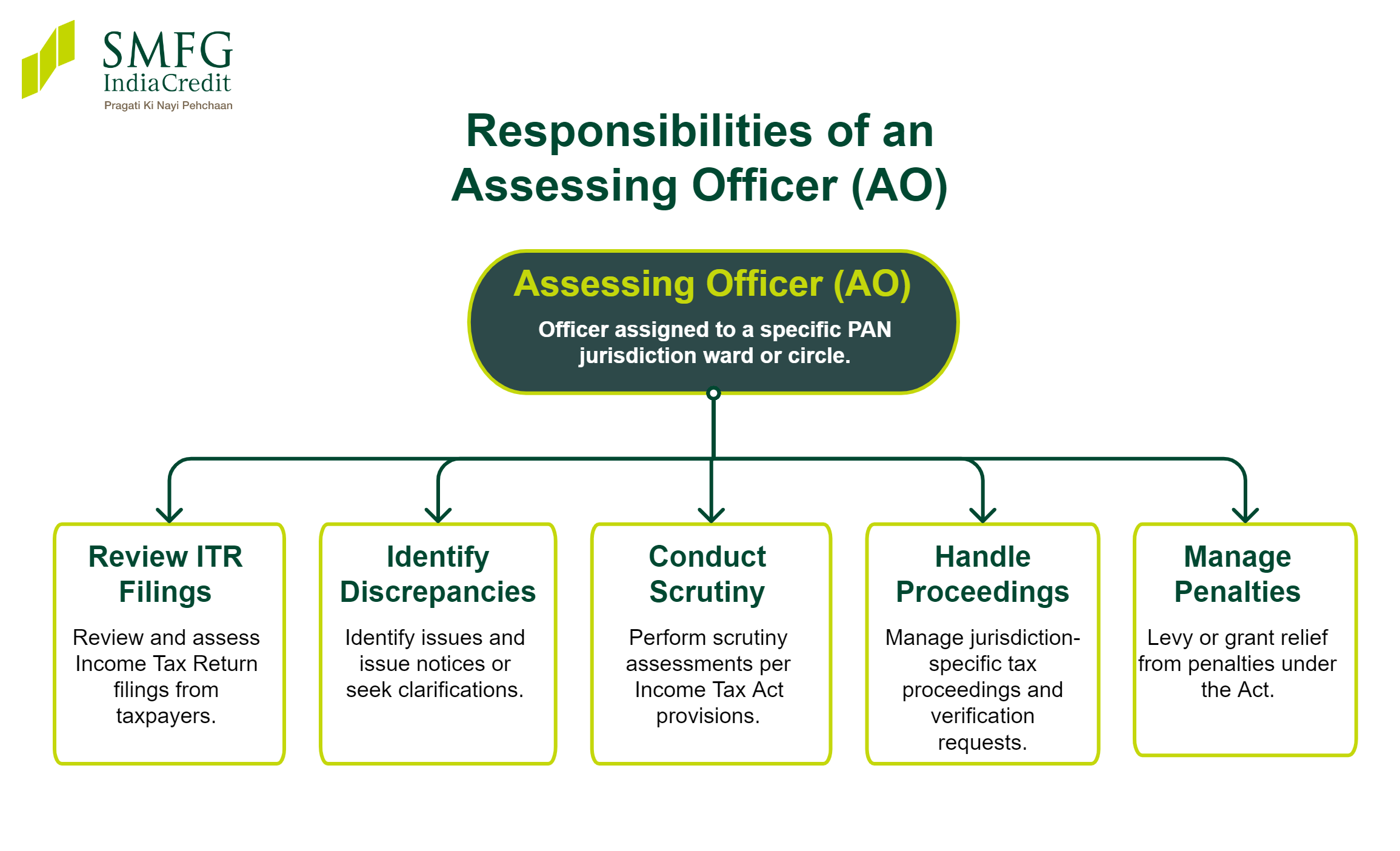
An Assessing Officer (AO) is an officer of the Income Tax Department assigned to a specific ward or circle within your PAN jurisdiction. You can view your income tax officer details through the Income Tax e-Filing Portal based on your assigned jurisdiction.
The responsibilities of an income tax Assessing Officer include:
- Reviewing and assessing Income Tax Return (ITR) filings submitted by taxpayers in their ward
- Identifying discrepancies and issuing notices or seeking clarifications, where required
- Conducting scrutiny assessments in accordance with the provisions of the Income Tax Act
- Handling jurisdiction-specific tax proceedings, verification requests, and other matters relating to taxpayer records, including PAN card verification, where applicable
- Levying or granting relief from penalties, wherever permitted under the Income Tax Act
Why Are PAN Jurisdiction Details Important?
The importance of PAN jurisdiction can be understood through the following points:
- Tax Notices: The Income Tax Department sends notices based on the taxpayer's registered details. Keeping your PAN jurisdiction and contact information up to date helps ensure that communications reach you without unnecessary delays.
- Income Tax Assessments: Your jurisdiction determines the Assessing Officer responsible for handling scrutiny assessments, notices, and other tax-related proceedings, whenever applicable.
- Verification and Rectification: Accurate PAN AO details can help facilitate jurisdiction-specific verification, rectification requests, and the resolution of certain tax-related matters.
- PAN Corrections: When updating your PAN details through Protean (formerly NSDL e-Gov) or UTIITSL, you may also need to verify whether your jurisdiction details require updating.
- Tax Disputes: If you receive a notice or your case is selected for scrutiny, knowing your PAN card Assessing Officer helps you identify the appropriate tax office for further correspondence or assistance.
Further, maintaining accurate tax records and filing your returns on time helps build a reliable financial profile. This can support a smoother application process when you apply for credit products like a personal loan, as lenders often review income and tax documents during their assessment.
Consistent tax compliance also strengthens your financial documentation and credibility. Along with other lending criteria, this may support personal loan eligibility and make it easier to demonstrate your financial stability during the loan application process.
How to Find PAN Card Jurisdiction Online
The easiest way to check PAN jurisdiction online is through the official Income Tax Portal. Here is the step-by-step process.
Step 1: Visit the Income Tax e-Filing Portal
On the homepage, look for "Know Your JAO" under the "Quick Links" section. You can access this Income Tax Portal PAN jurisdiction tool without logging in.
Step 2: Enter PAN Details
Enter your PAN card number and your registered mobile number in the fields provided. Click "Continue." The system will send an OTP to your registered mobile number for verification.
Step 3: Verify and View Jurisdiction Details
Enter the OTP received on your mobile and click "Validate." The portal will display your PAN jurisdiction details, including:
- Area Code, AO Type, Range Code, and AO Number
- The address and contact details of the jurisdictional office
- The email ID of the PAN card Assessing Officer's office, where available
To check PAN jurisdiction online, this is the fastest method available to any taxpayer.
How to Find Assessing Officer Details Online
If you want to do an AO code lookup specifically, follow the same process above. Alternatively:
- Log in to the Income Tax Portal with your PAN and password.
- Go to "Profile Settings" and select "My Profile".
- Click on "Jurisdiction Details".
- View your assigned jurisdiction, Assessing Officer AO code, and other relevant information available on the portal.
Who Is an Assessing Officer?
An Assessing Officer is a designated official of the Income Tax Department responsible for administering tax matters within a defined ward or circle. The AO handles PAN jurisdiction-specific matters such as assessments, scrutiny proceedings, notices, and other tax-related actions assigned under the Income Tax Act.
How Is an AO Assigned?
The Income Tax Department assigns an AO primarily based on factors such as your residential or business address, taxpayer category (for example, an individual, company, resident, or non-resident), and administrative jurisdiction. Taxpayers are assigned to different wards or circles, as determined by the department's administrative framework.
This Assessing Officer AO code assignment is generally made when your PAN is issued and may be updated later if your jurisdiction changes due to relocation, a change in taxpayer category, or administrative reorganisation.
How to Change PAN Jurisdiction Online
Reasons for Updating PAN Jurisdiction
You may need to change the PAN jurisdiction online in the following situations:
- You have relocated to a different city or state
- Your PAN card jurisdiction was incorrectly mapped when the PAN was issued
- Your taxpayer category has changed (for example, from individual to business)
- You have switched from resident to NRI status or vice versa
Steps to Request Jurisdiction Change
A PAN correction request for jurisdiction change can be submitted through the following steps:
- Visit the Protean or UTIITSL website.
- Look for “Change / Correction in PAN Data” or a similar option.
- Enter the required personal details and update your address or other relevant information.
- Submit the necessary supporting documents and pay the applicable fee, if any.
Alternatively, you can write directly to your current jurisdictional AO requesting a transfer of jurisdiction, particularly when moving across cities.
Benefits of Knowing Your PAN Jurisdiction
- You can respond to tax notices accurately and on time by knowing which jurisdictional office issued them.
- Knowing your Assessing Officer code for PAN card helps you identify the correct jurisdictional officer for assessments, scrutiny proceedings, and other tax-related matters.
- You can contact the appropriate income tax office for jurisdiction-specific queries, assessments, or verification requirements, wherever applicable.
- Keeping your PAN card jurisdiction updated helps prevent compliance issues arising from outdated taxpayer records and ensures your details remain aligned with the Income Tax Department's records.
- Keeping your tax records accurate and up to date supports a stronger financial profile. Well-maintained tax and financial documentation can strengthen your loan application and may help you secure favourable terms, such as a lower personal loan interest rate, subject to overall eligibility.
Conclusion
Your PAN jurisdiction is more than just an administrative detail. It determines the Assessing Officer responsible for jurisdiction-specific tax matters such as assessments, scrutiny proceedings, notices, and certain verification requests. Completing a PAN jurisdiction check takes only a few minutes and can save you significant time and inconvenience later.
If your address or taxpayer details have changed, submit a PAN correction request, where applicable, and ensure that your jurisdiction records are updated through the appropriate channels.
As you manage your tax obligations, routine expenses, and long-term financial goals, additional financial support may sometimes be required for planned or unforeseen expenses. In such cases, SMFG India Credit offers personal loans of up to Rs. 10 Lakhs* at competitive interest rates starting from 12.5%* per annum. Use our personal loan EMI calculator to estimate your monthly repayments and apply online with ease.
You can also use the personal loan eligibility calculator to estimate your borrowing capacity and make informed financial decisions before applying.