Risk appetite in NBFCs (Non-Banking Financial Companies) defines how much risk an institution is willing to take to achieve its financial and strategic goals. Risk appetite helps set the line between ambition and caution, ensuring steady growth without compromising financial stability.
This comprehensive guide explains the risk appetite meaning, distinguishes it from risk tolerance and risk capacity, and outlines how to develop and implement an effective risk appetite framework.
Must Read: Understanding NBFC & Types of NBFC
What Is Risk Appetite?
The meaning of risk appetite is the level of uncertainty an NBFC is prepared to accept in pursuit of its objectives. It differs from risk tolerance (the day-to-day variation allowed) and risk capacity (the maximum limit based on capital adequacy).
For example, an NBFC with strong capital and efficient credit risk management may adopt a higher risk appetite compared to one with tight liquidity. Together, these elements define an overall enterprise risk management in NBFCs.
Understanding Risk Appetite with an Example
To clarify this concept, let’s look at a risk appetite example: Suppose an NBFC decides to expand its digital lending operations. It accepts a credit risk of up to 5% in defaults as part of its risk appetite. The risk tolerance allows ±1% deviation, but exceeding 6% triggers review. Meanwhile, the risk capacity vs risk tolerance balance ensures that the firm’s capital adequacy and reserves can withstand losses up to 8%. This simple risk appetite framework helps the NBFC grow responsibly without compromising stability.
Risk Appetite vs Risk Tolerance
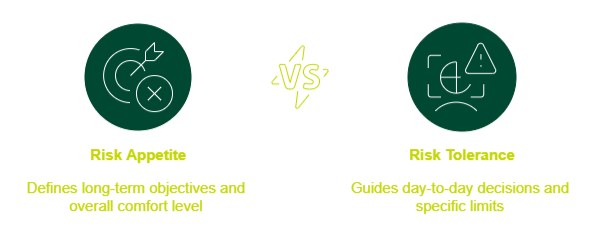
Risk appetite represents the overall comfort level of risk an NBFC is willing to take to achieve its long-term objectives, whereas risk tolerance refers to the specific degree of fluctuation allowed within those defined limits.
In practice, liquidity management in NBFCs plays a vital role in shaping both risk appetite and tolerance. For instance, an NBFC with strong liquidity buffers may adopt a higher risk appetite by expanding its unsecured loan portfolio, while one focused on stability might prefer a conservative approach with more secured loans.
Essentially, risk appetite is strategic – it defines the big picture and long-term direction – while risk tolerance is operational, guiding day-to-day decisions and responses to changing market conditions.
Must Read: Different Types of Unsecured Loans
Key Risks Faced by NBFCs
Credit Risk
The possibility of loss arising when borrowers default or fail to meet their repayment obligations on time.
Liquidity Risk
The risk arising from cash flow mismatches that form an obstacle in meeting short-term financial commitments or disbursements.
Market Risk
Exposure to losses due to adverse changes in interest rates, market prices, or currency movements.
Operational Risk
The possibility of system failures, human errors, or external events that disrupt business.
Compliance & Regulatory Risk
The threat of penalties or restrictions arising from non-adherence to RBI regulations, statutory norms, or legal requirements.
Reputational Risk
The potential damage to public image or stakeholder confidence due to negative publicity, service failures, or loss of customer trust.
Factors Influencing Risk Appetite in NBFCs
Business Objectives and Strategy
Aggressive growth goals increase risk appetite; conservative plans lower it.
Capital Adequacy and Financial Strength
Stronger capital supports higher market risk assessment and lending flexibility.
Market Environment and Economic Conditions
Volatility and inflation may force a cautious approach, limiting digital lending expansion. A proactive approach to cybersecurity is also essential, as digital expansion comes with data-related risks that can directly influence overall risk appetite.
Governance Structure and Leadership Vision
Boards that prioritise transparency ensure balanced credit risk decisions.
Regulatory Requirements
Strict Reserve Bank of India (RBI) guidelines for NBFCs cap exposure and dictate capital buffers.
Developing a Risk Appetite Framework
A clear risk appetite framework helps NBFCs manage exposure while supporting growth.
Components of a Risk Appetite Framework
Risk Appetite Statement (RAS)
The Risk Appetite Statement (RAS) defines clear objectives and outlines how much risk the organisation is willing to take.
Risk Limits and Thresholds
Measurable limits across areas such as credit risk, market risk, and liquidity management help ensure exposures remain within acceptable boundaries.
Monitoring and Reporting Mechanisms
Dashboards and scenario analyses are used to monitor risks, detect breaches, and adjust limits as necessary.
Steps to Define Risk Appetite for NBFCs
Engage stakeholders, draft the RAS, gain board approval and review it regularly.
Aligning Risk Appetite with Business Strategy
Ensure the risk appetite framework supports sustainable growth without compromising capital adequacy.
Risk Appetite Statement (RAS) for NBFCs
Risk Appetite Statement (RAS) formally defines acceptable levels of exposure across operations. It covers credit caps, market risk thresholds, and liquidity coverage.
Example: “We allow up to 4% GNPA (Gross Non-Performing Assets), 2% mismatch in interest sensitivity, and 90-day liquidity coverage.”
Implementation of Risk Appetite in NBFCs
- Board Oversight & Governance: Regular reviews, breach reporting, and updates.
- Employee Training: Awareness programs on operational risk in NBFCs and tolerance limits.
- Integration with Lending Decisions: Balancing unsecured vs secured loans in NBFCs' portfolios.
- Technology Adoption: Using Artificial Intelligence (AI) and analytics for scenario analysis and alerts.
Challenges in Defining and Applying Risk Appetite
Defining risk appetite is complex due to changing markets and regulations.
- Balancing Growth and Safety: Rapid expansion may increase digital lending risks for NBFCs.
- Regulatory Updates: Evolving RBI guidelines for NBFCs require frequent recalibration.
- Market Volatility: External shocks may exceed tolerance limits.
- Data and Culture Gaps: Inadequate systems or awareness weaken monitoring.
Conclusion
A strong risk appetite framework helps NBFCs achieve stability, maintain capital adequacy, and strengthen enterprise risk management. As markets evolve, continuous market risk assessment, better technology, and proactive governance ensure long-term sustainability in India’s NBFC ecosystem.
For individuals and businesses seeking financial solutions backed by a structured and reliable approach, SMFG India Credit offers a range of tailored loan options. Our personal loans provide flexible loan amounts and repayment tenures to meet diverse personal or professional requirements, while our business loans support enterprises focused on growth, expansion, or effective working capital management.
Explore our loan offerings and apply online today, or contact us to find the financing solution best suited to your needs.