SSIs or small-scale industries in India form the backbone of the country's economic structure, generating employment, supporting entrepreneurship, and driving local production across sectors. These businesses operate at a smaller investment and workforce level compared to large industries, yet account for a significant share of India's total output. Understanding the SSI meaning, from the small-scale industries list in India to registration requirements, is essential for any aspiring entrepreneur looking to build a low-investment manufacturing business.
Let’s delve into the basics of an SSI and explore some of the best small industry business ideas.
What Is the Small-Scale Industry (SSI)?
SSI's full form is Small Scale Industry.
The small-scale industry definition refers to businesses that manufacture goods or provide services using modest capital, simpler technology, and a relatively smaller workforce. While SSI is a traditional term, such businesses are now generally covered under the MSME framework established by the Ministry of MSME.
Under the current MSME classification, a small enterprise is defined as one with an investment in plant, machinery, and equipment not exceeding Rs. 10 crore and an annual turnover not exceeding Rs. 50 crore. SSI in India spans sectors ranging from food processing and textiles to handicrafts and leather goods.
Objectives of Small-Scale Industries
The SSI’s objectives are deeply tied to India's broader development goals.
Key purposes of small industries include:
- Employment Generation by SSIs: SSI industries are labour-intensive and create jobs across both rural and urban areas, directly addressing unemployment.
- Balanced Regional Development: SSI promotes growth in less developed and rural regions, reducing economic imbalances between urban centres and the rest of the country.
- Optimal Resource Utilisation: Small industries use locally available raw materials and resources efficiently, minimising wastage.
- Entrepreneurship Support: SSI provides a low-barrier entry point for first-time entrepreneurs to start and scale a business.
- Equitable Income Distribution: By spreading economic activity across regions and communities, SSI contributes to fairer wealth distribution.
- Self-reliance: SSI supports the Make in India initiative by producing domestically and reducing dependence on imports.
Features of Small-Scale Industries
Understanding the characteristics of SSIs helps distinguish them from larger enterprises.
The salient SSI features include:
- Low to Moderate Capital Investment: SSI businesses typically require lower initial investment, making them accessible to a wider range of entrepreneurs.
- Local Labour Dependency: These industries rely more on manual labour than on advanced automation, making them significant contributors to employment.
- Simpler Management Structure: Most SSIs operate under single ownership or partnership, with the owner actively involved in day-to-day operations.
- Flexibility: Smaller scale allows SSIs to adapt more quickly to market changes, consumer preferences, and regulatory shifts.
- Niche and Localised Production: SSIs often cater to specific local or regional demands, producing goods and services tailored to community needs.
- Government Support Eligibility: Registered SSIs benefit from subsidies, credit schemes, and incentives under various government programmes.
- Access to External Financing: SSIs can avail of tailored small business loans to support working capital needs or expansion plans.
Types of Small-Scale Industries in India
India's economic growth is strongly supported by its small-scale industries. Below is a comprehensive top 10 small-scale industries in India that have a good potential for long-term business success:
1. Textile Industry
The textile industry is an important economic sector in India, providing small business opportunities across segments such as garments, handloom, and fabric production. With relatively low initial investment and high market demand both domestically and internationally, the textile industry is a popular choice for small-scale entrepreneurs looking for steady growth and profitability in one of India’s most established industries.
2. Food Processing
The food processing industry is rapidly expanding due to the increasing demand for packaged foods and beverages. Entrepreneurs can explore various niches, including dairy, snacks, and health foods, to tap into this high-growth sector. With government support and consumer trends favouring ready-to-eat foods, this is among the top small-scale industry ideas that have a good potential for significant returns.
3. Agarbatti (Incense Stick) Manufacturing
Agarbatti manufacturing is a lucrative small-scale industry that requires minimal initial investment. The demand for agarbatti is consistently high due to its cultural and religious significance in Indian households, temples, and ceremonies. Entrepreneurs can set up production units with relatively simple machinery and raw materials, making it an accessible business venture. Additionally, there is a growing demand in international markets, making it a profitable option with minimal entry barriers.
4. Paper Products
The paper products industry is thriving due to the growing demand for eco-friendly alternatives to plastic, making it an attractive small-scale manufacturing idea. Businesses can produce items like paper bags, notebooks, and packaging materials. As sustainability becomes a global priority, there is growing market demand for environmentally friendly products, making this sector a promising option for entrepreneurs seeking profitability and growth.
5. Leather Goods Manufacturing
Leather goods manufacturing is also one of the potentially profitable small-scale industries, benefiting from India’s tradition of leather craftsmanship. Entrepreneurs can produce a variety of products, including shoes, belts, and bags, catering to both domestic and international markets. With a focus on quality and effective branding, small-scale leather manufacturers can stand out in this competitive industry.
6. Handicrafts
The handicraft industry represents India’s rich cultural heritage and offers numerous opportunities for small-scale businesses. Entrepreneurs can focus on producing traditional crafts such as pottery, textiles, and woodwork. With growing demand in both local and international markets, this industry can prove to be a sustainable and profitable business model, particularly for rural artisans.
7. Candle-Making
Candle-making is an evergreen addition to any list of small-scale industries in India. The industry has consistent demand throughout the year, particularly during festivals and special occasions. Entrepreneurs can start with low investment, producing decorative, aromatic, or therapeutic candles. The market for eco-friendly and customised candles is expanding, offering significant opportunities for differentiation and profitability in this niche industry.
8. Wooden Furniture Manufacturing
Wooden furniture manufacturing is one of the thriving small industries, driven by the demand for customised and high-quality furniture. Entrepreneurs can combine traditional craftsmanship with modern design trends to cater to urban markets. With moderate investment, this industry can offer substantial returns, especially as consumers increasingly seek unique and durable furniture pieces.
9. Toy Manufacturing
Toy manufacturing is one of the promising small industries owing to the growing demand for educational and eco-friendly toys. Manufacturers can produce various products, such as wooden toys, puzzles, and board games, that appeal to both domestic and global markets. With a focus on innovation and sustainability, this small business opportunity has considerable potential for profitability and growth.
10. Herbal Products Manufacturing
Herbal products manufacturing is one of the most profitable examples of small-scale industries, fueled by the global shift towards natural and organic products. Aspiring business owners can explore segments like skincare, wellness, and dietary supplements. With consumers prioritising health and sustainability, this industry offers substantial growth opportunities for small-scale businesses committed to quality and authenticity.
Role of Small-Scale Industries in the Indian Economy
The importance of small-scale industries in India's economy is substantial and multi-dimensional:
- Employment: SSIs are one of the largest sources of employment in India, particularly in labour-intensive sectors where large-scale automation has not penetrated.
- Total Production: Small industries account for a significant portion of India's total production of goods and services, making them a critical pillar of economic output.
- Export Contribution: India's exports get a substantial contribution from SSIs, making them essential to the country's foreign exchange earnings.
- Rural and Regional Development: SSIs operate extensively in rural and semi-urban areas, supporting local economies and reducing migration to urban centres.
- Entrepreneurship and Innovation: SSIs serve as a seedbed for larger enterprises, giving entrepreneurs the experience and capital base to scale operations over time.
What Are the Benefits of SSI Registration?
Registering as an SSI under the MSME framework through Udyam registration unlocks several practical advantages:
- Access to tax rebates, including extended Minimum Alternate Tax (MAT) credits of up to 15 years.
- Eligibility for government tenders is exclusively open to SSI and MSME-registered businesses.
- Access to specialised, collateral-free MSME loans from lenders and financial institutions.
- Reduced costs for acquiring patents and setting up industry infrastructure.
- Higher priority for government licences and certifications.
- Eligibility for government schemes for small-scale industries, including CGTMSE , CLCSS, and market promotion programmes.
These advantages of small-scale industry make formal registration a valuable step for businesses looking to scale, access funding, and benefit from policy support.
What Are the Eligibility Criteria for Small Scale Industries (SSI) Registration?
SSI registration is available to businesses that qualify as small enterprises under the MSME framework.
To be classified as a small enterprise, a business must meet the following criteria:
- Investment limit in plant, machinery, or equipment not exceeding Rs. 10 crore, and
- Turnover limit not exceeding Rs. 50 crore annually.
Once registered, enterprises looking to expand can check their business loan eligibility and explore suitable funding options to support growth and operational needs.
What Is the Small Scale Industries (SSI) Registration Process?
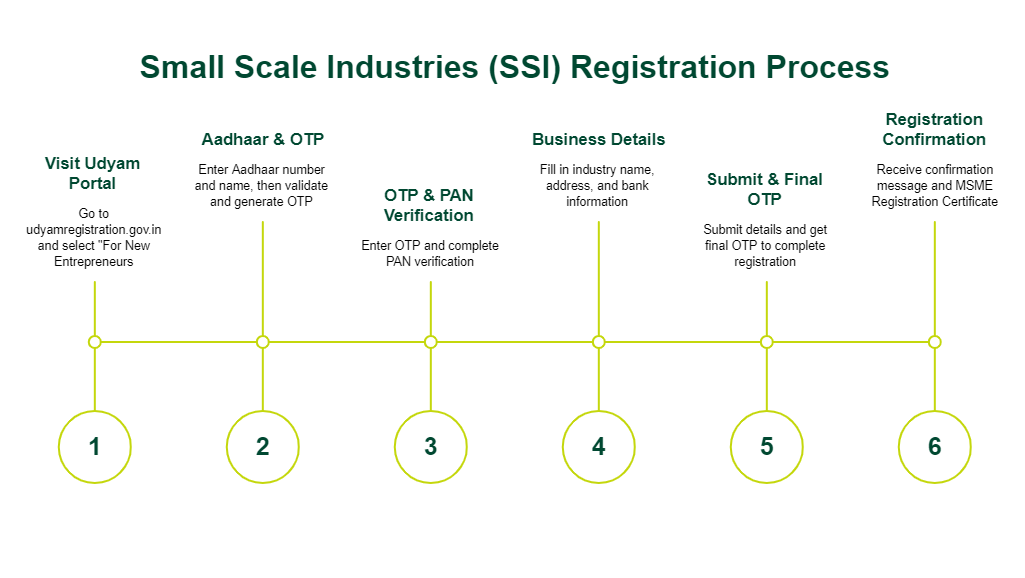
The MSME registration for small industries is completed online through the Udyam registration portal:
- Visit the Udyam registration portal and select "For New Entrepreneurs who are not Registered yet as MSME or those with EM-II."
- Enter your Aadhaar number and name, then click "Validate and Generate OTP."
- Enter the OTP received on your registered mobile number and complete PAN verification.
- Fill in all business details, including industry name, address, and bank account information.
- Click "Submit and Get Final OTP" to complete the registration.
- A registration confirmation message with a reference number will appear. The MSME Registration Certificate is issued upon verification.
There are no registration fees for Udyam registration . The process requires only your Aadhaar number and PAN card.
Documents Required for Small Scale Industries (SSI) Registration
The documents required for SSI registration through Udyam are minimal:
- Aadhaar Card: Mandatory for identity and OTP verification during registration.
- PAN Card: Required for business and personal tax identity verification.
- Bank Account Details: Account number and IFSC code of the business official account.
- Business Details: Industry name, address, NIC code of the business activity, and number of employees.
For enterprises planning expansion or growth after registration, it is equally important to prepare business loan documents along with Udyam paperwork. These typically include standard KYC documents, proof of business registration, and CA-audited financial statements.
Government Support Schemes for Small-Scale Industries
Several government schemes for small-scale industries provide financial and operational support to registered SSIs:
- CGTMSE (Credit Guarantee Fund Trust for Micro and Small Enterprises): Provides collateral-free institutional credit to small-scale industries.
- CLCSS (Credit-Linked Capital Subsidy Scheme): Supports technology upgradation in SSIs by extending credit subsidies.
- Market Promotion and Development Scheme (MPDA): Helps SSIs expand their marketing networks for Khadi and Gram Udyog products.
- Coir Vikas Yojana (CVY): Supports skill development, market promotion, and export of coir-based products.
- Entrepreneurship Skill Development Programme: Aimed at building entrepreneurial skills in individuals keen on setting up SSIs.
- Marketing Assistance Scheme: Facilitates participation in overseas exhibitions and international promotional campaigns.
Accessing these schemes becomes significantly easier once your SSI is registered under Udyam. A business loan can complement government support by providing additional working capital to scale operations. Demonstrating healthy cash flow and creditworthiness can improve the likelihood of securing a competitive business loan interest rate.
Small-Scale Industry Examples
Here is a concise overview of small-scale industries examples across different sectors:
- Manufacturing: Agarbatti production, candle making, toy manufacturing, paper bags, and herbal product units.
- Food and Agro-based: Pickle manufacturing, bakeries, dairy processing, and spice-making units.
- Textile and Craft: Handloom weaving, leather goods, handicrafts, and garment production.
- Service-based SSI: Photography studios, beauty parlours, repair workshops, and printing units.
Challenges Faced By Small-Scale Industries
Despite their importance, small industries face several structural challenges:
- Limited Access to Formal Finance: Many SSIs struggle to meet collateral requirements for loans from traditional financial institutions, restricting their growth.
- Competition from Large Industries: Larger manufacturers benefit from economies of scale that SSIs cannot always match.
- Rising Raw Material Costs: Fluctuating input prices affect profit margins, especially for manufacturing SSIs.
- Limited Technology Adoption: Many SSIs rely on outdated equipment, which affects productivity and product quality.
- Restricted Market Reach: Smaller budgets limit marketing capabilities, making it harder to expand beyond local or regional markets.
How to Choose the Right Small-Scale Industry
Selecting the right SSI from the list of small business industries in India requires careful evaluation of several factors:
- Available Budget: Start with industries that match your current capital. Low-investment manufacturing businesses like agarbatti or paper products are accessible entry points.
- Skills and Experience: Choose an industry where you have domain knowledge or are willing to invest in skill development.
- Local Demand: Research what products or services are in demand in your area before committing to a business category.
- Raw Material Availability: Proximity to raw material sources reduces input costs and supply chain risk.
- Space and Infrastructure: Consider the physical space, power requirements, and equipment needed for your chosen SSI.
- Scalability: Select a business with growth potential so that your SSI can eventually expand into a larger MSME.
Conclusion
Small-scale industries in India offer a wide range of profitable opportunities for aspiring entrepreneurs. Whether you're looking to start a business or expand an existing one, exploring our small-scale industries list can provide valuable insights. As you consider starting a business, remember that success lies in careful planning, market research, and a clear understanding of industry dynamics.
Financial planning is an aspect of business growth that cannot be overlooked. From managing daily operations and paying wages to purchasing high-quality equipment, every business needs financial support. SMFG India Credit offers unsecured business loan of up to Rs. 1 crore* at minimal and competitive interest rates for eligible borrowers. Apply online or contact us for more information on how our business loan solutions can support your entrepreneurial ambitions. You may also use our business loan EMI calculator to estimate repayments and plan your cash flow before starting your application.
* Please note that this article is for your knowledge only. Loans are disbursed at the sole discretion of SMFG India Credit. Final approval, loan terms, disbursal process, foreclosure charges and foreclosure process will be subject to SMFG India Credit's policy at the time of loan application. If you wish to know more about our products and services, please contact us