When you run a business in India, you often deal with invoices, Goods and Services Tax (GST) filing, and product classification. This is where the HSN code becomes important. The HSN full form in GST is Harmonised System of Nomenclature. It is a global system used to classify goods so that taxes and import and export rules stay consistent across countries.
The HSN in India is part of the GST framework. You are expected to use it on invoices, e-way bills, and GST Return (GSTR-1) so that your goods are clearly identified and taxed correctly. The international HSN system helps you avoid mistakes, reduce disputes, and keep your records in line with GST rules.
If you sell goods locally or trade across borders, knowing what HSN means helps you stay compliant, choose the right GST rate by HSN code, and complete your filings without confusion. In this guide, you will understand the Harmonised System of Nomenclature’s meaning, the importance of HSN in GST, how it is structured in India, and how you can use it correctly for your business.
What Is an HSN Code?
So, what does the HSN code stand for? As seen above, the HSN full form, or the HSN code full form, is Harmonised System of Nomenclature. It is a standardised numerical method used to classify traded products. It is an internationally accepted system of product classification developed by the World Customs Organisation (WCO). This system is used by more than 200 countries worldwide for customs and taxation purposes.
If you’re wondering how many digits there are in the HSN code, it consists of 6 digits, with some countries adding additional digits for further trade classification. Each digit in the code represents a specific category or subcategory of products. The first 2 digits denote the chapter, the next 2 digits represent the heading, and the last 2 digits indicate the subheading. Understanding this HSN digit’s meaning allows for a precise and uniform classification of goods across different countries, facilitating international trade and ensuring consistency in taxation.
In India, the HSN code is widely used under the Goods and Services Tax (GST) regime, ensuring that goods are categorised uniformly across the nation, thereby reducing ambiguities and errors in tax calculation.
Why Is the HSN Code Important for Business?
The Harmonised System of Nomenclature code is essential for standardising product classification under GST in international trade and taxation. It ensures uniformity, simplifies customs processes, and helps businesses adhere to GST compliance in India.
HSN Worldwide
Globally, the HSN system is used by over 200 countries for customs and taxation purposes. Developed by the World Customs Organisation (WCO), it enables seamless trade by classifying goods uniformly, reducing misclassification issues and simplifying import and export regulations.
How Does the HSN Code Work? Explained with Example
To further understand the HSN code meaning and how it works, let's delve into an example that shows the practical application of this system.
Imagine you're exporting a cotton t-shirt. The HSN code for this product would be 610910. Here's how this HSN number breaks down:
- Chapter 61: Articles of apparel and clothing accessories, knitted or crocheted
- Heading 09: T-shirts, singlets, and other vests
- Subheading 10: Of cotton
This detailed HSN classification system demonstrates the hierarchical nature of the HSN code, showcasing how each digit contributes to a more specific product description. The HSN code's meaning becomes clear when we see how it precisely identifies the nature of the product. This level of detail is crucial for various stakeholders in international trade.
For customs officials and tax authorities, the HSN code allows for quick identification of the product's nature, enabling them to apply appropriate duties or taxes efficiently. Businesses benefit from this system as well, as it assists them in determining the correct GST rates and navigating import and export regulations for their products.
Understanding what the HSN code is in GST and its practical application is essential for businesses engaged in international commerce, as it streamlines processes and reduces potential misunderstandings in trade classifications and transactions.
HSN Code Structure and Applicability in India
India follows the global HSN framework developed by the World Customs Organisation (WCO) and officially adopted it in 1971. Under the Goods and Services Tax (GST), the country uses a tiered system to simplify compliance for small businesses while ensuring detailed classification for larger taxpayers.
The HSN code structure in India is based on a standard hierarchy:
- First 2 digits: Chapter
- Next 2 digits: Heading
- Last 2 digits: Subheading
For Goods and Services Tax (GST), the number of HSN digits in India depends on annual turnover:
- 4-digit HSN code for businesses with turnover up to ₹5 crore
- 6-digit HSN code for businesses with turnover above ₹5 crore
- 8-digit HSN code for businesses engaged in import/export
This structure ensures uniform trade classification of goods, accurate GST rate mapping, and reduced errors in tax filing. It also helps align Indian taxation with global trade nomenclature and systems, making import–export processes smoother for businesses.
HSN Code List for GST India
Below is a simplified snapshot of major HSN chapters to help businesses quickly understand how goods are grouped under GST. These ranges indicate typical classifications and commonly applied GST rates for broad categories.
|
Section
|
Chapter Range
|
Commodities Description
|
HSN Code Range
|
Typical GST Rates
|
|
Section I
|
01–05
|
Live animals; meat; fish; dairy; animal products
|
0101–0507
|
0%–18%
|
|
Section II
|
06–14
|
Vegetable products (fruits, vegetables, coffee, spices)
|
0601–1404
|
0%–18%
|
|
Section III
|
15
|
Animal & vegetable fats and oils
|
1501–1522
|
5%, 18%
|
|
Section IV
|
16–24
|
Prepared foods, beverages, and tobacco
|
1601–2403
|
0%–40%
|
These chapters represent only a high-level view of the WCO harmonised system. Actual GST rates vary depending on the specific product within each chapter, heading, and subheading in HSN.
For the complete and updated HSN code list, businesses should refer to the official Goods and Services Tax (GST) portal and the Central Board of Indirect Taxes and Customs (CBIC) website. Third-party GST HSN lookup or HSN lookup tools are also available.
HSN in GST
Under GST, the HSN code standardises product classification, customs tariff classification, simplifying tax calculations, and ensuring accurate tax rates. It reduces confusion, streamlines tax filing, and prevents misclassification-related penalties, benefiting both businesses and tax audits.
Usage of the HSN Code for GST
- Classifies goods for accurate GST rate application.
- Mandatory for businesses with GST registration.
- Use in GST invoices, returns, and e-way bills.
- Ensures tax compliance with GST regulations.
How Businesses Use HSN Codes in Practice
Proper HSN code implementation helps businesses stay accurate and maintain tax compliance. It ensures correct tax calculation, smooth invoicing, and avoids penalties during tax audits.
- Training: Teams are trained to identify the right HSN code for each product. This reduces confusion and prevents wrong tax entries.
- System Integration: Businesses update their billing and ERP systems with correct HSN codes so invoices are generated automatically without errors.
- Compliance Monitoring: Finance teams regularly review HSN in invoices to ensure it matches product categories and follows correct customs tariff
Tip: Check HSN updates often on the official Goods and Services Tax (GST) portal to stay tax audit-ready.
The Benefits of the HSN Classification
The implementation of the HSN code system offers numerous benefits for businesses and governments. The advantages of the HSN code include:
- Uniformity in Classification: HSN promotes standardised product classification across countries. This uniformity reduces confusion and disputes in international trade, as the HSN code remains consistent globally.
- Streamlined Customs Procedures: The HSN code allows for smoother customs tariff processes and faster clearance of goods. Customs officials can quickly understand the nature of products using the HSN code.
- Tax Compliance: Understanding and correctly using HSN codes ensures tax compliance, particularly in the context of GST in India.
- Accurate Tax Rate Determination: The HSN code details help in determining appropriate tax rates for products in GST invoices, avoiding errors in calculations and potential penalties.
- Global Product Tracking: The HSN code system enables businesses to easily identify and track their products in international trade codes. This feature of the HSN in ERP systems provides valuable insights for market research and expansion strategies.
- Simplified Trade Documentation: Using standardised HSN codes simplifies trade documentation for taxpayers, reducing paperwork and potential errors in international transactions.
- Data Analysis: The Government of India can use HSN code data for economic analysis, policy-making, and monitoring trade patterns.
Declaration of HSN Code for Goods and Services
As per the HSN code under the GST system in India, businesses must declare the code on invoices, GST Returns (GSTR-1), and e-way bills to ensure uniform classification of goods and services.
For exports and imports, an 8-digit HSN code in India is used to align with international trade standards. Declaring the correct HSN code ensures accurate GST rate application, reduces classification errors, and simplifies tax compliance.
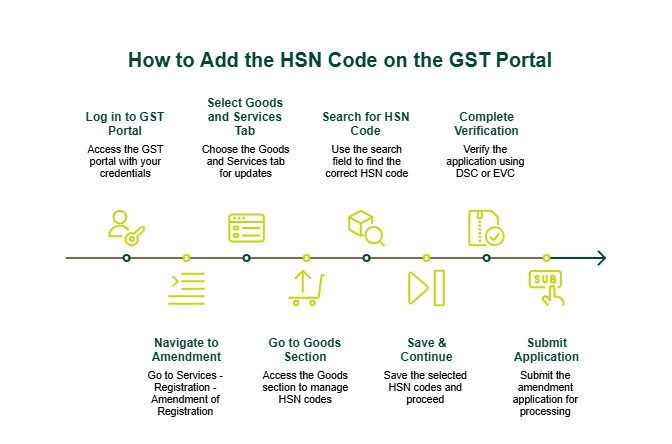
How to Add the HSN Code on the GST Portal
If you need to add an HSN code on the GST portal in India, here’s how you do it in a few simple steps, especially useful when you update your product list or GST registration.
Steps to Add HSN Code (Amendment):
- Log in to the GST Portal (www.gst.gov.in) with your credentials.
- Navigate to Services - Registration - Amendment of Registration (Non-Core Fields).
- Select the Goods and Services tab.
- Under this, go to the Goods section to manage your HSN codes.
- Use the search field to look up an HSN chapter by name or by the first few digits. Then enter or select the correct HSN code.
- Click Save & Continue after selecting the relevant HSN codes.
- Complete the verification at the “Verification” tab by choosing either Digital Signature Certificate (DSC) or Electronic Verification Code (EVC).
- Submit your amendment application.
Note: It’s wise to double-check each HSN code you add, especially after product changes, to ensure you remain compliant and accurate.
If possible, review updates or new HSN codes occasionally on the official GST Portal (www.gst.gov.in) or the Central Board of Indirect Taxes and Customs (CBIC) website so your classification stays current.
What Is the HS and HSN Code Difference?
The HS code (Harmonised System Code) is a globally recognised classification system developed by the World Customs Organisation (WCO) for categorising goods in international trade. The HS code consists of a 6-digit structure used worldwide for customs, tariffs, and trade policies.
The HSN Code (Harmonised System of Nomenclature) is an extension of the HS code, adopted in India under the GST system. While the HS code is used globally, the HSN code is primarily for taxation and GST compliance in India. It ensures consistent product classification and tax application within India.
Additionally, the ITC-HS code in India is an 8-digit version of the global 6-digit HSN code, used specifically in the country for trade and customs.
Conclusion
The HSN code system plays a vital role in international trade and tax compliance, providing a standardised method for classifying goods globally. By correctly applying HSN codes, businesses can simplify tax calculations, improve efficiency, and enhance their overall financial management.
To further enhance your business’s financial efficiency and optimise day-to-day operations, consider SMFG India Credit’s tailored business loan solutions. We offer unsecured financing of up to Rs. 1 crore* at competitive business loan interest rates and a straightforward business loan eligibility criteria.
You can use our business loan eligibility calculator and business loan EMI calculator to understand your borrowing potential and monthly repayments in advance. We also share a clear list of required business loan documents, making the entire application process smooth and hassle-free. Apply online now or contact us for more details.
* Please note that this article is for your knowledge only. Loans are disbursed at the sole discretion of SMFG India Credit. Final approval, loan terms, disbursal process, foreclosure charges and foreclosure process will be subject to SMFG India Credit's policy at the time of loan application. If you wish to know more about our products and services, please contact us