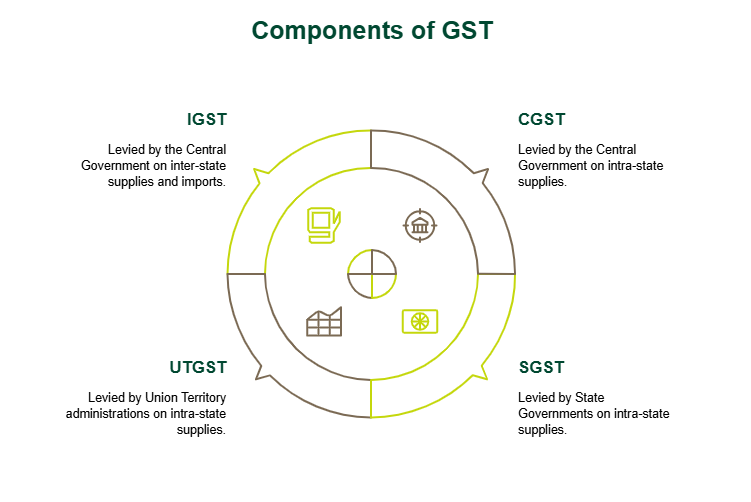
You must know the components of GST in India if you run a business or deal with taxation. They include CGST, SGST, IGST, and UTGST, and each applies depending on whether the supply is intra-state or inter-state. The structure of GST in India in 2026 continues to follow a destination-based taxation model.
Let’s understand the GST component’s meaning and how it works to help your business stay compliant, manage pricing effectively, and avoid errors in GST filing.
What Are the Components of GST?
The components of GST in India form the foundation of the Goods and Services Tax framework. India follows a dual GST model, where tax is concurrently levied by the Centre and the States (or Union Territories, where applicable).
The main types of GST in India are CGST, SGST, IGST, and UTGST. This GST structure, as explained, ensures balanced revenue sharing and smoother compliance.
Why Is GST Split Into CGST, SGST, IGST, and UTGST
You may ask why GST is split into CGST, SGST, and IGST. The reason lies in India’s federal structure. Under the Goods and Services Tax, revenue must be fairly distributed between the Centre and States.
When a supply happens within a state, both CGST and SGST apply. For inter-state transactions, IGST is charged and later shared. UTGST applies in Union Territories without a legislature.
This division under the GST tax structure in India ensures destination-based taxation, meaning tax is collected where goods or services are consumed.
What Is CGST (Central Goods and Services Tax)?
The CGST meaning refers to the central portion of GST collected on intra-state supplies. It stands for the tax levied by the Central Government under the CGST Act, 2017. CGST applicability comes into play when both the buyer and the seller are located in the same state. Under the GST system in India, CGST is charged along with SGST at equal rates for intra-state transactions.
What Is SGST (State Goods and Services Tax)?
The SGST meaning pertains to the tax collected by the State Government on intra-state transactions. Under the SGST Act, this tax ensures that states receive their share of revenue. Unlike CGST, which goes to the Centre, SGST tax directly contributes to the respective state’s treasury. Within the broader GST framework, SGST plays a key role in maintaining fiscal autonomy for states.
CGST and SGST: How Intra-State GST Works
When you supply goods within the same state, both CGST and SGST apply equally.
CGST and SGST Difference
|
Basis
|
CGST
|
SGST
|
|
Levied By
|
Central Government
|
State Government
|
|
Revenue Goes To
|
Centre
|
Respective State
|
|
Applicability
|
Intra-state supply
|
Intra-state supply
|
If GST is 18%, it is split as 9% CGST and 9% SGST. This difference between CGST and SGST helps you issue accurate invoices and avoid compliance errors.
What Is IGST (Integrated Goods and Services Tax)?
The IGST meaning indicates the tax charged on inter-state supplies of goods and services. It is governed by the IGST Act and is collected by the Central Government. Under the GST system, IGST applies when goods move between two states or when goods are imported or exported. The concept of IGST on inter-state supplies simplifies taxation by combining CGST and SGST into a single tax.
How IGST Works in Inter-State Transactions
Let’s understand how IGST is calculated with a simple example. Suppose you sell goods worth ₹10,000 from Maharashtra to Karnataka at 18% GST. Instead of splitting into CGST and SGST, you charge 18% IGST, which equals ₹1,800. The Centre collects this amount and later shares it with the destination state. This system ensures smooth interstate trade without tax overlap.
What Is UTGST (Union Territory Goods and Services Tax)?
The UTGST meaning refers to tax collected on intra-Union Territory transactions in areas without a legislature, under the UTGST Act 2017. UTGST applies in:
- Andaman and Nicobar Islands
- Chandigarh
- Dadra and Nagar Haveli
- Daman and Diu
- Lakshadweep
- Ladakh
Note that the union territories of Delhi, Jammu & Kashmir, and Puducherry follow state GST rules as they have their own legislation.
Examples of CGST, SGST, IGST, and UTGST
CGST and SGST Example
If you sell goods worth ₹10,000 in Gujarat at 18%, you charge ₹900 as CGST and ₹900 as SGST.
IGST Example
If you sell goods from Delhi to Tamil Nadu at 18%, you charge ₹1,800 IGST.
UTGST Example
If goods worth ₹10,000 are sold within Chandigarh at 18%, ₹900 goes as CGST and ₹900 as UTGST.
How GST Components Impact Businesses
The components of GST in India directly affect how your business operates:
- Determine the correct GST filing category and tax reporting requirements
- Impact the flow and utilisation of input tax credit (ITC)
- Affect pricing strategy and working capital management
- Influence inter-state trade planning and supply chain structuring
Importance of Understanding GST Components for Compliance
If you do not understand the components of GST in India, you may select the wrong tax while invoicing. This can lead to return mismatches on the GST Network (GSTN) portal. Proper knowledge of GST compliance requirements in India ensures accurate tax reporting, smoother audits, and better eligibility for funding where GST returns are reviewed.
Conclusion
The components of GST, including CGST, SGST, IGST, and UTGST, create a structured and transparent taxation system. Under the Goods and Services Tax, the split ensures fair revenue distribution and smoother trade across states. If you understand the GST components explained here clearly, compliance becomes simpler, and errors can be reduced. In 2026, clarity around GST and its components remains essential for every registered business.
As your enterprise manages GST-related financial and compliance obligations alongside routine operational expenses, maintaining healthy cash flow becomes critical. To support your business needs, SMFG India Credit offers unsecured business loans of up to Rs. 75 lakhs* at competitive interest rates. Use our business loan EMI calculator and eligibility calculator to plan your finances and apply online with ease. Check your business loan eligibility and the documents required to ensure a smooth application process.
* Please note that this article is for your knowledge only. Loans are disbursed at the sole discretion of SMFG India Credit. Final approval, loan terms, disbursal process, foreclosure charges and foreclosure process will be subject to SMFG India Credit's policy at the time of loan application. If you wish to know more about our products and services, please contact us