Understanding the personal loan closure process correctly can save you money and protect your credit profile. Many lenders now allow borrowers to close a personal loan online, making the process far more convenient and accessible.
Whether you repay your loan at the end of the tenure or ahead of schedule, proper personal loan closure can help you avoid future financial complications and support better long-term financial planning.
What Is Personal Loan Closure?
The personal loan closure meaning refers to the complete repayment of your outstanding loan balance, either at the end of the agreed tenure or before it. In simple terms, it is the process through which your loan account is formally closed after all dues and applicable charges, if any, have been cleared.
There are two primary types of personal loan closure. Regular closure occurs when you repay all scheduled EMIs until the tenure ends, and the lender automatically closes the account. Pre-closure, also known as foreclosure, is when you choose to repay the remaining balance before the tenure ends.
Personal loan foreclosure is typically chosen by borrowers who receive a salary increment, a bonus, or a financial windfall and wish to reduce their overall interest burden.
Personal Loan Foreclosure/Pre-Closure Charges
When you opt for pre-closure, lenders may apply personal loan prepayment charges. Here is what you should be aware of early loan closure before proceeding:
- Most personal loans are offered at fixed interest rates and may attract a foreclosure charge on the remaining principal balance.
- Personal loan foreclosure charges generally range between 2% and 7%* of the outstanding principal amount, depending on the lender's policy.
- Many lenders enforce a lock-in period, during which you may not be permitted to pre-close a personal loan.
- Charges, lock-in periods, and eligibility criteria vary across institutions, so always review the applicable terms and conditions before you initiate the loan foreclosure process.
Types of Personal Loan Closures
Different repayment methods are available to customers for personal loans. A personal loan account can be closed through any of the following processes:
1. Pre-closure of a Personal Loan
Personal loan pre-closure allows you to repay the entire outstanding amount before the loan tenure ends. This can help you save on interest costs and may improve your credit score. Foreclosure charges may apply depending on how many EMIs you’ve paid, but if a sufficient number of EMIs are completed, these charges might be waived. For more details on how to close a personal loan early, visit our personal loan preclosure page.
2. Regular Loan Closure
This is the standard way of closing a personal loan. You continue paying EMIs as per schedule, and once the full tenure is completed, the loan account is automatically closed.
3. Part-Payment of a Personal Loan
Part-payment allows you to repay a portion of the principal loan amount before its due date. Although it does not lead to full closure of the loan account, it reduces the outstanding principal and helps lower your future EMIs.
*Please note that, as per SMFG India Credit’s current policy, prepayments on personal loans are accepted only in full. Therefore, if you intend to prepay or foreclose your personal loan, you will need to repay the entire outstanding amount along with any applicable fees and charges.
4. Loan Extension
In exceptional circumstances, you may request a loan extension if you’re unable to make repayments on time. This option gives you additional time to manage your finances. However, not all lenders offer this facility, and approval is at the lender's discretion.
5. Top-Up Loan
If you need additional funds instead of closing your personal loan, many lenders offer top-up loans to eligible customers. This gives you access to extra funds over and above your existing loan balance. To find out if you are eligible, please get in touch with us today.
Reasons to Close Your Personal Loan
Closing a personal loan involves more than just completing your EMIs; it involves formally closing the loan account with your lender. Doing so ensures your financial records are accurate and future credit opportunities remain smooth.
Here’s why you should close a personal loan properly:
- No Outstanding Debt: Official closure confirms that no dues remain in your name, protecting you from future disputes or negative credit remarks.
- Lower EMI Burden: If you have multiple loans, closing one reduces your monthly obligations and improves your cash flow.
- Better Loan Options: Improves eligibility for new loans or credit opportunities, especially with the same lending institution.
- Boosts Credit Score: A timely and full loan repayment, followed by formal closure, positively impacts your credit history and credit score.
Always complete the loan closure procedure to maintain a strong financial standing.
Advantages of Pre-Closure of a Personal Loan
Choosing to pre-close your personal loan can offer several benefits:
- Interest Savings: Repaying your loan before the end of the tenure can reduce the total interest outgo, especially if the loan is closed during the early stages of repayment.
- Debt-Free Status: Early closure eliminates monthly EMI obligations, improves cash flow, and provides greater flexibility in managing other financial goals.
- Stronger Credit Profile: Timely repayment and successful loan closure demonstrate responsible credit behaviour, which can positively influence your credit history.
- Better Borrowing Capacity: Closing an existing loan may improve your eligibility for future credit by reducing your overall debt obligations, subject to the lender's assessment criteria.
- Clear Financial Records: After completing the closure process, ensure you obtain a loan closure letter from your lender. This document serves as proof that all outstanding dues have been settled and can help prevent future disputes.
- Reduced Long-Term Financial Burden: One key personal loan foreclosure benefit is the reduction in long-term interest costs, allowing you to redirect funds towards savings, investments, or other financial priorities.
Requirements for Personal Loan Closure
You’ll typically need to provide the following personal loan closure documents and details:
- Loan-related documents (loan agreement, sanction letter, EMI schedule)
- Identity and address proof (Aadhaar card, PAN card, Passport, Voter ID)
- Loan statements showing paid EMIs till date
- Demand draft or cheque for the outstanding balance
If you're opting for personal loan preclosure, check with your lender about any applicable charges or minimum EMI payment requirements. Following these steps ensures a smooth and official personal loan closing process.
How to Close Your Personal Loan Account?
If you're wondering how to close a personal loan, here’s a quick guide. Whether you're nearing the end of your EMI schedule or planning a personal loan pre-closure, closing your account properly is important for your financial health.
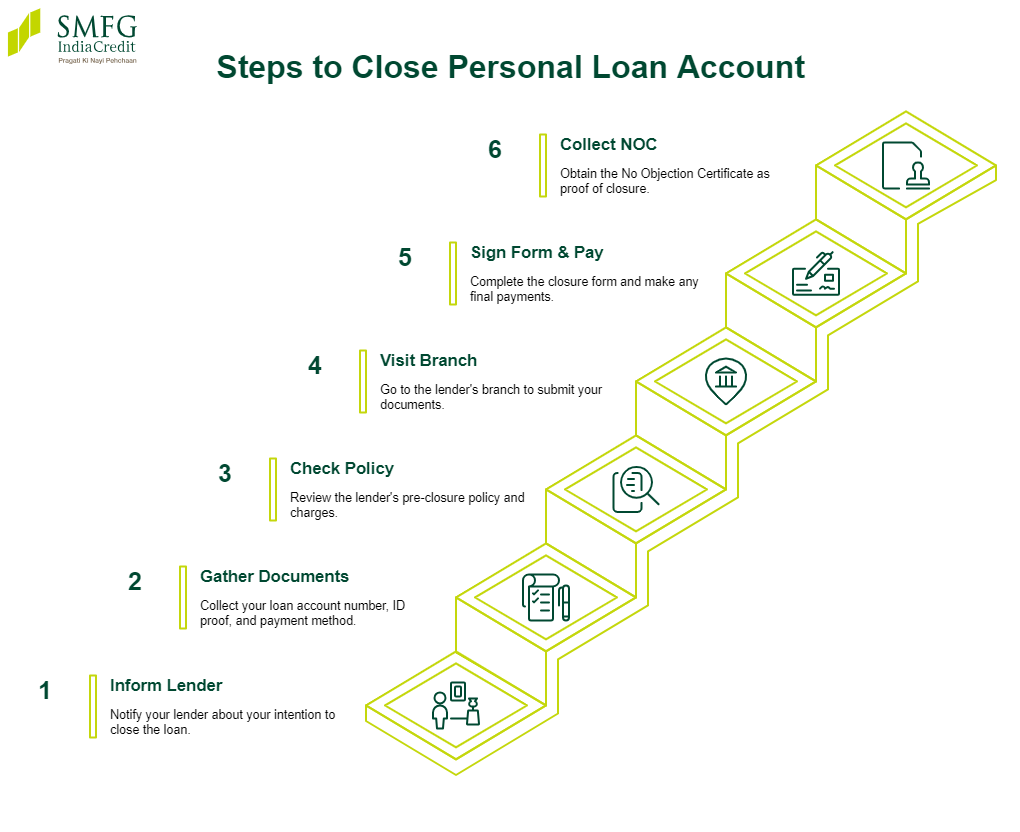
Here’s how to close a loan account:
- Inform the lender once you’ve repaid the full outstanding loan amount or are ready to do so.
- Carry your loan account number, a valid identity proof, and a cheque or DD for any dues.
- For personal loan pre-closure, check the lender’s policy regarding applicable charges and the minimum number of EMIs paid.
- Visit the lender’s branch and submit the required documents.
- Sign the closure request form and make the final payment if needed.
- Collect the No Objection Certificate (NOC) as proof of official personal loan closure.
Once the lender processes your request, your loan will be marked as "closed" in their system and reported accordingly to credit bureaus.
Please note that the exact loan closure process may vary by lending institution.
Tips to Close a Personal Loan Faster
If you are looking at how to repay a personal loan early, a few practical strategies can help you do so without putting pressure on your monthly budget.
Making regular part-prepayments, even in modest amounts, can reduce the outstanding principal faster and lower the total interest paid. However, check your lender's policy, as some lenders may restrict part-prepayments.
When your income increases, consider requesting an EMI increase to shorten the repayment tenure. This can help you repay a personal loan quickly and reduce your overall interest outgo.
Directing annual bonuses, incentives, or financial windfalls towards your loan balance is another effective approach.
Cutting back on non-essential spending and redirecting those savings towards your loan can also help reduce personal loan burden and accelerate debt closure.
Things to Keep in Mind While Closing a Personal Loan
- Choose Closure Type: Depending on your financial situation, decide whether to go for regular closure at the end of the tenure, pre-closure, or part-payment (if your lender allows it).
- Get Pre-closure Quote: If you’re planning to close your loan early, request the exact outstanding balance along with any applicable foreclosure charges from your lender. This helps you make an informed financial decision.
- Pay via Cheque, Demand Draft, or Digital Transfer: Avoid cash payments to ensure proper transaction records and acknowledgement.
- Check Your Credit Report: After loan closure, monitor your credit report to ensure that the loan is marked as "closed." This step helps protect your credit score and ensures your financial records remain accurate.
- Follow the Correct Process: Understanding how to close a personal loan early helps you avoid unexpected charges or missed steps, safeguarding your creditworthiness and financial stability.
Conclusion
Personal loan closure is about officially concluding your financial obligation with the right documents. Proper closure clears your debt history, boosts your credit score, and opens doors for future credit opportunities.
If you’ve been wondering how to close a loan account or whether you can close a personal loan early, keep in mind that pre-closure may involve specific terms and applicable charges, such as minimum EMI requirements or foreclosure fees.
For a smooth personal loan closure, consider trusted financial institutions like SMFG India Credit. Our straightforward procedures and expert support can guide you through the best way to close your personal loan quickly and securely.
If you’re exploring personal loan options, we offer funds of up to Rs. 10 Lakhs* at competitive interest rates and flexible tenures. Apply online today or visit our nearest branch to learn more.