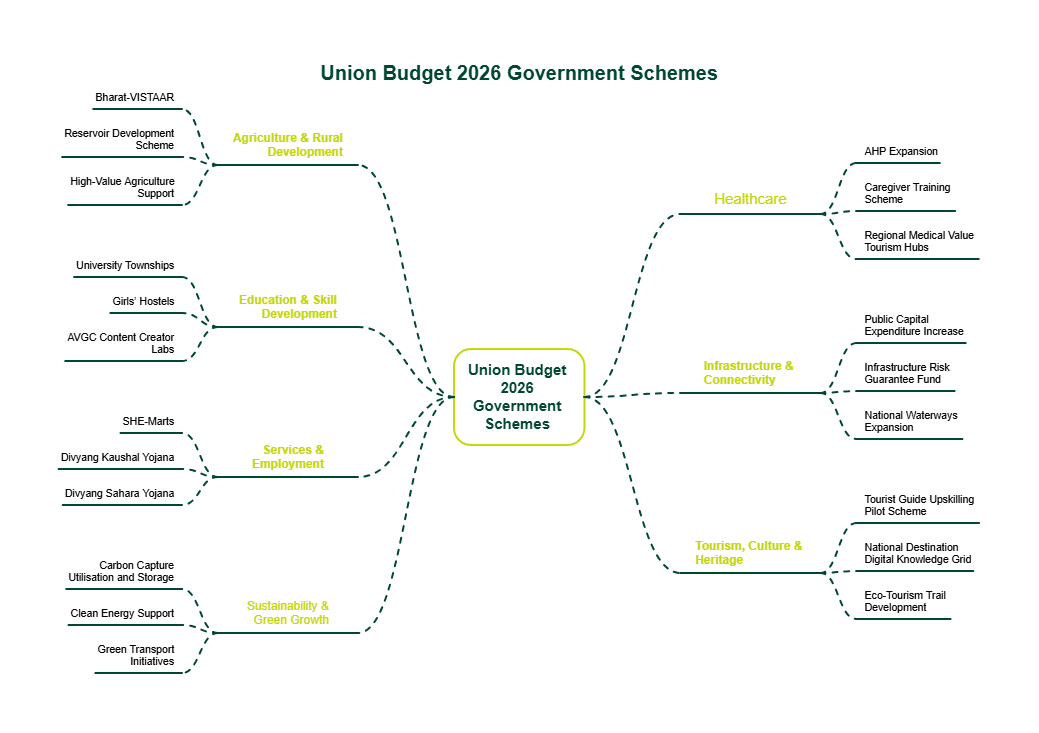
This Union Budget 2026 schemes list brings together all major government provisions announced by Finance Minister Nirmala Sitharaman.
This article provides a comprehensive overview of the Union Budget 2026 government schemes, covering the schemes announced for agriculture, infrastructure, welfare, healthcare, and MSME development. If you are looking for a comprehensive Union Budget 2026 schemes list in India, this guide explains what was included and what it means for citizens, businesses, and investors.
Key Themes of Union Budget 2026: Government Schemes
The Union Budget 2026–27, presented by Finance Minister Nirmala Sitharaman, focuses on several socioeconomic aspects such as inclusive economic growth, employment generation, and long-term resilience. Budget 2026 aims to strengthen infrastructure, digital systems, and manufacturing while expanding government schemes for rural and urban communities. The core objective of the Union Budget 2026 government schemes is to balance social welfare priorities with fiscal discipline.
The emphasis on economic growth, MSME support, and social inclusion makes the Union Budget 2026 a policy roadmap rather than just an annual financial statement.
Government Schemes for Agriculture & Rural Development
Under the Union Budget 2026–27, several provisions have been introduced to strengthen rural incomes and productivity. Key agricultural schemes in Budget 2026 include:
- Bharat-VISTAAR: An AI-enabled advisory platform offering customised support to farmers.
- Reservoir Development Scheme: Integrated development of 500 reservoirs and Amrit Sarovars to improve fisheries and irrigation.
- Coconut Promotion Scheme: Focused support to enhance coconut production and productivity.
- High-value support for enhancing the production of coconut, cashew, cocoa, sandalwood, almonds, walnuts, and pine nuts.
These new government schemes in 2026 aim to modernise agriculture, improve water management, and boost allied activities. These rural development schemes for 2026 are designed to increase income stability and reduce regional disparity.
Healthcare and Public Health Schemes
Healthcare schemes in the Budget 2026 focus on access, training, and medical infrastructure.
- Training 1.5 lakh caregivers over five years through the Caregiver Training Scheme.
- Expansion of allied health institutions.
- 5 new medical value tourism hubs in partnership with private players.
- Strengthening emergency and trauma care centres.
These government schemes improve public access to healthcare and support job creation in medical services. Finance Minister Nirmala Sitharaman emphasised preventive care and regional health infrastructure in Budget 2026, making public health initiatives central to the government schemes announced this year.
Education and Skill Development Schemes
Education and skill schemes in 2026 are structured around linking learning with employment.
- 5 new University townships to be set up in the proximity of industrial and logistical corridors.
- Establishment of one girl’s hostel in every district for higher education STEM institutions.
- AVGC content creator labs to be set up in 15,000 schools and 500 colleges.
- Establishment of the education-to-employment standing committee.
The focus is on skill development schemes and industry-linked training. In the Union Budget 2026–27, Finance Minister Nirmala Sitharaman highlighted long-term investment in human capital as key to sustained growth. The government schemes announced in 2026 in this segment aim to improve employability and entrepreneurial capacity.
Infrastructure, Connectivity & Industrial Schemes
Infrastructure schemes in 2026, under the umbrella of the Union Budget 2026–27, aim to strengthen logistics, manufacturing, and green transition. Key provisions include:
- Infrastructure Risk Guarantee Fund setup to speed up project execution and support developers.
- National waterways expansion through 20 new waterways over the next 5 years.
- Development of 7 high-speed rail corridors to connect major cities.
- Seaplane VGF scheme to improve last-mile connectivity.
These government schemes announced in 2026 support industrial expansion and manufacturing. Budget 2026 also increases capital expenditure to boost connectivity and energy transition. Through these Union Budget 2026 initiatives, the government aims to enhance competitiveness and long-term productivity.
MSME, Khadi, Handloom, and Textile Sector Schemes
MSME support schemes in Budget 2026 are geared to strengthen small enterprises. These include:
- ₹10,000 crore SME growth fund to create future “champion MSMEs”.
- TReDS reforms and integration with GeM to improve cash flow.
- Setting up Mega Textile Parks in challenge mode to support scale and value addition.
- Mahatma Gandhi Gram Swaraj Initiative to improve the quality and production of khadi, handloom, and handicrafts.
Along with these measures, government subsidies for MSMEs will continue to improve access to formal credit. Existing schemes such as Pradhan Mantri MUDRA Yojana, Stree Shakti Yojana, and the CGFMU scheme will be integral to support micro and small businesses.
Employment & Skill Building Initiatives
Employment schemes in 2026 under the Union Budget 2026–27 focus on job creation schemes across sectors.
- Allocation of ₹95,692.31 crore in 2026–27 to the Viksit Bharat Guarantee for Rozgar and Ajeevika Mission (Gramin) Act, 2025.
- 10,000 tourist guides to be trained and upskilled at 20 iconic tourist sites.
- Service-sector employment support.
- Skill pathways for youth.
These government schemes are aligned with service expansion and local employment. Budget 2026 integrates skill-building with infrastructure growth, ensuring direct job opportunities. Through targeted government schemes, the aim is to create sustainable livelihoods rather than provide short-term incentives.
Welfare & Inclusion Oriented Schemes
Inclusive schemes in 2026 under the Union Budget 2026–27 are centred around social equity.
- Divyang Kaushal Yojana for skill training across IT, AVGC, hospitality, and services sectors.
- Divyang Sahara Yojana to provide support for assistive devices.
- SHE-Marts for rural women entrepreneurs, encouraging transition from livelihood to enterprise ownership.
These government schemes strengthen women's welfare schemes in the Budget 2026 and support marginalised communities. Finance Minister Nirmala Sitharaman positioned inclusion at the centre of Budget 2026, ensuring that growth benefits vulnerable groups through structured government schemes announced in 2026.
Tax and Fiscal Policy Changes
Tax schemes in the Union Budget 2026–27 complement development initiatives. Finance Minister Nirmala Sitharaman announced some rationalisation measures and relief mechanisms linked to sectoral growth. Reduced compliance burdens and targeted tax relief measures support tourism, education remittances, and MSME operations.
These changes strengthen the impact of government schemes by improving liquidity and easing procedural challenges. In Budget 2026, fiscal discipline remains important while ensuring that government schemes drive sustainable expansion.
How These Schemes Impact Citizens and Businesses
The impact of Budget 2026's new schemes will be visible across households and enterprises. Farmers benefit from agricultural reforms such as Bharat-VISTAAR and the Reservoir Development Scheme. Health workers gain opportunities under the Caregiver Training Scheme.
For businesses, especially MSMEs, government schemes in the Union Budget 2026–27 are expected to improve access to finance, infrastructure, and market linkages. Expanded connectivity and industrial support may stimulate new demand across sectors. Overall, Union Budget 2026 seeks to align welfare measures, enterprise growth, and regional development within a unified policy framework.
As enterprises adapt to these developments, they may also explore tailored financing solutions, including small business loans or business loans for startups*, to maintain healthy working capital and stable cash flow.
Conclusion: Union Budget 2026–27 Scheme Outlook
The Union Budget 2026–27 brings together a wide-ranging set of government schemes aimed at strengthening agriculture, infrastructure, welfare systems, and MSME growth. Through the Union Budget 2026, Finance Minister Nirmala Sitharaman has outlined long-term priorities focused on economic stability, employment creation, and inclusive development.
As you review the government schemes announced in Budget 2026, it is equally important to consider how they can translate into real opportunities for businesses. Alongside policy support, access to timely finance will play a key role in benefiting from Budget 2026 initiatives. An unsecured business loan of up to Rs. 1 Crore* from SMFG India Credit can help you manage expansion or working capital needs with competitive business loan interest rates and straightforward business loan eligibility criteria. You can check your borrowing capacity using a business loan eligibility calculator and plan repayments in advance with a business loan EMI calculator.
Keep your business loan documents ready for a smoother process and start your online application today!