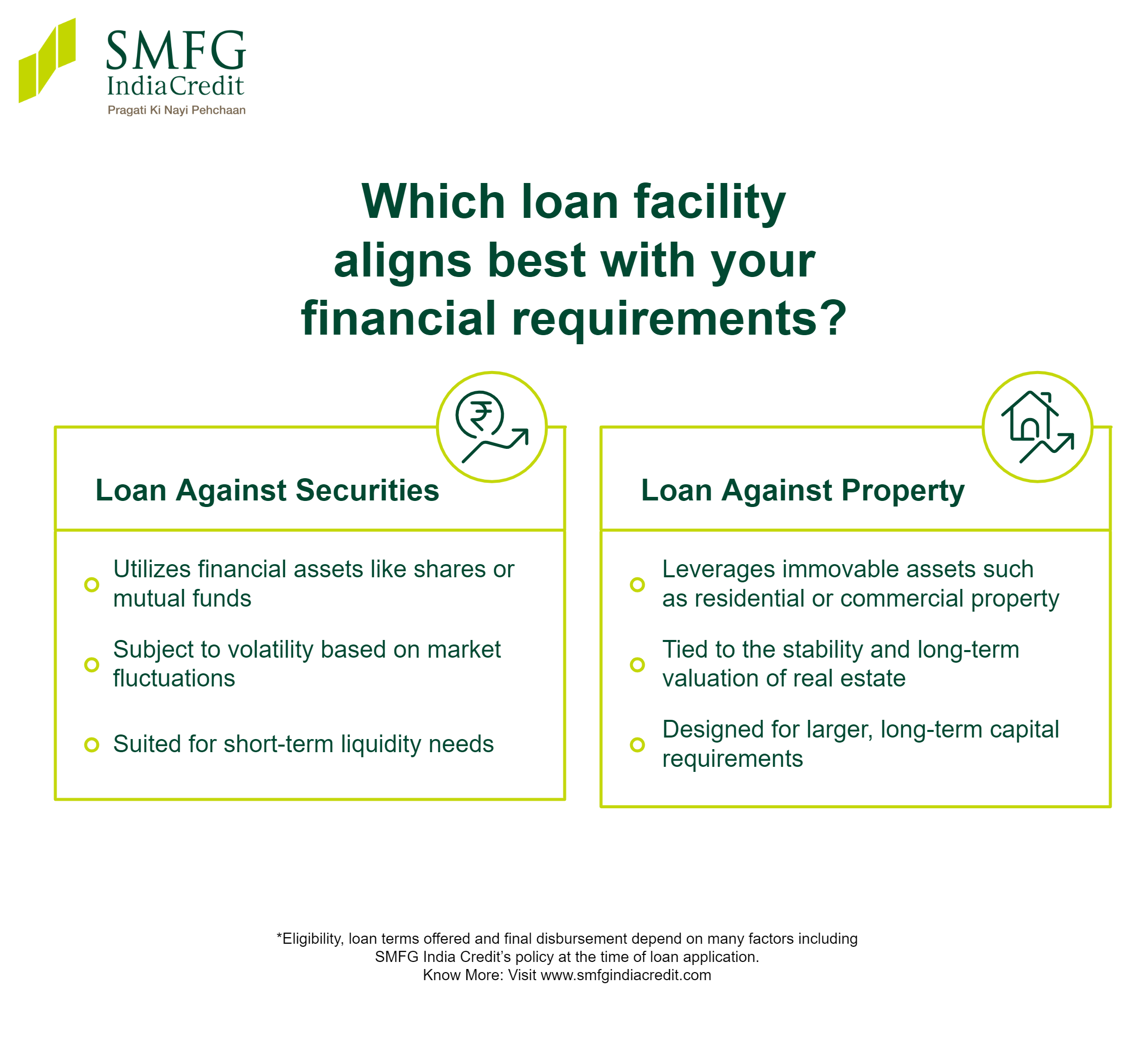
When you need funds without selling your assets, Loan Against Securities and Loan Against Property are two common secured loan options available. While LAS allows you to borrow against eligible financial investments, LAP uses an eligible property as collateral. This article covers the differences between LAS and LAP across collateral requirements, interest rates, eligibility, and use cases, so you can decide which fits your situation.
What Is Loan Against Securities (LAS)?
The Loan Against Securities meaning refers to a loan facility where you pledge financial assets such as shares, mutual funds, or bonds as collateral. Your investments stay in your name, held in a demat account with depositories like the National Securities Depository Limited (NSDL) or Central Depository Services (India) Limited (CDSL), while the lender places a lien on them. You continue earning any applicable returns while accessing funds against their value.
What Is Loan Against Property (LAP)?
The Loan Against Property meaning refers to a secured loan in which a property owner mortgages a residential or commercial property to raise funds. The property serves as collateral, while ownership generally remains with the borrower. The lender holds a security interest in the property until the loan is fully repaid. It's commonly used for business expansion, higher education, medical needs, or large personal expenses, and usually carries a longer tenure than LAS.
How Does Loan Against Securities Work?
The Loan Against Securities process generally starts with selecting eligible securities from your portfolio. The lender verifies the holdings and portfolio value, creates a pledge or lien as applicable, and determines the available loan limit based on the applicable Loan-to-Value (LTV) ratio.
Depending on the lender and loan structure, you can access funds against the approved limit. For overdraft-based facilities, interest is generally charged on the amount utilised, and the pledge is released after the outstanding obligations are repaid.
The Loan Against Securities rate is determined by the lender based on factors such as the type of securities pledged, your overall eligibility, and applicable lending policies.
How Does Loan Against Property Work?
The Loan Against Property process begins with submitting your application and the required financial and property documents. The lender or Non-Banking Financial Company (NBFC) may conduct a property valuation, title verification, and legal check to assess the property's value and ownership status.
Once the checks are completed, the lender determines the loan amount and issues a sanction based on your eligibility and applicable terms. The property is placed under mortgage as security, following which the loan proceeds to disbursal.
Repayment is typically made through an Equated Monthly Instalment (EMI). The applicable Loan Against Property interest rates depend on the lender's policies, your financial profile, property details, loan amount, and other relevant factors.
LAS vs LAP: Quick Comparison
Comparison between Loan Against Securities vs Loan Against Property becomes clearer when you look at each aspect side by side.
|
Aspect
|
Loan Against Securities (LAS)
|
Loan Against Property (LAP)
|
|
Collateral
|
Eligible financial securities, such as shares, mutual funds, bonds, or other lender-approved investments
|
Eligible residential or commercial property
|
|
LTV ratio for LAS and LAP
|
Usually up to 50%* for shares; 50–85%* for mutual funds/bonds
|
Up to 60–70%* of property value
|
|
LAS interest rate/LAP interest rate
|
Varies based on the type of securities, loan structure, borrower profile, and lender policies
|
Varies based on the borrower profile, property details, loan amount, and lender policies
|
|
Tenure
|
Generally suited to relatively shorter-term borrowing, depending on the lender and facility
|
Generally offers a longer repayment tenure, subject to the lender's terms
|
|
LAS and LAP eligibility
|
Loan Against Securities eligibility depends on factors such as the applicant type, eligible securities held, portfolio value, credit score (CIBIL), and lender requirements
|
Loan Against Property eligibility generally depends on factors such as income, repayment capacity, property ownership and valuation, applicant profile, and credit score requirements
|
This LAS and LAP comparison shows that LAS can be useful for accessing funds against eligible investments, while LAP may be more suitable when seeking a larger loan amount with a longer repayment tenure.
Which Is Better: Loan Against Securities or Loan Against Property?
The better option depends on your funding needs and the assets you own. LAS may be suitable if you need relatively short-term liquidity and want to access funds without selling eligible investments.
LAP may be more suitable if you need a larger loan amount with a longer repayment tenure and own an eligible property.
Ultimately, the choice between LAS and LAP should be based on factors such as the required loan amount, repayment period, eligible collateral, interest rate, associated charges, and your repayment capacity.
Common Mistakes to Avoid When Choosing Between LAS and LAP
- Choosing LAP for a small, short-term requirement without comparing whether LAS may offer a more suitable alternative.
- Taking LAS without considering how market fluctuations can affect the value of pledged securities.
- Borrowing more than you actually need under either facility.
- Ignoring the total interest cost over the full repayment tenure.
- Not checking applicable prepayment or foreclosure charges before signing the loan agreement.
- Overlooking the possible consequences for your pledged securities or mortgaged property if repayments are missed.
Things to Consider Before Taking a Loan Against Securities or Property
A Loan Against Securities vs Loan Against Property checklist can help you compare both options based on your financial needs and available assets. Before making a decision, consider the following:
- Assess your loan requirement and determine how much funding you actually need.
- Consider the urgency of your funding needs, as processing timelines can differ between LAS and LAP.
- Identify the type of collateral you can provide, such as eligible securities or property.
- Choose a suitable tenure based on your repayment ability and expected cash flow.
- Compare the applicable interest rate and overall borrowing cost under both options.
- Review the Loan Against Property documents needed for property, income, identity, and other verifications.
- Check the Loan Against Securities eligibility & document requirements for the securities you intend to pledge.
- Consider your comfort with fluctuations in the value of pledged securities and the implications of missed repayments under either facility.
Use this LAS LAP decision checklist to decide upon the more suitable option, and compare lender terms, charges, repayment conditions, and eligibility requirements before applying.
Conclusion
Both LAS and LAP are secured borrowing options that can help you access funds without selling the assets you own. Loan Against Securities benefits can include relatively quick processing and continued ownership of eligible investments, while Loan Against Property benefits can include access to substantial loan amounts and longer repayment tenures, subject to eligibility and lender terms.
At SMFG India Credit, you can access both Loan Against Securities and Loan Against Property. Before applying, compare factors such as eligibility, collateral requirements, loan amount, tenure, interest rates, and documentation to determine which option may better suit your financial requirements. Feel free to reach out to us for guidance on the best loan option that suits your requirements.