When you sell a residential property, it can result in a significant tax liability if you earn a profit from the transaction. However, Section 54 of the Income Tax Act, 1961 allows eligible taxpayers to claim a long-term capital gains exemption by investing the gains in another residential house within the prescribed time limit.
Read on to learn the eligibility criteria, conditions, and timelines that can help you reduce your tax burden while staying compliant with tax laws.
What Is Section 54 of the Income Tax Act?
Section 54 of the Income Tax Act is a tax provision that allows eligible taxpayers to claim an exemption on Long-Term Capital Gains (LTCG) arising from the sale of a residential house property if the gains are reinvested in another residential house. The primary objective of this provision is to encourage reinvestment in residential real estate while reducing the tax liability on capital gains.
The exemption is available only when specific Section 54 conditions laid down under the Income Tax Act are satisfied.
Purpose of Section 54
The purpose of Section 54 is to encourage taxpayers to reinvest the capital gains from the sale of a residential property into another residential house instead of paying LTCG tax.
By offering this Section 54 capital gains tax exemption, the government promotes investment in the housing sector while providing tax relief to individuals and Hindu Undivided Families (HUFs).
Eligibility Criteria for Claiming Exemption Under Section 54
The Income Tax Act specifies several conditions that must be met before the exemption can be claimed.
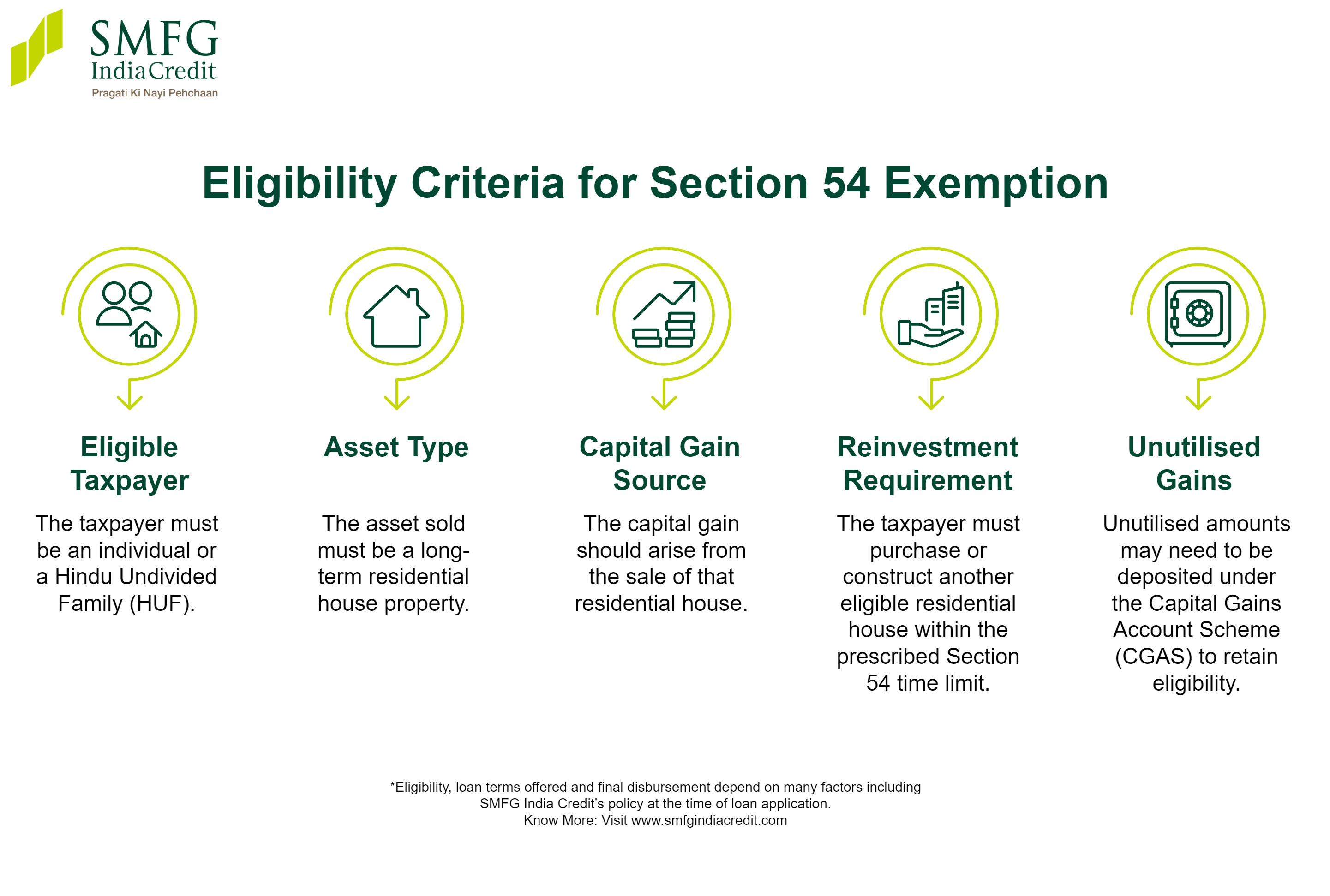
To qualify for the capital gains from house property exemption:
- The taxpayer must be an individual or a Hindu Undivided Family (HUF).
- The asset sold must be a long-term residential house property.
- The capital gain should arise from the sale of that residential house.
- The taxpayer must purchase or construct another eligible residential house within the prescribed Section 54 time limit.
- If the capital gains are not utilised before filing the income tax return, the unutilised amount may need to be deposited under the Capital Gains Account Scheme (CGAS) to retain eligibility, subject to applicable rules.
Who Can Claim the Exemption?
The benefit under Section 54 is available only to individual taxpayers and Hindu Undivided Families (HUFs). Companies, partnership firms, Limited Liability Partnerships (LLPs), trusts, and other entities are generally not eligible to claim this exemption under the provision.
The taxpayer must earn LTCG from the sale of a qualifying residential house property and reinvest the gains in another eligible residential house. As long as all statutory conditions are fulfilled, eligible taxpayers can claim either a full or partial exemption depending on the amount invested.
Eligible Assets and Transactions
Section 54 applies when a taxpayer sells a long-term residential house property, including the land attached to the house where applicable, and earns LTCG from the transaction.
The exemption is available only for eligible sale transactions involving residential property that qualifies as a long-term capital asset under the Income Tax Act. The taxpayer must subsequently invest the eligible capital gains in purchasing or constructing another residential house within the prescribed timeline.
The amount of exemption depends on factors such as the capital gains earned, the amount invested in the new residential property, and compliance with all applicable provisions.
Conditions to Claim Capital Gains Exemption Under Section 54
The key conditions to claim an exemption under Section 54 are:
- The property transferred must be a long-term residential house: Capital gains should arise from the transfer of a residential house property that qualifies as a long-term capital asset under the Income Tax Act.
- Eligible taxpayers: Section 54 is available to individuals and Hindu Undivided Families (HUFs).
- Investment in a residential house: The capital gains must be invested in purchasing or constructing another eligible residential house in India within the prescribed timeline.
- Exemption cap: The Section 54 exemption is limited to a maximum of Rs. 10 crore. Any investment exceeding this amount will not provide an additional exemption.
- Option to invest in two houses: If your capital gains do not exceed Rs. 2 crore, you can invest in two residential houses instead of one. However, this option can be exercised only once in your lifetime.
- Holding period: If the new residential house is transferred within three years of its purchase or construction, the Section 54 exemption previously claimed is effectively taken into account when calculating capital gains on the subsequent transfer.
- Capital Gains Account Scheme (CGAS): If the capital gains are not utilised for purchasing or constructing the new house within the applicable period, the unutilised amount must generally be deposited under CGAS by the prescribed deadline to retain eligibility for the exemption.
Time Limit for Purchasing or Constructing a New House
Section 54 specifies strict timelines for purchasing or constructing a new residential house after selling the original property. Adhering to these timelines is essential for claiming the exemption.
The prescribed timelines are:
- Purchase of a new residential house: Up to one year before the date of sale or two years after the date of sale of the original residential property.
- Construction of a new residential house: Within three years from the date of sale of the original property.
Tip: If you need funds but do not want to sell your existing property, you may consider a Loan Against Property (LAP). It allows you to borrow against an eligible property while retaining its ownership, subject to the lender's terms and eligibility criteria.
You can use a Loan Against Property EMI calculator to estimate your repayments across different loan amounts and tenures before applying.
Capital Gains Account Scheme (CGAS)
Under Section 54 Capital Gains Account Scheme, the unutilised capital gains can be deposited in a designated capital gains account before the applicable income tax return filing deadline. The amount deposited is treated as if it has been utilised for the purpose of claiming the exemption under Section 54.
The funds deposited in the CGAS must later be used exclusively for purchasing or constructing the new residential house within the prescribed timelines. If the deposited amount remains unutilised after the allowed period expires, the unspent balance may become taxable under the Income Tax Act.
How Is the Exemption Calculated Under Section 54?
The exemption available under Section 54 generally depends on the long-term capital gain and the amount invested in the eligible new residential house, subject to the applicable Rs. 10 crore cap.
The calculation follows this principle:
Exemption under Section 54 = Lower of:
- Long-term capital gain, or
- Eligible amount invested in the new residential house, subject to the Rs. 10 crore limit.
Therefore, the exemption cannot exceed the long-term capital gain arising from the transfer of the original residential property.
The table below illustrates a sample calculation.
|
Particulars
|
Example Amount (Rs.)
|
|
Sale price of residential property
|
1,20,00,000
|
|
Indexed cost of acquisition
|
70,00,000
|
|
Long-term capital gain
|
50,00,000
|
|
Investment in new residential house
|
40,00,000
|
|
Exemption under Section 54
|
40,00,000
|
|
Taxable long-term capital gain
|
10,00,000
|
In this example, the taxpayer has a long-term capital gain of Rs. 50 lakhs but invests only Rs. 40 lakhs in the new residential house. Therefore, the Section 54 exemption is limited to Rs. 40 lakhs, leaving Rs. 10 lakhs as taxable long-term capital gains.
Example of Section 54 Exemption Calculation
Let’s take a look at another example. Meera earns a Rs. 50 lakhs long-term capital gain from selling a residential property. If she invests Rs. 55 lakhs in another residential house within two years, she can generally claim an exemption on the full Rs. 50 lakhs, subject to applicable tax rules.
If she invests only Rs. 35 lakhs, the exemption will be limited to Rs. 35 lakhs, while the remaining Rs. 15 lakhs will be taxable as LTCG.
*Given above are simplified illustrations. The actual calculation of long-term capital gains, including the treatment of the cost of acquisition and Cost Inflation Index (CII), depends on the applicable tax provisions and the dates of acquisition and transfer.
When Is the Section 54 Exemption Withdrawn?
The Section 54 tax benefits can generally be withdrawn in the following situations:
- The new residential house is sold before the prescribed holding period. In such cases, the exemption claimed earlier may be reversed while computing capital gains.
- The amount deposited under the CGAS is not utilised for purchasing or constructing the new residential house within the specified time.
- The taxpayer does not satisfy the conditions prescribed under Section 54 for claiming the exemption.
- Incorrect or false information is furnished while claiming the exemption in the income tax return.
Section 54 vs Section 54F: Key Differences
Although both Section 54 and Section 54F of the Income Tax Act provide relief from capital gains tax, they apply in different situations.
|
Basis
|
Section 54
|
Section 54F
|
|
Applicable asset sold
|
Long-term residential house property
|
Any long-term capital asset other than a residential house
|
|
Eligible taxpayers
|
Individuals and HUFs
|
Individuals and HUFs
|
|
Investment required
|
Investment in a residential house
|
Investment in a residential house
|
|
Basis of exemption
|
Depends on the amount of capital gain invested
|
Depends on the proportion of the net sale consideration invested
|
|
Ownership conditions
|
No additional restriction based on ownership of other residential houses
|
Additional restrictions apply to ownership and subsequent purchase or construction of other residential houses
|
Documents Required to Claim Section 54 Exemption
While the exact requirements may vary depending on the transaction and the taxpayer's circumstances, the following documents are commonly required:
- Sale deed of the original residential property.
- Purchase deed or registration documents of the new residential house.
- Construction agreement, invoices, and payment receipts, where applicable.
- Proof of payments made towards the purchase or construction of the new property.
- Capital gains computation showing the calculation of LTCG.
- CGAS deposit records, if the exemption is claimed through the scheme.
- Bank account statements supporting the investment.
- Income Tax Return (ITR) and relevant schedules where the exemption has been claimed.
- Permanent Account Number (PAN) or any other supporting documents requested by the Income Tax Department during assessment.
Conclusion
Section 54 of the IT Act provides tax relief to eligible individuals and Hindu Undivided Families (HUFs) who reinvest LTCG arising from the transfer of a residential house property in another eligible residential house.
However, this residential property capital gains exemption is available only when the applicable Section 54 eligibility conditions, investment timelines, and other prescribed requirements are satisfied.
If you need funds but prefer to retain ownership of your existing property, you may consider an SMFG India Credit LAP of up to 70%* of the property’s market value at competitive Loan Against Property interest rates.
Check your Loan Against Property eligibility and submit your application online.
Before applying, review the Loan Against Property documents required to help ensure you have the necessary paperwork ready.