A reverse mortgage loan can provide an additional source of monthly income during retirement years by allowing homeowners to unlock the home equity built up in their residential property without selling it. The reverse mortgage for senior citizens helps eligible borrowers meet living expenses while continuing to reside in their home, subject to the loan terms.
This article explains how a reverse mortgage works, its eligibility criteria, benefits, interest rates, application process, and other important considerations before applying.
What Is a Reverse Mortgage Loan?
The reverse mortgage meaning refers to a loan that enables a homeowner to receive a loan payout against the value of their home equity without selling their residential property.
Under a reverse mortgage loan in India, the lender provides payments, usually in periodic instalments or another approved form, while the borrower continues to live in the property. It is primarily intended to help senior citizens supplement their retirement income while retaining property ownership and occupancy of their home.
Note: The availability of reverse mortgage financing depends on the lender's policies. It is advisable to check with your lender before choosing this option. If you are exploring property-backed financing options, SMFG India Credit offers tailored Loan Against Property solutions. Contact us to learn more.
How Does a Reverse Mortgage Loan Work?
Understanding how reverse mortgage works is easier when the process is broken down into a few simple steps.
While the exact reverse mortgage loan process may vary by lender, it generally works as follows:
- The lender conducts a property valuation to determine the market value of the residential property.
- Based on the valuation and the lender's reverse mortgage payout options, the eligible loan amount is sanctioned.
- The borrower receives the approved amount as a monthly payout or in another permitted form, as agreed with the lender.
- In many cases, no regular EMI is payable by the borrower during the loan tenure, although accrued interest may be added to the outstanding loan balance.
- The loan typically becomes due for repayment after the last surviving borrower permanently moves out of the property or passes away, in accordance with the loan terms. At that stage, legal heirs may have the option to repay the outstanding dues and retain the property or settle the loan as per the lender's process.
Reverse Mortgage Example
A reverse mortgage loan example could involve a senior citizen owning a house with a property value of Rs. 1 crore. Based on the valuation and the lender's policy, a loan amount is sanctioned and disbursed as a monthly payout. The outstanding balance, along with interest, is recovered during the final settlement as per the loan agreement.
Key Features of Reverse Mortgage Loan
The reverse mortgage features are designed to help eligible borrowers access funds from their property while continuing to live in it. A reverse mortgage for homeowners generally includes the following:
- Available primarily to eligible senior citizens aged 60+.
- Secured against a self-occupied property.
- Offers a reverse mortgage payout through a suitable payment option, subject to the lender's terms.
- Allows borrowers to continue enjoying ownership and occupancy of the property during the loan tenure.
- Does not require the property to be sold to receive the loan.
- Repayment is typically triggered after a specified event, as defined in the lender's terms and conditions.
Reverse Mortgage Loan Eligibility Criteria
The eligibility for a reverse mortgage loan depends on both the applicant and the property offered as security. Lenders assess the applicant's profile, the condition and ownership of the property, and other eligibility requirements before approving the loan. While the exact criteria may vary, they generally include the following:
- The borrower's age should meet the lender's minimum eligibility requirement.
- The applicant should own a self-occupied residential property.
- The property should have clear title ownership.
- It should be free from any material encumbrance or unresolved legal disputes.
- The property should have sufficient residual life as specified by the lender.
- An eligible spouse may be included as a co-borrower, where permitted by the lender.
Eligibility Criteria: Quick Overview
|
Criteria
|
Requirement
|
Why It Matters
|
|
Reverse mortgage age limit
|
Usually 60 years or above
|
The product is primarily designed for a senior citizen.
|
|
Property
|
Self-occupied residential property
|
The loan is secured against the value of the home.
|
|
Ownership
|
Clear property title
|
Helps establish legal ownership and facilitates loan processing.
|
|
Property Condition
|
Adequate residual life and acceptable condition
|
Supports the property's long-term value.
|
|
Co-borrower
|
Eligible spouse, where permitted by the lender
|
Helps define borrower rights under the loan agreement.
|
Who Should Consider a Reverse Mortgage Loan?
A reverse mortgage can serve as a useful retirement income solution for eligible homeowners. If you are wondering who should take a reverse mortgage, the following profiles may benefit from it:
- Reverse mortgage for senior citizens who own and live in their home but have limited pension income.
- Reverse mortgage for retirees seeking additional funds to meet medical expenses or daily household expenses.
- Homeowners who wish to continue living in their property without selling it.
- Individuals looking to unlock the value of their home while retaining ownership and occupancy, subject to the loan terms.
- Borrowers who have discussed the decision with their legal heirs and understand the implications of the loan agreement.
Who May Not Be Suitable for a Reverse Mortgage Loan?
A reverse mortgage loan may not be the right choice for every homeowner. Before deciding whether you should take a reverse mortgage, it is important to understand the disadvantages of a reverse mortgage and consider your long-term financial goals. You may wish to explore other alternatives if any of the following apply:
- You want to leave your property completely debt-free for your legal heirs as part of your estate planning.
- You expect a property sale in the near future.
- The property is subject to a title dispute or other legal issues.
- You have access to funding options with a lower loan cost that better suit your needs.
- You are uncertain about the long-term implications and potential reverse mortgage risks and would benefit from independent financial or legal advice before proceeding.
Benefits of a Reverse Mortgage Loan
The reverse mortgage benefits are aimed at helping eligible senior citizens access the value of their home without giving up the right to live in it. Depending on the lender's terms and the loan structure, some of the key advantages of a reverse mortgage include:
- Receive regular income to support day-to-day living expenses after retirement.
- Supplement retirement income without selling your self-occupied home.
- Continue living in the property while retaining home ownership, subject to the loan agreement.
- Strengthen financial independence by using the value of your home to meet monetary needs.
- Use the funds to manage medical expenses, home maintenance, or other essential costs.
- In many loan structures, no regular EMI is payable during the loan tenure, although interest continues to accrue on the outstanding amount.
- Unlock the value of an existing asset without requiring the immediate sale of the property.
A reverse mortgage can be a suitable option for eligible senior citizens seeking additional financial support in retirement. However, since the loan affects the value of the estate over time, borrowers should carefully review the terms and discuss the decision with their family before applying.
Limitations and Risks of Reverse Mortgage Loan
While a reverse mortgage can provide financial support during retirement, it is equally important to understand the reverse mortgage disadvantages before applying.
Some of the common limitations of a reverse mortgage loan include:
- The outstanding loan balance increases over time as accrued interest is added, as per the lender's terms.
- The eligible loan amount depends on the property value assessed by the lender.
- Borrowers are generally responsible for the maintenance of the property and complying with the loan conditions.
- The outstanding loan may reduce the value of the inheritance available to legal heirs after settlement.
- Family and succession planning considerations should be discussed before proceeding.
Before choosing a reverse mortgage, compare it with other financing options and carefully evaluate the terms, costs, and long-term implications to determine whether it suits your financial needs.
Reverse Mortgage Loan Interest Rates
The reverse mortgage loan interest rate determines how interest is calculated on the outstanding loan balance over time. Reverse mortgage interest rates vary across lenders and may depend on factors such as the borrower's profile, property valuation, the selected loan tenure, and prevailing market conditions. Depending on the lender's offering, the loan may be available at a fixed rate or a floating rate. Before applying, always check your lender's latest reverse mortgage interest rate and schedule of charges to understand the total cost of borrowing.
Factors Affecting Reverse Mortgage Interest Rate
Several reverse mortgage interest rate factors influence the final lender decision. While the exact reverse mortgage rate calculation varies by lender, the following factors are commonly considered:
- The lender's internal lending policy and risk assessment.
- Borrower age, which may influence the loan structure and terms.
- The property location and its marketability.
- The assessed property value.
- The chosen payout option, such as periodic payments or another approved mode.
- The selected tenure of the loan.
- Whether the loan carries a fixed or floating interest rate.
- Changes in the applicable benchmark rate, where relevant for floating-rate loans.
Reverse Mortgage Loan Charges and Fees
The total cost of a reverse mortgage includes more than just interest.
Common reverse mortgage loan charges or reverse mortgage fees may include:
- Reverse mortgage processing fee
- Valuation charges
- Legal fee for property verification
- Documentation charges
- Stamp duty, registration charges, where applicable
- Prepayment or loan closure charges, if applicable under the lender's terms
Before accepting the loan, review the sanction letter or agreement carefully to understand all applicable charges and the overall cost of borrowing.
Payout Options in Reverse Mortgage Loan
The available reverse mortgage payout options depend on the lender's policies and the borrower's financial requirements. While a monthly payout reverse mortgage is commonly chosen to supplement retirement income, other disbursement methods may also be available. The exact payout structure and amount are determined at the time of loan sanction.
|
Payout Option
|
Typical Use Case
|
|
Monthly
|
Regular income to meet day-to-day living expenses
|
|
Quarterly payout
|
Periodic financial support at fixed intervals
|
|
Annual
|
Larger yearly payouts for planned expenses
|
|
Lump sum reverse mortgage
|
One-time funding for eligible expenses, subject to lender terms
|
|
Line of credit
|
Withdraw funds as and when required, if offered by the lender
|
|
Combination
|
Mix of periodic payouts and a one-time disbursement, where permitted
|
Before selecting a payout option, every borrower should compare the available choices and confirm the applicable terms with the lender.
Payout Options: Quick Summary
|
Payout Option
|
Best For
|
Key Point
|
|
Monthly payout
|
Meeting regular retirement income needs
|
Provides a steady cash flow.
|
|
Quarterly payout
|
Planned periodic expenses
|
Funds are received every three months.
|
|
Annual payout
|
Yearly financial requirements
|
Larger payment made once a year.
|
|
Lump sum
|
Eligible one-time expenses
|
Single disbursement, subject to lender terms.
|
|
Line of credit
|
Flexible withdrawals
|
Access funds as needed, if offered by the lender.
|
Reverse Mortgage Loan Tenure
The reverse mortgage tenure varies depending on the lender's policy, borrower age, property value, and the specific product terms. The reverse mortgage loan period or loan tenure determines how long the borrower receives payments, and the payout period may be fixed under the loan agreement. The reverse mortgage repayment tenure generally concludes through settlement after the borrower permanently moves out, sells the property, or passes away, in accordance with the agreement.
How Is Reverse Mortgage Loan Amount Calculated?
The reverse mortgage loan amount calculation is based on several factors that help the lender determine the eligible loan amount and payout structure. While you may use a reverse mortgage calculator for indicative estimates, the final loan amount depends on the lender's assessment and product-specific criteria, such as:
- The assessed reverse mortgage property value through a professional property valuation
- The borrower's age or the lender’s permissible reverse mortgage age limit
- The property's remaining residual life
- The applicable interest rate
- The chosen payout mode
- The property location and its marketability
- The lender's loan-to-value ratio policy
Reverse Mortgage Loan Calculation Example
A reverse mortgage calculation example can be a senior citizen owning a house with a property value of Rs. 80 lakhs. Based on its LTV, the applicant's age, the chosen payout structure, and the lender policy, the lender determines the approved amount. This loan amount may then be disbursed as monthly income or another permitted payout option, depending on the loan terms and the borrower's preference.
Documents Required for Reverse Mortgage Loan
The reverse mortgage documents required may vary by lender, but applicants are generally asked to provide personal identity and property-related records to support the loan application. Commonly required documents include:
- Identity proof, such as Aadhaar and PAN
- Valid address proof, such as a passport
- Recent photographs and bank account details
- Income or pension details, if requested by the lender
- Property title deed
- Latest tax receipts
- Approved building plan, where applicable
- Encumbrance certificate and other relevant legal records
Additional reverse mortgage property documents may be requested depending on the lender's eligibility criteria and verification process.
How to Apply for a Reverse Mortgage Loan
The reverse mortgage application process is designed to assess both the applicant's eligibility and the property's suitability. Although the exact reverse mortgage loan process varies by lender, it generally begins with completing the application form, followed by property verification, legal verification, and valuation. If you are considering a reverse mortgage, it is advisable to discuss the decision with your family before proceeding. Once the assessment is complete, the lender issues a sanction letter outlining the approved terms.
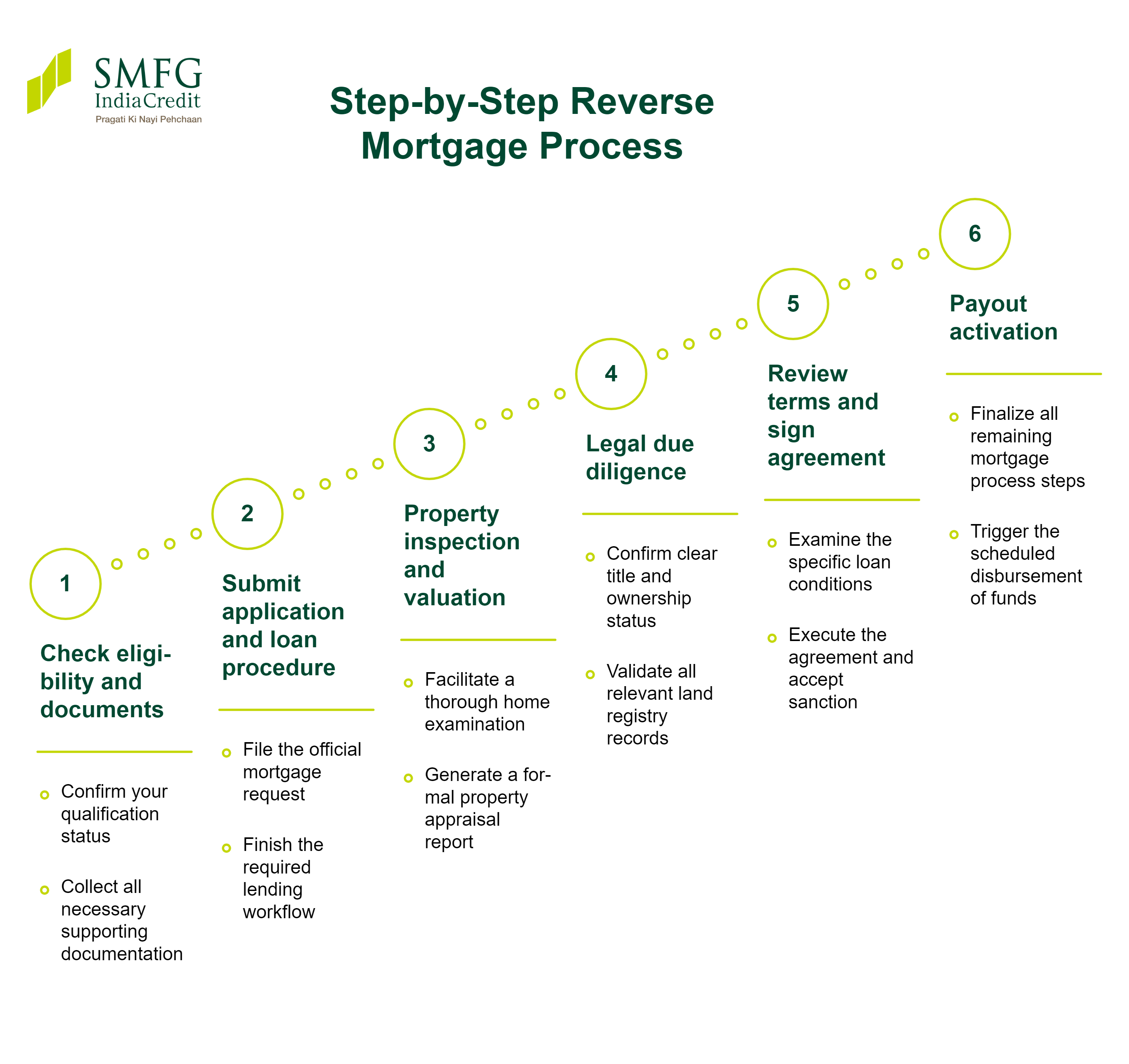
Step-by-Step Reverse Mortgage Process
- Check your eligibility and gather the required documents.
- Submit the application and complete the reverse mortgage loan procedure.
- The lender conducts a property inspection and prepares a valuation report.
- Complete legal due diligence to verify ownership and property records.
- Review the loan terms, sign the agreement, and accept the sanction.
- The lender completes the reverse mortgage process steps and initiates payout activation as per the approved terms.
Common Mistakes to Avoid Before Taking a Reverse Mortgage
Understanding common reverse mortgage mistakes can help you make a more informed decision and reduce potential reverse mortgage loan risks. Use the following reverse mortgage checklist before applying:
- Conduct a lender comparison instead of accepting the first offer.
- Understand how interest accumulation affects the outstanding loan balance over time.
- Discuss the decision with your legal heirs or spouse before proceeding.
- Ensure the property title is clear and free from material legal issues.
- Review all applicable charges before accepting the loan.
- Do not assume the property can never be sold or transferred; understand the lender's terms.
- Read the repayment clause carefully to understand when and how the loan will be settled.
Reverse Mortgage Loan vs Loan Against Property
A reverse mortgage and a Loan Against Property are both secured by residential property, but they serve different purposes. A reverse mortgage is designed primarily for senior citizens seeking regular income during retirement, whereas a Loan Against Property provides a lump sum or sanctioned credit for personal or business needs and requires regular repayments. Before applying, review both the reverse mortgage and the Loan Against Property eligibility criteria, as well as other terms, to determine which option better suits your financial requirements.
Another key difference is the repayment structure. In many reverse mortgage arrangements, regular EMIs are not payable during the payout period, whereas a Loan Against Property is typically repaid through scheduled EMIs over the agreed tenure. Before making a decision, compare Loan Against Property interest rates, applicable charges, repayment terms, and overall borrowing costs to choose the most suitable financing option.
Conclusion
Reverse mortgage financing can be a suitable option for eligible senior citizens seeking additional income during retirement. However, understanding the reverse mortgage pros and cons is essential before making a decision. Careful evaluation, family discussions, and thoughtful retirement planning can help you choose the solution that best supports your long-term financial needs.
If you’re exploring property-backed financing solutions, SMFG India Credit offers Loan Against Property solutions of up to 70%* of the property’s market value. Before applying, review the required Loan Against Property documents to ensure a smooth process.
You can also use our Loan Against Property EMI calculator to estimate your monthly outflow before applying online.
* Please note that this article is for your knowledge only. Loans are disbursed at the sole discretion of SMFG India Credit. Final approval, loan terms, disbursal process, foreclosure charges and foreclosure process will be subject to SMFG India Credit's policy at the time of loan application. If you wish to know more about our products and services, please contact us